

Introduction
Regional economics is a field of economic study that focuses on the spatial distribution of economic activities within a region of a country (J. Zhao et al., 2021). This concept examines how economic process-es and policies affect various geographical areas. In recent years, there has been significant methodological development in regional economics to address regional disparities, economic growth, and the adaptation of local economic potential. This aspect is well known as a focus in the Sustainable Development Goals (SDGs), specifically goals eight and ten, which are decent work, economic growth, and reduced inequalities (Anbumozhi et al., 2022).
The existence of the development of this particular science is inseparable from its driving factors. The first is the difference in resources in each region of a country. This causes differences in economic activities that require adaptive policies through regional analysis (Seidel, 2024). The second is the con-centration of industries that form economic clusters. Companies tend to gather in certain areas to gain benefits from agglomeration economies (Wudu et al., 2024). The third is demographic factors. This as-pect includes education, age, and family structure, which greatly influence economic activities.
Studies on regional economies are very important to conduct in both developed and developing countries. For developed countries, regional economies serve as a methodology to enhance spatial balance, interregional innovation, and overall regional competitiveness. In addition, they are also used as a basis for analysing the optimisation of transportation, logistics, and infrastructure to make economic activities more productive (S. Zhao & Xie, 2022). An equally important aspect is the use of technology in optimising regional economies, which often serves as an example for developing countries.
For developing countries, the regional economy is an aspect discussed every year across all areas. The regional economy serves as the main context for addressing issues of high income inequality, unemployment, and the creation of many job opportunities (He & Liu, 2022; Rauf et al., 2021) Central Sulawesi, Indonesia. Inequality income is proxied by Gini, Williamson and Theil (GWT. Optimisation is more towards developing local potential in areas such as agriculture, the creative economy, and tourism. The regional development map created from regional economic analysis is used for future investment planning to stimulate the economy.
Observing the development of regional economic studies empirically, both as a context and methodology, the analysis of research mapping trends on regional economics becomes very important. This is necessary to understand how the direction, patterns, and focus of regional economic studies have changed and will develop in the future. Trend analysis of regional economics is needed by researchers to understand the evolution of findings and map the distribution of studies to identify related research gaps. Meanwhile, for policymakers, this is utilised to formulate regional development strategies in line with academic trends and international best practices.
Mapping trends, context, and all related analysis in regional economic studies can be conducted quantitatively, qualitatively, and using a mixed approach. Qualitatively, the literature review method is generally used to map existing findings and provide future research directions. However, metadata analysis cannot yet be performed. The opposite applies to quantitative mapping. Therefore, the most comprehensive trend mapping uses a mixed approach. This approach can be accommodated by one method, namely bibliometrics, which has been extensively discussed. Bibliometric research is powerful quantita-tively and normatively, but the findings can also be maximised through qualitative analysis.
Various studies examining the development of regional economic research have been conducted. In a literature review (qualitative), research by Jenniches, (2018) highlighted the regional economic impacts of renewable energy sources, with findings showing that the transition to renewable energy not only affects the national economy but also has significant consequences at the regional level due to its more decentralised nature. Meanwhile, research by Calero & Turner, (2019) focused on regional economics and tourism, highlighting the increase in regional economic studies for economic sustainability agendas.
On the other hand, research mapping trends and findings using bibliometrics focuses more on specific aspects such as the rural economy, as evidenced by the research of Alcázar Blanco et al., (2024) with the finding that the rural economy is booming, with a focus on entrepreneurship. Another data source comes from the research of Zhang et al., (2022) the issue of regional economics and carbon emissions has become a research hotspot in the cross field of economy, environment and ecology. This paper selects the regional economics and carbon emissions related literature collected in the Web of Science (WOS, with the results indicating that strategies and policies on carbon emissions are starting to develop for the optimisation of the regional economy. The data was taken from the Web of Science (WOS).
Based on previous research, a research gap was identified, namely that it is very difficult to find studies using bibliometrics to discuss metadata, trends, findings and future directions concerning regional economics on a broad scale in both developed and developing countries. Therefore, this study aims to analyse trends in regional economic studies comprehensively, from general results, conceptual, intellectual, and latest social findings, with a focus on implications for both developed and developing countries. The novelty of this research lies in the use of the most recent data from 1995-2025 and the use of the Scopus database, which has never been investigated before.
This research provides both theoretical and practical contributions. Theoretically, it can enhance the understanding of the Evolution of Regional Economic Paradigms broadly, which is useful for deep-ening theory, strategy and implications. Practically, this research can serve as a consideration for policy directions related to the optimisation of regional economies in both developed and developing countries. Additionally, the government and universities build international research collaboration networks on regional economics to create the best solutions.
The research questions that arise are as follows: (Q1) What is the main information from the de-velopment of the scientific literature related to the regional economy? (Q2) What are the conceptual, intellectual, and social structures related to the literature on the regional economy? (Q3) How can the potential and strategies for developing research and policies related to the regional economy be directed for developed and developing countries?
Literature Review
Regional Economic Concept
Regional economics is a relatively young aspect of macroeconomic study, emerging in the mid-1950s. Regional economics examines why some areas can prosper economically while others lag behind, as well as how policies can reduce these disparities (Azis, 2020). This field is studied in greater depth at the university level, incorporating various related theories, such as location theory, regional growth theory, and regional inequality theory. Research in regional economics is essential for developed countries to optimise regional innovation and connectivity, while for developing countries, it is crucial to optimise local potential and the equitable distribution of income and industry.
The scope of regional economic environment is quite broad, covering Regional Growth and Develop-ment, inter-regional linkages, and most prominently, Regional Disparities and Inequalities. The existence of regional economy provides opportunities to help identify regional competitive advantages, thereby addressing various economic issues mentioned. Practically, regional economy is reflected in the planning of economic zones, policies to minimise disparities, and the impact of various global innovations on the relevant regional economy.
The regional economy has proven to exist and tends to withstand various international issues. De-veloped countries are often used as benchmarks for regional economic policies by developing countries. Therefore, the trends in regional economic studies need to be clearly mapped for the formulation of visionary policies with adaptation to global challenges such as digitalisation, urbanisation, and energy transition. Once regional economic issues are mapped, they can serve as a reference for sustainable re-gional development policies in accordance with the achievement of the SDGs.
Bibliometric analysis
Bibliometrics is the application of quantitative methods to analyze various aspects related to a con-text in academic literacy, such as citations, journals, and related article contents. Some core components that must be present in bibliometric research include impact factor and h-index, citation analysis, key-word frequency, and author and collaboration analysis. Bibliometrics is commonly applied for research evaluation (Marvi & Foroudi, 2023). This means that this method can analyze the performance of au-thors, institutions, papers, and journals related to specific topics. Another contribution of bibliometrics is science mapping. This involves creating visual representations of the structure and dynamics of scientific research fields. Research with a bibliometric approach is always popular every year and consistently ranks among the quality research in Scopus and other leading international indexes.
Studies on the trend of regional economy based on bibliometric frameworks are very rarely conduct-ed. However, updates on the development of this trend must continue to be carried out to realize various inclusive international economy targets. It should be noted that in bibliometrics, three aspects will be used: conceptual, intellectual, and social. All three refer to the focus of discussion on co-occurrence, co-citation, and collaborative networks. With this, regional economy research can identify research di-rections, map dominant topics, author collaborations, and gaps in studies that have not been addressed.
Methodology
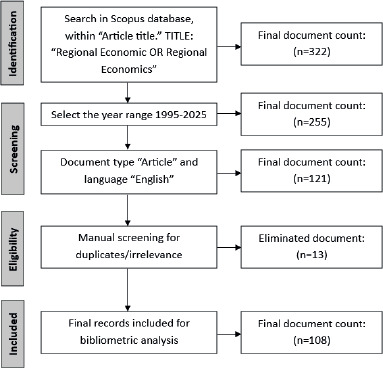
This study uses a bibliometric approach to explore and map research trends related to “Regional Economic”. Research trends refer to the collective shift in research conducted by researchers on a par-ticular topic. In other words, this trend reflects the growing global interest and need for scientific inves-tigation. By applying bibliometric methods, researchers can identify relevant research directions and their associated content. Access to bibliographic databases is essential for finding scientific publications, such as articles, authors, abstracts, and references. This research uses Scopus, a trusted and quality bib-liographic database. Figure 1 illustrates the procedures for this bibliometric research:
Figure 1
Workflow of the bibliometrics
Source: framework developed by the researcher based on previous studies.

The bibliometric metrics planned for analysis in this research encompass quantitative, concep-tual, intellectual, and social aspects. Some examples include publication count, citation count, linkage networks, keyword co-occurrence mapping, citation pattern analysis, as well as standard bibliometric indicators.
Bibliometric data and filtering process
The mechanism for searching bibliographic data in Scopus will be carried out in October 2025. The search process begins by selecting the “Article Title” field and typing the keyword “Regional Economic or Regional Economics.” The selection of the filter on “Article Title” was chosen because it better reflects the focus of the research by the set theme and has been proven to be effective. Initial results show that there are 322 data records. Further searches were conducted for the period 1995 to 2025, which narrowed the results to 255 data records. Furthermore, filters were applied by document type (“Articles only”) and language (restricted to English), resulting in 108 articles. The final check was carried out using Microsoft Excel to review the article title and abstract, verifying the accuracy of the results. A total of 108 articles were declared valid.
The manual screening process was conducted using Microsoft Excel by applying inclusion and ex-clusion criteria. In the inclusion stage, the selected articles are those that explicitly focus on regional economics as the main object of study, whether in the context of regional development, spatial inequality, industrial localization, policy analysis, or sustainable regional growth. Meanwhile, the exclusion stage involves eliminating articles that only briefly mention regional economics or treat it as a minor aspect of broader discussions without making it the primary analytical focus.
The research term was obtained in the following format: In Scopus. TITLE ( Regional Economic OR Regional Economics ) AND PUBYEAR > 1995 AND PUBYEAR < 2025 AND ( LIMIT-TO ( DOCTYPE , “ar” ) ) AND ( LIMIT-TO (LANGUAGE , “English”)). Searching with the TITLE format is preferred over TITLE-abs-KEY to find more relevant articles. Figure 2 is an overview of the data filtering performed:
Data analysis
The filtered documents were exported in a CSV file format from Microsoft Excel, containing informa-tion such as author name, affiliation, title, country, journal name, and keywords. The files were then ana-lyzed descriptively according to the research questions. To present bibliographic data, this research uti-lizes Biblioshiny software (RStudio). This software offers a variety of features for in-depth bibliographic analysis of scientific publications, including metrics on the number of publications, citations, linkage net-works, and keywords. Additionally, Biblioshiny offers standard and reliable bibliometric measurements and indicators.
Additionally, biblioshiny offers standard and reliable bibliometric measurements and indicators. Quantitative descriptive analysis is used to extract key insights from research on regional economic. The study also explores citation patterns among authors through co-authorship analysis. In addition, knowledge co-occurrence mapping is conducted to visualize trends, development paths, keywords, and research themes related to regional economic. The occurrence and prominence of common keywords in this analysis reflect the popularity of a specific theme in the field (Moresi & Pinho, 2021).
Results
Key information about the development of regional economic research is explicitly explained in Table 1.
Table 1
Main information
Table 1. Reflects basic information regarding the bibliographic data processed for research in regional economics across all fields. A total of 93 sources were found, involving 268 authors with 108 validated articles. The annual growth rate reached 1.36%, indicating a growing research trend on related topics, although not massive.
Publication trend
The trend of research development on the topic of regional economics can be reviewed in Figure 3.
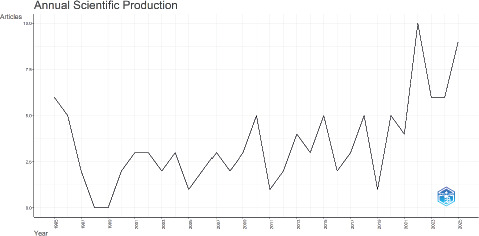
There is a fluctuation in the number of articles from 1995 to 2025. In 1996, the number of articles was still relatively low but quite stable. 1997-1999 showed a sharp decline, while from 2000 onwards, there was continuous fluctuation until 2021. There was a significant increase in 2022, involving more documents up to 2025. The highest number of publications was in 2022 with 10 articles, and in 2025 with nine articles. This positive fluctuation is potentially caused by the adoption of new regional economic theories such as New Economic Geography, which has become one of the foundations of regional economic re-search on the international stage. In addition, significant developments since 2022 have been driven by numerous studies focusing on global attention to the SDGs, which highlight regional equality. This makes the topic of regional economics interesting to discuss for at least the next few years.
Average citation per year
Figure 4. depicts the average number of citations per year for articles related to regional economics.
Figure 4
Average citations per year
Source: Scopus database.It is noted that there was a massive increase in citations in 2003, potentially due to strong research that was fundamental both theoretically and practically with high relevance. The increase in citations over the last five years points to contemporary issues regarding regional development supported by global factors, which also have updated fundamental elaboration.
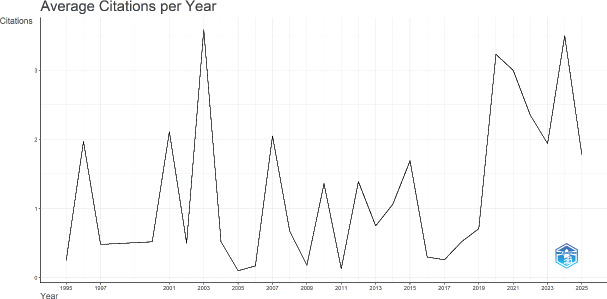
Table 2. illustrates the list of top authors who have made significant contributions to research on regional economics.
Table 2
Top author
| Authors | Articles | Articles Fractionalized | H-index | Total Citation |
|---|---|---|---|---|
| Saarinen, Jarkko | 2 | 2.00 | 2 | 156 |
| Newman, Chris J | 2 | 0.33 | 2 | 27 |
| Zhou, Zhaomin | 2 | 0.33 | 2 | 27 |
| Barrio, Rafael A | 2 | 0.50 | 1 | 4 |
| Snellman, Jan E | 2 | 0.50 | 1 | 4 |
Productive authors provide valuable insights into the development of the research in question. This is useful for fostering collaboration and analysing the impact of the research they produce. The publica-tion of recent articles is an important consideration in determining the ranking.
The results show that there is an evenly distributed contribution from significant authors with relatively few publications. Saarinen, Jarkko stands out as the most relevant author with two articles and a total of 156 citations. He is from Uppsala University, Uppsala, Sweden. Additionally, Newman, Chris J. and Zhou, Zhaomin are also noted with two research publications and a total of 27 citations. They are from the University of Oxford, Oxford, United Kingdom and the Environmental Science and Biodiversity Conservation of Sichuan Province, Nanchong, China, respectively.
Table 3. presents various journal sources that are most influential in research related to regional economics.
Table 3
Top source
| Source Name | N | Cite Score | H_Index | G_Index | M_Index | TC | Py_Start |
|---|---|---|---|---|---|---|---|
| International Regional Science Review | 7 | 5.1 | 4 | 6 | 0.129 | 42 | 1995 |
| Journal Of Regional Science | 4 | 5.8 | 2 | 4 | 0.125 | 90 | 2010 |
| Sustainability (Switzerland) | 3 | 7.7 | 2 | 3 | 0.250 | 12 | 2018 |
From the table, it can be seen that the International Regional Science Review has the largest con-tribution with a total of seven published articles, an H-index of 4, and a total of 42 citations. Meanwhile, another source, the Journal Of Regional Science, published four articles with a total of 90 citations. The journal with the most citations is the Annals of Regional Science, with a total of 164 citations. Exposure to various journal sources that support many related studies can be used as a reference for researchers to find reliable and comprehensive study materials.
Table 4. presents studies related to regional economics that have a significant impact on the development of the research context.
Table 4
Most influential literature
Martin Ron L, 1996 ranks at the top with his article titled “Paul Krugman’s geographical economics and its implications for regional development theory: A critical assessment”. This article has been cited 281 times. The outline of the article discusses how Krugman’s approach (New Economic Geography) success-fully explains why industries are concentrated in certain regions.
Recent research with significant impact from Liu et al., (2022) & Xue et al., (2024) discusses that the agricultural sector serves as the main economic foundation of a region and assesses how environmen-tal and social factors affect regional competitiveness. Rooftop photovoltaic/PV is becoming a strategic source of renewable energy for enhancing regional competitiveness.
Table 5. shows the distribution of research publications on regional economics by country.
Table 5
Top countries
| Country | Frequency |
|---|---|
| USA | 48 |
| China | 37 |
| UK | 23 |
| Australia | 18 |
| Canada | 13 |
| Germany | 12 |
| India | 11 |
| Spain | 11 |
| Italy | 10 |
| Indonesia | 9 |
The data indicates that the USA (48) and China (37) dominate research contributions. This reflects a significant focus from developed countries on regional economic issues. An interesting observation is that the top countries are mainly developed, while among developing countries only India (11) and Indo-nesia (9) appear. Research readiness, infrastructure and the strength of theories developed in developed countries related to regional economics are key factors.
Figure 5. reflects the significant contribution of institutions in producing regional economic works.
Top Affiliations
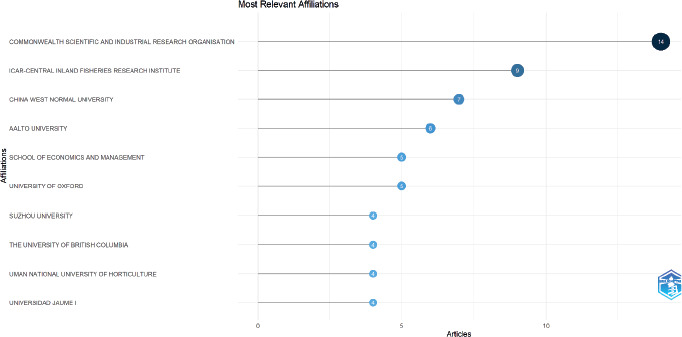
The development of regional economic research in the image above does not come solely from uni-versities. The dominance of the Commonwealth Scientific and Industrial Research Organisation from Australia, which published 14 articles, was noted. In addition, several institutions in Asia have consider-able influence, such as the ICAR-Central Inland Fisheries Research Institute from India, China West Nor-mal University, and Suzhou University from China. Europe also has a significant influence, represented by institutions such as Aalto University (Finland), the University of Oxford (UK), and Universidad Jaume I (Spain).
Figure 6. reflects the latest researched topics related to regional economy.
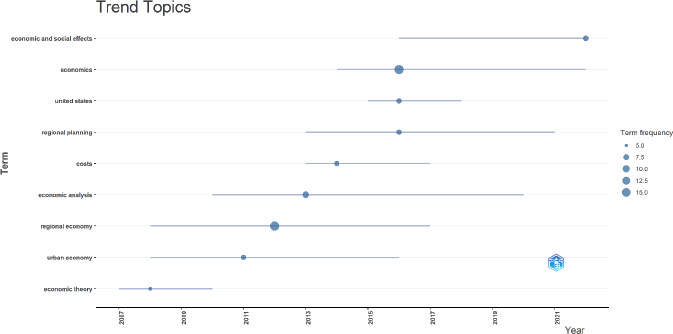
This chart shows the development of research themes related to regional economics from 1995 to 2025. Themes that have become popular and significant emerged in 2012, examining the regional economy. The development of the latest topic trends stopped in 2022, discussing the economic and so-cial effects. This indicates that regional economic research has begun to reach a reflective phase, where researchers not only map growth patterns but also assess how regional economic policies affect social structures, inequality, and sustainable development. Therefore, themes developing in the future can be explored in the thematic map section of this article.
Conceptual Structure
Figure 7. shows co-occurrence network map in research on regional economics shows how key-words are interconnected based on their frequency of appearing together in scholarly articles.
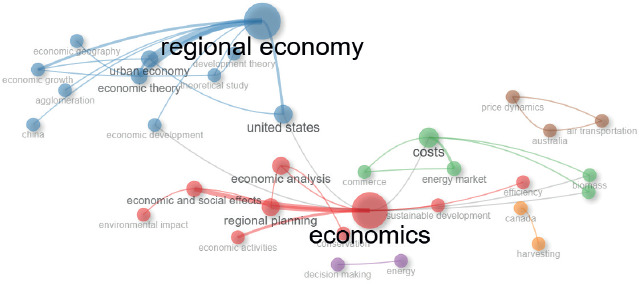
There are two main clusters, blue and red, which are strongly related. The blue cluster represents clas-sical research focus on growth and regional economic theory, while the red cluster focuses on economic analysis and the social-environmental impacts of policies or regional planning. Meanwhile, novelty in the context is reflected in the green cluster, which focuses on discussing energy economics and sustainability approaches.
Figure 8. shows thematic map depicts several themes that have been categorised into various quadrants,
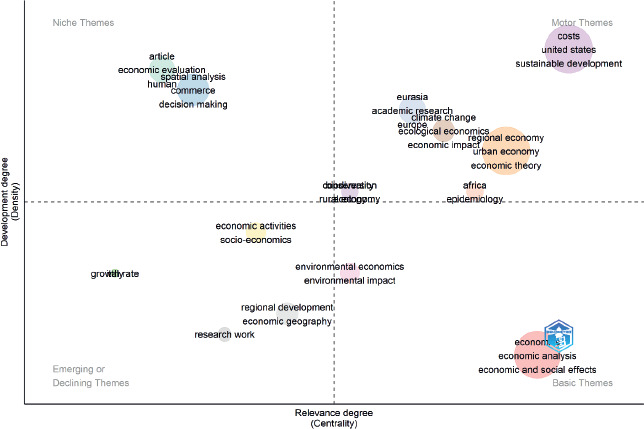
This is important for the development of future research. The basic theme quadrant reflects the fundamental or core themes, which include economic analysis, economic and social effects, and environ-mental economics. Meanwhile, the motor themes contain the most strategic themes worthy of continuous study, which include sustainable development, rural economy, and several contextual cases in the United States and Africa.
In the top-left quadrant are Niche themes. These reflect themes that are advanced in method but less relevant. They include economic evaluation, spatial analysis, and decision making in the context of regional economics. There are also emerging or declining themes that could become future themes or, at the same time, may be declining. These include regional development, economic geography, and so-cio-economic topics. Future research can focus on motor themes and emerging themes.
Intellectual Structure
Figure 9. shows a co-citation network is a visualisation of the relationships between publications based on how often documents are cited together by other documents.
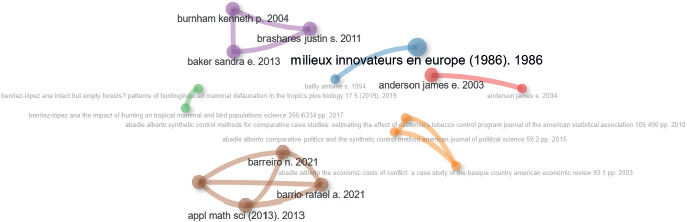
The most significant and main cluster is coloured blue, referring to a theoretical concept “milieu in-novateur” in Europe in 1986. The main characteristic of this concept is a Regional/Local focus emphasis-ing the important role of specific regions or areas in the innovation process, not just the national level or individual companies (Guesnier, 1998). More broadly, there are studies of informal social and economic relationships between various local actors (companies, universities, research institutions).
Other significant clusters highlighted in purple include Kenneth P. Burnham (2004) along with Jus-tin S. Brashares (2011). Burnham’s primary focus was “Multimodel Inference: Understanding AIC and BIC in Model Selection.” Its connection to regional or informal economic research seems indirect as it leans more towards statistical methodology and models that can be applied in economics (Burnham & Anderson, 2004). Overall, the documents presented can serve as a primary reference providing a meth-odological and epistemological foundation for modern regional economic research.
Social Structure
Figure 10 illustrates collaboration between authors in research related to the regional economy.
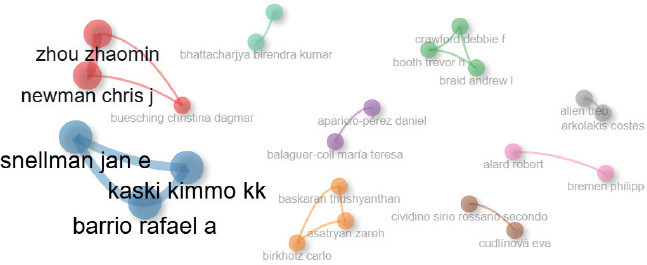
There are nine collaboration network clusters. The largest contribution comes from the blue clus-ter collaboration. Among the articles within it is titled “Modelling the interplay between epidemics and regional socio-economics” which discusses how community economic behaviour and regional authority policies influence the spread of infectious diseases (J. Snellman et al., 2021).
Figure 11. depicts a collaboration network between countries represented by brown lines.
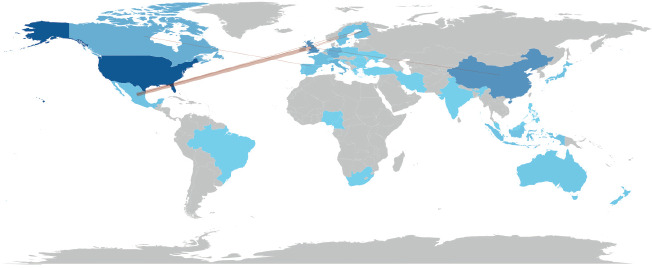
Significant collaboration exists across continents, namely the UK with Mexico, and China with the UK. Meanwhile, collaboration within the same European continent is seen between the UK and Sweden. The limited research collaboration provides opportunities for exploring regional economic research, espe-cially in developing countries in Africa and Asia.
Discussion
Quantitative Trends in Regional Economic Research
Overall, the trend in the quantity and concepts related to regional economic research can be catego-rised as positively fluctuating with an annual total growth rate of 1.36%. The average article is 12 years old with 15.3 citations per document, indicating stability in the context of regional economics. In other words, publications in this field have long-term scholarly relevance. The trend’s progress aligns with the implementation of New Economic Geography (NEG) theory as a new paradigm. This concept emphasises economies of scale, transportation costs, and agglomeration as the basis for regional economic analysis in accordance with the challenges faced. This is reinforced by the global focus on the SDGs, particularly the goal of interregional equality. In the past five years, regional economic research has been reflective. This means strengthening the previous conceptual direction while also encouraging the exploration of new issues.
Contributions of Authors, Countries, and Publication Sources
In terms of authors, Saarinen, Jarkko (Uppsala University, Sweden) is the most influential author, fre-quently researching the interaction between tourism, regional economics, and sustainability. A recent arti-cle by Barrio Rafael A., Snellman Jan E., and Kaski Kimmo K.K. expands the perspective with an agent-based model that integrates epidemiology, socio-economic behaviour, and regional policy (J. E. Snellman et al., 2024). This method enriches the literature by allowing the analysis of regional dynamics in a bottom-up manner. The main source that can be used as an appropriate reference for investigating regional economic development is the International Regional Science Review. This journal has a very interesting and relevant scope regarding issues of theory, methods, and public policy where spatial or regional dimensions are cen-tral. Thus it can encompass multiple disciplines to achieve sustainable regional economic science.
In terms of country contribution, the majority of regional economic development research refers to developed countries such as the USA, China, and UK, while in developing countries it is still very limited. This cannot be separated from an adequate academic, innovation, and financing ecosystem. Therefore, developed countries deserve to act as a role model or best practice in concepts, models, and regional eco-nomic practices for developing countries. Of course, the regional economic model of developed countries should be adapted, not directly adopted by developing countries.
Conceptual Structure
Co-occurrence networks and thematic maps are able to offer several themes that are relevant for ongoing and future research, for both developed and developing countries. These include the relation-ship between regional economies and sustainable development, the rural economy, regional develop-ment, economic geography, and socio-economics. Motor themes should continue to be involved in future research in the context of urban economy, economic impact, as well as sustainable development. The identification of several of these concepts indicates that regional economy is now supported by a multi-disciplinary approach that combines geography, policy, and social behaviour with wide-ranging impacts.
Intellectual Structure
From an intellectual structure perspective, the concept of “milieu innovateur” emphasises the im-portance of the local scale and social interactions in the regional innovation process. Its current impli-cation is the shift of regional economics towards quantitative methodology such as comparative case studies and economic modelling. In regional economics, spatial and multilevel models require model selection techniques where Burnham’s idea becomes important. With the combination of mechanisms from the “milieu innovateur” and reliable empirical evidence, evidence-based regional development can be achieved.
Social Structure
All existing content and trends should involve broader collaboration, not just focusing on developed countries. Available data shows an uneven distribution of knowledge, mainly because the development context in developing countries structurally and institutionally differs, while researchers are dominated by those from developed countries with different focuses. The involvement of researchers and institu-tions in Asia and Africa remains limited, particularly in research on regional policy, innovation, and sustainability, which are urgent issues. Cross-country and cross-continent collaboration between de-veloped and developing countries is quite important to equalise various new models and innovations in addressing regional economic problems with different characteristics.
Synthesis of the Five Most Influential Articles
Table 6. reflects the content of the findings and the best research implications on regional economics used for mapping the latest research.
Table 6
Most influential article review
Based on the findings and implications of the five most influential articles, it is found that knowledge of regional economic research has evolved significantly from a theoretical approach towards a contextual and practical perspective. Overall, built from Krugman’s theory through New Economic Geography, it emphasises the importance of location, agglomeration, and transportation costs in determining regional competitiveness. However, there are findings that regional economic development is not merely a con-centration of industries but a study involving local social and economic dimensions. The paradigm shift becomes clearer as the evolutionary economic approach introduces the concept of path dependency. This means that regional development in each country is dynamic and cannot be standardised.
Interestingly, a new perspective has emerged through New Economic Geography, promoting the integration of spatial analysis, productivity, and interregional interactions, leading to regional econom-ics being recognised as an independent discipline. In terms of impact, regional economic research is no longer limited to industrial location analysis, but has evolved into a multidimensional framework em-phasising the equitable distribution of spatial economic benefits, local innovation, and socio-economic sustainability. This approach strengthens the relevance of regional economics in formulating develop-ment policies that are adaptive and inclusive of the unique characteristics of each region. This is crucial in addressing various macroeconomic issues.
The findings of the popular article show the correlation of top articles on regional economics over the past five years. Regional development must simultaneously consider social dimensions and local in-novation to achieve a balance between economic growth and sustainability (Medeu et al., 2025; Vukovic et al., 2025). This concept is implemented in the agricultural sector as a key driver, especially in rural areas, as it involves many local communities. Furthermore, the development of renewable energy tech-nology has become a major strategy in strengthening regional competitiveness today.
Table 7. maps in detail the implications for developed and developing countries related to regional economic research
Table 7
Framework of future research directions and policy recommendations
Based on Table 7, it is reflected that regional economic research should have different patterns be-tween developed and developing countries. Research findings within the conceptual, intellectual, and social frameworks suggest that the research potential for developed countries lies in best practices that lead to regional economic transformation through technological innovation and sustainability. As drivers of global economic improvement trends, developed countries have greater opportunities to develop flexi-ble regional economic models while still being based on Krugman’s theory through New Economic Geog-raphy. The government’s role is highly expected to invest in achieving inclusive innovation programmes (Bernhard et al., 2021; Taherdoost et al., 2024).
Conversely, the urgency of regional economic development for developing countries is facilitated with different strategies. Research on the implementation of regional economies varies depending on the characteristics of each region. The focus on developing countries should be aligned with addressing fundamental regional development issues, addressing disparities, and empowering the local economy through government intervention. Some concrete examples include village development programmes and the development of regional flagship sectors (Ibrahim, 2023). The existing facts show that develop-ing countries are still at the stage of strengthening basic research capacity and socio-economic impact within the context of regional economies. Furthermore, in line with the research prospects of developed countries, developing countries must also simultaneously adjust strategies through participatory-based regional economic planning and impact-driven research funding.
Various future research opportunities and recommended policies must align with current glob-al trend strategies. In the context of the SDGs trend, facilitating the development of regional economic models based on evolutionary approaches, sustainability indicators, and empirical policy studies directly supports points on inclusive growth, innovation, and infrastructure (Venkatesan & Luongo, 2019; Ver-ma et al., 2025). One example of something adaptive and relevant to both developed and developing countries is the green economy (Ostapenko et al., 2024). The digital regional economy, exemplified by e-governance, is commonplace in developed countries and can be further developed in depth. The focus on developing countries’ south-south cooperation should continue in addressing regional economic im-plementation challenges such as regional connectivity collaboration (Ali, 2020; Kapesa, 2025).
Conclusions
Over the past three decades, research trends on regional economics worldwide have experienced positive fluctuating growth with an annual growth rate of 1.36%. The most contributing author is Saarinen, Jarkko. The country contributing the most is the USA. The most relevant source is the Interna-tional Regional Science Review. Meanwhile, the top institution in the context of regional economics is the Commonwealth Scientific and Industrial Research Organisation from Australia.
Based on the analysis of intellectual structures, the fundamental concept in regional economics is the ‘milieu innovateur’ which explains that regional focus plays an important role in economic devel-opment. Within the conceptual framework, several strong themes are claimed to be quite promising, namely regional economies and sustainable development, rural economy, regional development, eco-nomic geography, and socio-economics. Analysis of social structures indicates that there is still a need to expand cooperation between continents and countries, especially in Africa and Asia.
Future research directions for developed countries include focusing on the integration of evolution-ary regional economic models encompassing technology and sustainability concepts while not neglecting socio-economic analysis. Policy recommendations include significant investment in regional economic model development practices with international research collaboration innovation programmes. Mean-while, for developing countries, the focus should be on empirical studies of the implementation of existing regional economic development models to address macroeconomic issues. The main policy recommen-dation is strengthening participatory-based regional economic planning.
The limitation of this study is that it only uses data from the Scopus database, so articles from other databases such as Google Scholar, WOS, and Dimensions have not been included. Researchers interested in similar topics are advised to broaden the database coverage by incorporating those sources. This is important for understanding the findings of the extensive regional economic literature.