1. Introduction
The modern world grapples with the ever-increasing challenges of climate change, depletion of nat-ural resources, environmental degradation, and the dire need for sustainable economic models, which have never been more pronounced (Aranda-Usón et al., 2020). Conventional linear manufacturing pro-cesses, labelled as the “take-make-dispose” paradigm, contribute significantly to environmental damage and solid waste production. The situation is more acute in developing economies, where the priority of in-dustrialisation often surpasses environmental safety. Thus, the concept of Circular Economy (CE) emerg-es, namely as a promising solution, aiming to reduce waste and promote resource efficiency through the principles of 3R; reuse, recycling, and regeneration (Yuan & Bi, 2006). The circular economy (CE) is con-sidered a method for managing resource circularity, efficiency, and optimisation that converts manufac-tured waste into resources to generate value (Ghisellini et al., 2016) The implementation of CE practices will enhance economic resilience, foster innovation, create employment opportunities, and protect the environment (Figge et al., 2017).Indeed, leadership plays a crucial role in shaping company strategies and fostering a culture of sustainability. Circular leadership (CL) is a modern leadership approach that integrates three concepts ; systematic thinking, resource efficiency and sustainability(Harvin & Phillips, 2020). In an interview published at Linkedin, Spires (2024) advocates CL to foster reproduction, collab-oration, inclusivity and inspire Eco-innovation.
CL brings a shift in mindset, from a short-term, ecosystem-based cash cow to a long-term, sustain-able, and regenerative approach, taking into account ecosystem-based strategies (Bashynska et al., 2024) Such a leadership style promotes sustainability through boardroom vision and commitment, as their operational focus relies on circular principles (Rafferty & Griffin, 2004). Specifically in a developing and emerging economy, where a traditional linear thinking model exists, CL can catalyse the shift towards more sustainable practices. CL significantly enhances organisational commitment through CE practices, consequently tailoring employee attitudes, resource distribution, and strategic orientations. The United Nations Environment Programme (UNEP) reported that the extraction of natural resources increased threefold in the last 40 years (UNEP, 2016). UNEP also reports that, if the resources can be used effi-ciently, they could generate an additional $2 trillion for the global economy by 2050. Circular economy (CE) practices can be related to several of the SDG goals, such as SDG-6 (Clean Water and Sanitation), SDG-7 (Affordable Clean Energy), SDG-12 (Responsible Consumption and Production), and SDG-15 (Life on Land)(Schroeder et al., 2019). In this system, the companies provide services rather than selling phys-ical products (Schroeder et al., 2019). As of now, a plethora of research has been focused on systematic literature review of CE practices (Droege et al., 2023; Mhatre et al., 2021; Rosa et al., 2020; Suchek et al., 2021), some particularly focused on dimensions of CE (Katou et al., 2023). CE implementation in specific industry (Benachio et al., 2020; Hjaltadóttir & Hild, 2021; Silva & Sehnem, 2022) but the term CL remains almost unexplored.
The study holds significant importance, considering its relevance, as there is only a few number of studies that explore the term Circular leadership (Harvin & Phillips, 2020). Moreover, as of now, none of the present studies attempt to explore the factors that comprises CL. Besides, present study attempts to evaluate the impact of Circular Leadership in adoption of Circular Economy Practices, which has never been tested before, but it has significant impact as the findings may be motivating for industry leaders and offer directives to realize what form of leadership is essential to implement Circular Economy Prac-tices. Present study also intends to examine the role of Organisational Climate (OC) in the relationship between CL and the implementation of CE practices. OC serves as a catalyst, potentially enhancing the efficacy of CL in promoting the adoption of CE (Katou et al., 2023). A favourable OC fosters an environ-ment that supports innovative minds, and employees are engaged in sustainable initiatives (Asmawi & Mohan, 2011). Thus, investigating the mediating role of OC between CL and CE practices adds another significance to the present study, suggesting an integrated model that has never been tested before.
The expected outcome may offer valuable insights for organisations that intend to incorporate cir-cularity into their strategic and operational frameworks to meet the Sustainable Development Goals (SDGs). Moreover, this research will enrich the theoretical discourse on circular leadership by uncovering the mechanisms through which effective leadership can cultivate pro-environmental outcomes that pave the way for a more sustainable future.
The paper will be structured as follows: The paper presents underpinning theory, literature Review and Hypotheses development in section 2. Section 3 will outline the methodology used in the study. Fol-lowing that, Section 4 will present the main results of the research. Finally, Section 5 will discuss the re-sults, section 6 contains implications for relevant stakeholders, and finally section 7 provides directions for future research.
2. Underpinning Theory, literature review, and hypothesis development
2.1. Goal Setting Theory
Goal-Setting Theory (GST) is considered as a most prominent theory in organizational behavior, of-fering a detailed framework for understanding clearly defined goals and challenges, which will enhance motivation and performance at both individual and organizational levels(Locke & Latham, 2006, 2015; Neubert & Dyck, 2016). (Locke & Latham, 2015)opined that, “the primary role of a leader is to establish objectives for the company” (p. 289), encouraging the transparency and understandability of goals and ensuring efficacy of leadership. The theory establishes that feedback affects performance through ap-praisal, consequently it enhances self- efficacy and views the goal as important. The theory also stated that role overload moderates goal outcomes. (Latham & Yukl, 1975)found that productivity improves sig-nificantly when leaders and the teams are actively engaged in goal-setting processes, demonstrating the worth of participative leadership that aligns closely with the collaborative ethos of circular leadership. In a similar vein, performance-linked objectives and clarifying expectations reflect principles embedded in GST, reinforcing the theory’s applicability in leadership studies (Locke & Latham, 2006, 2015; Neubert & Dyck, 2016)
The applicability of GST into the current study context is relevant for several reasons. Firstly, Cir-cular Leadership entails objectives such as resource efficiency, responsible consumption, waste min-imization and closed – loop production, where goals are specific and measurable. Goal specificity and challenges stimulate higher performance (Locke & Latham, 2015). Furthermore, GST illustrates the psy-chological and behavioral mechanisms through which leaders’ vision is converted into tangible organi-zational outcomes. Circular leaders will provide direction for fostering organizational alignment and achieving sustainability as an integral performance criterion. Organizational Climate plays a pivotal role for internalization and implementation of company goals. OC is deemed as a shared perception of policies, values and practices that signal what behaviors will be prioritized and recognized (Liu et al., 2020).
OC may act as the mediating conduit through which the leader’s circular vision is embedded into the collective mindset, ensuring that sustainability objectives are embraced and enacted by employees. The mediating role suggests that OC significantly influences the transformation of strategic intent into oper-ational behavior (Das et al., 2019). For instance, (Carvalho & Rabechini, 2017) stated that clearly defined goals and leadership commitment are essential for successful implementation of sustainable projects. (Liu et al., 2020) also opined that environmental initiatives when becoming part of organization strategy, yield maximum outcomes, thus underscores an interactive mechanism among leadership, organization climate and goal driven action.
In the landscape of CE adoption, GST offers an explanatory lens that clarifies how leaders’ belief and action fosters organizational commitment to circularity. They play instrumental role in defining sustainability for the organization, splitting down broader circular economy principles into actionable objectives, such as reducing material waste, full recyclability of products within a defined timeline. When these set of goals are integrated into the organizational climate – manifesting through shared values, performance metrics, and communication norms – they become part of the collective identity, guiding employee behavior and decision-making. Employees are likely to internalize and champion CE practices when they perceive alignment between leadership directives and organizational expectations, a dynamic that GST effectively captures through its emphasis on goal clarity and feedback loops (Locke & Latham, 2015). Thus, the mediating role of OC in this relationship is imperative: it shapes the cognitive and moti-vational context that determines whether leadership-set goals translate into organizational routines and outcomes.
However, other theoretical lenses offer a different perspective. Institutional Theory, as advanced by (DiMaggio & Powell, 1983) helps to analyse how external pressures, such as normative, coercive, and mimetic, influence both leadership behaviours and Organisational climate. Similarly, Stakeholder Theory, as introduced by (Freeman, 1984) focuses on how firms tailor their internal climates to respond to stakeholders’ expectations. Hence, Institutional Theory and Stakeholder Theory frame the external forces, more particularly broader socio-environmental influences, that shape rganizational adaptation to changes and innovation. On the contrary, GST clarifies the internal leaders’ psychological and be-havioural mechanisms encompassing the Organisation Climate’s (OC’s) mediating role.
In short, in a context of alignment between CL and CE practices, GST may serves as a theoretically sound and empirically tested framework, which expresses internal dynamics of goal-setting, climate formation and behavioral execution.
2.2. Literature Review
2.2.1. The Term Circular Leadership
The term Circular Leadership (CL), evolves as a contemporary leadership approach, rooted in the principles of the concept of Circular Economy, which emphasizes resource efficiency, sustainability and systematic thinking (Harvin & Phillips, 2020). Spires (2024) opined in an interview published in linkdn that unlike the conventional method of leadership, which is authority and linear growth centric, CL pro-motes inclusivity, collaboration and reproduction, inspiring organizations to adopt closed loop system and eco-innovation . It also champions equality, shared responsibility and accountability all toward a common goal(Provensi & Sehnem, 2025a)the role of circular start-ups in this process remains under-explored in the academic literature, which has traditionally focused on established firms. This study aims to address this gap by investigating how circular start-ups operate, their business models, stakeholder engagement and the use of Industry 4.0 technologies. Through a systematic literature review supported by AI tools for the selection and analysis of 28 scientific articles, the study identified seven key areas of action for circular start-ups: circular innovation, social inclusion, knowledge dissemination, education and advocacy, collaborative partnerships, disruptive leadership and sustainability promotion. The find-ings reveal that although these start-ups act as catalysts for change at the niche (micro Spires (2024) also said, Leaders in belief in the circular model support long-term initiatives, such as energy savings, recycling, reduced resource use, waste avoidance, and water conservation (Kalmykova et al., 2018) CL improves employees’ attitudes in the presence of a socially responsible managerial ambience (Harvin & Phillips, 2020). CL can help implement green management policies and motivate companies to devise “green development” goals through a holistic leadership approach. This type of leadership flair builds a relationship with the environment by engaging the people with a shared perception that allows them to express their gratitude and experience nature (Provensi & Sehnem, 2025a)the role of circular start-ups in this process remains underexplored in the academic literature, which has traditionally focused on established firms. This study aims to address this gap by investigating how circular start-ups operate, their business models, stakeholder engagement and the use of Industry 4.0 technologies. Through a sys-tematic literature review supported by AI tools for the selection and analysis of 28 scientific articles, the study identified seven key areas of action for circular start-ups: circular innovation, social inclusion, knowledge dissemination, education and advocacy, collaborative partnerships, disruptive leadership and sustainability promotion. The findings reveal that although these start-ups act as catalysts for change at the niche (micro. It fosters a holistic approach nurturing both people and performance parallelly, toward a common goal (Harvin & Phillips, 2020).
At its heart, CL embraces responsible resource consumption, long term socio- environmental well-being and stakeholder engagement. The guiding philosophy is that human survival is completely depends upon nature which makes environmental stewardship as a non-negotiable organizational priority Spires (2024) opined that CL is about coordination and collaboration promoting a shared sense of vision. 1This modern leadership also offers a fresh perspective on shared governance, offering enhanced opportu-nities for trusted partnerships, collegiality, and sustainable progress that can overcome polarization, disunity and distrust.
The model holds immense potential to drive sustainability in business, offering a beacon of hope for more sustainable future. The term “Circular Leadership” was coined by Alex Glassey, who introduced the concept of linear leadership to differentiate between the two distinct types of leadership. Gradual corporate transition to ecological sustainability necessitates this modern form of leadership, as CL places environmental commitment and responsible consumption at the center of their decision-making (Kalmy-kova et al., 2018). The leaders who believe in CL instil hope, cohesion, and faith in subordinates, which makes them passionate about attaining the desired social needs for future generations and the natural world.
Although CL may appear conceptually aligned with Sustainable Leadership (SL), the two leader-ship attributes are fundamentally distinct. SL advocates humanistic management, ethical responsibility and long-term viability within firms(Avery & Bergsteiner, 2011a). It integrates environmental and social dimensions but overlooks circularity principle (Avery & Bergsteiner, 2011b; Nazir et al., 2025). On the contrary, CL instills circular economy principles in leadership practices, prioritizing ecological regener-ation and resource loops as core strategic imperatives. When SL incorporates sustainability in broader dimension (Avery & Bergsteiner, 2011a), CL includes a systems-based logic of interreliance and resilience that tailors organizational structures, governance, and decision-making processes. Thus, CL appears as a distinct evolution beyond SL, not simply as a subset, because it institutionalizes circular resource flows as part of leadership action.
Conceptually, CL is also distinct from Transformational Leadership (TL). TL is often recognized for aspiring changes, inspiring followers and fostering innovation (Graves et al., 2013). The focal points of TL are intrinsic motivation and visionary influence. Such leadership mainly prioritizes organizational goals over ecological systems. While TL supports innovation , it does not inherently demand regenera-tive design principles or eco centric value creation. In contrast, CL reformulates eco innovation where environmental concerns are embedded in the innovation process, ensuring closed-loop processes and waste elimination. Hence, TL emphasizes leader-centric vision and hierarchical orientation, inspiration and implementation of the vision, contrasting with CL’s shared governance, collective responsibility and equality.
Based on the discussion, it can be concluded that CL is a leadership approach embedded in the circu-lar economy principles that promotes resource efficiency, regenerative systems, closed-loop processes, and through shared governance, systemic innovation, eco-centric decision-making, which is at enhancing organizational resilience and environmental sustainability.” It can also be induced that CL is neither an extension of Sustainable Leadership nor a subset of Transformational Leadership, but a modern para-digm that integrates ecological concerns with organizational vision and leadership traits. CL redefines leadership logic by embedding eco-centric values, minimizing wastes, and continuous resource regener-ation into the organizational strategy, thereby fostering sustainability in the long run and resilience in ever changing environments.
2.2.2. Circular Leadership (CL) and Adoption of Circular Economy (CE)
Circular Leadership is essential for amplifying Circular Economy techniques in organisations. These leaders are adept at managing the intricacies of sustainable growth, guiding the transition from tradi-tional, conventional economic models to circular, sustainable models that prioritise waste reduction and resource efficiency (Provensi & Sehnem, 2025b) The shift to a Circular Economy necessitates leaders who can ensure that their businesses remain profitable while contributing to broader environmental goals (Bauwens et al., 2020). Leadership, as a concept, involves guiding a group toward goals that are either set by the leader or collectively agreed upon by both the leader and the group (Devlin et al., 2023). There is a dearth of research that explores the relationship between circular leadership and circular economy practices. (Bashynska et al., 2024) emphasise the importance of examining how sustainable leadership impacts creative endeavours driven by the circular economy in businesses. A circular lead-ership approach can be used to originate, broadcast, and advance competence throughout a company, thereby making the application of circular Economy principles much simpler and more effective (Soni et al., 2023). As a result, executives should be in a position to design production lines that are remanufac-tured, reused, and recycled, thereby making circular economy operations more efficient (Biswas et al., 2022). CL is a form of collective leadership that emphasises the unity of the vision, the mutuality of the goals, and the cooperation of the parties, which are essential for the successful circular economy. (Soni et al., 2023) emphasised adaptable and eco-centric leadership in the processes of a circular economy. He opined that collaborative leadership can accelerate the adoption of circular economy practices. (Malik et al., 2022) place special emphasis on the challenges associated with adopting the circular economy in a developing country, claiming that circular leadership is a dominant factor influencing a company’s at-titude towards circularity. Based on the argument, the following hypothesis has been proposed.
H1: There is a positive relationship between Circular Leadership (CL) and the Adoption of Circular Economy (CE).
2.2.3. Circular Leadership (CL) and Organisational Climate (OC)
Circular Leadership shapes the organisational climate and promotes eco-friendly practices. Individuals who focus on sustainability foster a supportive environment that encourages similar practices among their peers (Chen & Chang, 2013; Rafferty & Griffin, 2004). The effect of Leadership on a corporation’s atmosphere is extensively documented, as leaders significantly shape the culture and direct team mem-bers on what is expected to meet company goals (Shamir et al., 1998). (Kozlowski & Farr, 1988; McGre-gor, 1960)viewed leadership as an organisational element that influences how employees perceive their environment. The actions of a leader serve as a significant reflection of the company’s standards and values, shaping the overall atmosphere within the company (Holloway, 2012). According to (Holloway, 2012)there is a critical and positive association between relationship-oriented leadership behaviours and the overall organisational climate. The behaviour of leaders is crucial in maintaining the organisa-tion’s climate and ensuring it is non-oppressive. examined the moderating role of leadership approach, climate type, sample group, and a few other variables on organisational climate and found that only the leadership approach has a significant impact on organisational climate. (Momeni, 2009)) indicates that the emotional behaviour and style of the leader primarily influence the organisational climate. (Cherniss et al., 2006)suggested that a leader’s state of mind plays an essential component in fostering a positive organisational environment. A study conducted over thirty years, conducted via the Six Second Consult-ing Group, shows that leaders’ attitudes and personal views are solely responsible for 70% influence of an organisation’s climate (Momeni, 2009). (Maamari & Majdalani, 2017)also opined in a similar vein. Based on the aforementioned discussion, it can be assumed that.
H2: There is a positive relationship between Circular Leadership (CL) and Organisational Climate (OC).
2.2.4. Organisational Climate (OC) and the Adoption of Circular Economy (CE) Practices
Companies are rganizat the benefits of circular models(Korhonen et al., 2018). Researchers em-phasise the importance of transforming the rganizational environment to promote the development of a circular economy. Previous literature has highlighted that embracing circular economy practices necessitates rganizational changes to restructure business practices aimed at achieving sustainable development. (Ellström et al., 2022)identified the rganizational climate as an integral element that can impact the implementation of circular practices.
Transitioning to a circular economy necessitates a nurturing environment where sustainability is embraced as a common principle and individuals are motivated to participate in eco-friendly practices (Katou (Katou et al., 2023). OC serves as the most significant catalyst for the adoption of a circular econo-my (Naqshbandi et al., 2015). A supportive environment can encourage a risk-taking attitude in the man-agement. Additionally, (Chowdhury et al., 2022)stated that interpersonal obstacles within organisations may hinder the implementation of a circular economy model. Based on the discussion, it can be assumed that :
H3: There is a positive relationship between the Organisational Climate (OC) and the adoption of Circular Economy Practices (CE)
2.2.5. The Role of Organisational Climate (OC) between Circular Leadership (CL) and Adoption of Circular Economy (CE) Practices
The OC may serve as a bridge between Circular Leadership (CL) and the integration of Circular Econ-omy (CE) Practices, which impacts the effectiveness of sustainability efforts. The atmosphere within an organisation acts as the cohesive element that brings together each of these variables to create a perfect balance(Maamari & Majdalani, 2017). A positive organisational atmosphere boosts the effectiveness of circular leadership by creating an environment where environmentally friendly methods can be estab-lished(Chen & Chang, 2013). The OC influences a corporation’s efficiency, development, and capacity to achieve its goals. It reflects the character of the organisation. OC is essential in turning leadership’s vi-sion into tangible results, ensuring sustainability goals are established and accomplished (Boeske & Murray, 2022). A study by (Moslehpour et al., 2018)demonstrated OC as a mediator in the context of Leadership. Synchronisation of leadership approaches with the organisational environment is essential to support the effective implementation of CE adoption (Liu et al., 2020). A study (Watkin & Hubbard, 2003) indicates that the OC is responsible for 30% of the deviation in business performance metrics. The internal environment of the organisation positively influences its performance (Kangis et al., 2000). The OC significantly influences organisational citizens, such as employees’ dedication, their shared identity, rewards, warmth, and support.(Linnenluecke & Griffiths, 2010) shows that the leading cause of failure in implementing organisational changes is frequently linked to the organisation’s culture. Axtell et al. (2006) identified a positive correlation between the organisational environment and the frequency of innovation within the Organisation. Based on the discussion, it can be hypothesised that.
H4: Organisational Climate (OC) mediates the relationship between Circular Leadership (CL) and Circular Economy (CE) Practices.
3. Methodology
3.1. Study Context and Sampling Strategy
The data have been collected from practitioners and high officials of the Pharmaceutical and Textile industries in Bangladesh. The pharmaceutical industry has experienced significant growth in recent years and now meets 98 percent of the national demand for medicine (Ahmed & Hossain, 2021). The in-dustry is also steadily expanding its international market (Ahmed & Hossain, 2021). At the same time, the industry is facing challenges due to the improper disposal of pharmaceutical waste that enters nearby water and soil (Hasan et al., 2020; Rahman & Sultana, 2022), endangering both aquatic life and human health. Similarly, the textile or ready-made garment (RMG) industry is another sector that contributes garments (RMG) industry is another sector contributing to remittance and employment in Bangladesh. It has made the country the second-largest RMG exporter globally due to its low production costs and large skilled labour force (Kabeer & Mahmud, 2022). Although the industry is committed to internation-al compliance standards, this sector is also responsible for environmental degradation. Some units of this industry, such as dyeing and washing, discharge their chemically untreated wastewater into nearby rivers, which ultimately harms the aquatic biodiversity in the areas where factories are located (Haque & Azmat, 2021) . Moreover, the industry generates substantial solid waste that is often improperly dis-posed of, resulting in air and land pollution(Hasan et al., 2020; Kabir et al., 2023). While some factories are adopting green technologies, many smaller units continue to struggle with compliance due to costs and regulatory challenges (UNIDO, 2020).
Data were collected using non-probability purposive sampling from practitioners, officials, and employees across various factory units. RMG factories were selected from the list provided by the Ban-gladesh Garment Manufacturers and Exporters Association (BGMEA). At the same time, pharmaceuti-cal firms were drawn from companies listed by the Bangladesh Securities and Exchange Commission (BSEC). This sampling method was adopted based on the rationale that specific individuals or organisa-tions possess relevant knowledge aligned with the study’s context, purpose, and objectives (Campbell et al., 2020). Accordingly, the sample was chosen based on the logical relevance to the research focus. The survey was conducted from March -2024 to February-2025.
3.2. Data Collection Procedure and Development of Survey Instrument
The study collected data through a structured questionnaire adapted and contextualised from pre-vious studies (Graves et al., 2013; Katou et al., 2023; Rafferty & Griffin, 2004; Sashkin & Rosenbach, 1990; Shamir et al., 1998; Su et al., 2020).The proposed model of the study consists of three constructs: Circular Leadership (CL), Organisational Climate (OC), and Adoption of Circular Economy Practices (CE). The study employs multi-item reflective indicators to operationalise all constructs, with responses mea-sured on a seven-point Likert scale (1 = “strongly disagree” and 7 = “strongly agree”). The CL has been operationalised as a second-order construct and measured through four other reflective subconstructs: Vision and inspiration (Rafferty & Griffin, 2004); Supportive Behaviour (Shamir et al., 1998); Rewards and recognition(Su et al., 2020); and Environmental Commitment (Graves et al., 2013). The other two constructs, OC and CE, and their corresponding items have been measured using items adopted from Katou et al., 2023;Sashkin & Rosenbach, 1990) respectively. The second part of the questionnaire includes demographic information about the respondents (Appendix 1). A pilot study involving 38 participants (16 from the pharmaceutical industry and 22 from the RMG industry) has been conducted to test the content valiidity, and Organisation of the prepared questionnaire. At the time of selecting respondents, their level of experience in the concerned area has been prioritised. Minor modifications have been made to improve the clarity and relevance of the questionnaire. Finally, the researcher distributed 676 questionnaires through personal visits and received 489 questionnaires, of which 431 were usable for the analysis.
3.3. Data Analysis
The data has been analysed using three software. SPSS was employed to analyse the common meth-od bias (CMB) and the demographic profile of the respondents. Meanwhile, the Partial Least Squares Structural Equation Modelling (PLS-SEM) was conducted using Smart-PLS to test the hypotheses and assess the measurement and structural Additionally, an Artificial Neural Network (ANN) was run in R (version 4) with a feedforward multilayer perceptron (MLP) architecture. The ANN structure consisted of an input layer, such as CL alone predicts CEA, CL+OC predicts CEA, and OC predicts CEA in three dif-ferent models with a single hidden layer with five neurons (ormalize via a 10-fold cross-validation grid search), and an output layer predicting Circular Economy Adoption (CEA). The hidden neurons ormaliz hyperbolic tangent activation to capture non-linear patterns, while the output neuron employed a linear function to predict continuous results (Aggarwal, C. C., 2018). The model was trained using the Adam ormalize (learning rate = 0.01, β1 = 0.9, β2 = 0.999), which efficiently handles sparse gradients and noisy data over a maximum of 2,000 epochs. Early stopping with a 100-epoch patience was ormaliz to prevent overfitting. Before analysis, the input data were ormalized through min-max scaling.Additionally, Gar-son’s algorithm was used post hoc to decompose and interpret the connection weights, thereby quanti-fying the contributions of each predictor (Chan & Chong, 2012; Garson, 1991)and the results from SEM were used as inputs for a neural network model for predicting RosettaNet adoption. The results showed that factors related to the environment, the Interorganizational Relationship (IOR. The total code used in the ANN is attached in Appendix 2.
3.4. Demographic Profiles of the Respondents
The number of questionnaires returned and usable for the analysis was 432. Of these, 20.93% of the respondents were female, while 79.07% identified as male. The largest portion of participants falls with-in the 45 years and above category, comprising 40.93% of the total respondents. In summary, the highest section of the respondents constitutes 34.88% in the 35-45 age group, while 20.47% of the total falls within the 30–35 age group. Only 3.72% of the respondents are in the average age group of less than 30 years old. Among the respondents, they hold positions of Chief Executive Officer (CEO), Chief Operating Officer (COO), Managing Director (MD), and Manager of different Textile and Pharmaceutical Companies from Bangladesh.
Analysis and Results
The model of the study consists of one reflective second-order hierarchical construct (CL), which further includes Environmental Commitment, Rewards and Recognition, Supportive Behaviour, and Vi-sion and Inspiration, and two first-order constructs (OC and CEA). To test the hypothesised model, the repeated indicator approach has been applied, as it is highly appropriate when the model includes a hier-archical construct that consists of a reflective second-order construct (Hair et al., 2021). Initially, all the first-order constructs were measured using multiple indicators, including internal consistency, conver-gent validity, and discriminant validity. Following the repeated measures approach, the latent variables of higher-order constructs are assigned to the corresponding constructs (Hair et al., 2018; Mikalef et al., 2014; Wetzels, Odekerken-Schröder, & Van Oppen, 2009)the role of Information Technology (IT. The repeated indicator approach is a widely used technique in PLS-SEM to model higher-order constructs.
In this technique, all indicators of lower-order constructs are assigned to the higher-order constructs to ensure a comprehensive representation of the multidimensional constructs (Hair et al., 2018; Mikalef et al., 2014; Wetzels, Odekerken-Schröder, & Van Oppen, 2009)the role of Information Technology (IT. This technique is particularly suitable for reflective-reflective hierarchical component models. The model was evaluated using a two-stage approach. In the first stage, the measurement model was assessed for convergent and discriminant validity using criteria such as Cronbach’s alpha, composite reliability (CR), and average variance extracted (AVE). In the second stage, the structural model was assessed using path coefficients and R2 values following the guidelines provided by (Hair et al., 2018; Hair Jr et al., 2014)the role of Information Technology (IT).
4.1 Results from Partial Least Squares Structural Equation Modelling (PLS-SEM)
Assessment of the Measurement Model
The measurement model has been tested to confirm the reliability and validity of the construct. The reliability and validity of the constructs were assessed using several statistical measures, includ-ing Cronbach’s Alpha (CA), Composite Reliability (CR), Average Variance Extracted (AVE), and Variance Inflation Factor (VIF). Item reliability was assessed using item loadings, with a threshold value of 0.7 as recommended by (Hair et al., 2019). As shown in Table 1, all measurement indicators loaded significantly onto their respective constructs, with item loadings exceeding the 0.7 threshold. The CR value and AVE have been evaluated to confirm internal consistency and convergent validity, with a threshold level of CR = and AVE = 0.50 (Hair et al., 2018; Sarstedt et al., 2022)). Both CR and AVE have crossed the threshold level that confirms internal consistency and convergent validity. Furthermore, all VIF values were below the threshold of 5.0, indicating that there are no issues with multicollinearity (Hair et al., 2018; Sarstedt et al., 2022)).These results confirm that the constructs exhibit reliability, convergent validity, and lack of multicollinearity, thereby ensuring the robustness of the measurement model.
Table 1
Psychometric Properties of the Model (outer model evaluation)
The discriminant validity has been checked using two criteria: the Fornell-Larcker Criterion and the Heterotrait-Monotrait Ratio (HTMT). In case of Fornell-Larcker Criterion (see table 2 ), all the diagonal values (square root of AVE) for these constructs are all higher than their corresponding inter-construct correlations, which confirms discriminant validity. Furthermore, a robust and complementary measure-ment, HTMT (see Table 3), has been used to check discriminant validity, with a threshold of 0.90 (Chhabra et al., 2020)education and infrastructure. This makes it inevitable to employ intermediary users who can bridge this gap between technology use and beneficiaries. Analyzing the technology adoption be-havior of intermediaries could help policy makers and designers of e-governance technologies to create devices, processes and training programs that target the factors that inhibit as well as encourage the use of ICTs among technology users. We study the effect of technology characteristics and users’ internal traits on technology satisfaction of intermediaries who are mandated by the government to use android tablets in order to provide efficient services to end-users in the Indian food security supply chain. We further translate the results into tangible recommendations in context of infrastructure, users’ traits, business performance, and technology and policy design. The research model proposes that certain tech-nology characteristics (screen design, technology relevance and terminology. In Table 3, all HTMT ratios are below this threshold, which validates that the constructs are distinct and free from concerns of multicollinearity.
Table 2
Fornell-Larcker Criterion
Table 3
Heterotrait-Monotrait Ratio (HTMT)
The assessment of Hierarchical Construct
To assess the hierarchical second-order construct, the study employs the repeated indicator ap-proach, as it is highly suitable when the model includes a hierarchical construct that consists of a reflec-tive second-order component. (Wetzels, Odekerken-Schröder, & van Oppen, 2009).The construct CL re-flects its four first-order dimensions: Environmental Commitment (EC), Rewards and Recognition (R&R), Supportive Behaviour (SB), and Vision and Inspiration (V&I). Results (see table 4) presents strong, statis-tically significant relationships between CL and all its corresponding first order constructs(CL → SB,β = 0.932, P Value=0, R Squared value= 0868, F square 6.6; CL -> R &R (β = 0.854, P Value=0, R Squared value= 0.726, F square =2.54; CL ->V&I (β = 0.820, P Value=0, R Squared value= 0.671, F square =2.05; CL → EC (β = 0.7620.000, P value= 0.00, R squared 0.581 and F square 1.39.All t-values exceed 1.96, confirming sta-tistical significance (Keim, 2020), with a particularly strong t-value for CL → SB at 127.783. All p-values are below 0.000, indicating robust significance. The R2 values show that CL explains varying amounts of variance, from 0.581 for EC to 0.868 for SB. The strong effect sizes, especially for CL → SB (f2 = 6.600), highlight the impact of Circular Leadership. These findings confirm that Circular Leadership operates as a second-order construct, integrating environmental values, recognition practices, supportive engage-ment, and visionary inspiration.
Table 4
Mean, STDEV, T-Values, P-Values
The assessment of the Structural Model
Table 5 presents the results of the hypothesis test and the explanatory power of the model. The result (see Table 5) confirms that CL has a significant and positive impact on the adoption of the circu-lar economy within the organisation. All the B values, T values, and P values at a 5% significance level indicate positive for all hypothesised relationships. The explanatory power of the model has also been evaluated using R2, Q2, RMSE, and MAE. The R2 values indicate that CL accounts for 75.9% of the variance in CEA and 58.0% of the variance in OC, and the Q2 values for CEA (0.729) and OC (0.573) exceed the recommended threshold of 0.35 (Hair et al., 2019). Both R2 and Q2 confirm that the model has sufficient explanatory and predictive power. The f2 effect size for the CL → CEA relationship is 0.765, and the f2 val-ue for CL → OC is 0.117, confirming a high to moderate level effect of CL on OC and CEA. Furthermore, the predictive accuracy of the model has been evaluated through RMSE and MAE (see table 5 ) where RMSE the RMSE values for the CL → CEA and CL → OC relationships are 0.523 and 0.657, respectively and The MAE values of 0.391 for CL → CEA and 0.507 for CL → OC further indicate that the model has reasonable predictive precision (Fernandez & Gallardo-Gallardo, 2020)Moreover, these findings support the the-oretical assertion that Circular Leadership plays a crucial role in promoting sustainable practices and shaping a supportive organisational climate. This supports conducive to transitions toward a circular economy.
Table 5
Test of Hypothesis
Table 6
Mediation Analysis
The mediation analysis reveals that CL has a significant direct and indirect impact on CEA, indi-cating indirect effect on CEA through OC. The total effect of CL on CEA is significant, with B = 0.855, T = 56.426, and a P-value of 0.000. The magnitude of the total effect reflects both direct and indirect influenc-es of CL on CEA. Subsequently, the direct effect of CL on CEA is also significant, with a B = 0.660, a T-val-ue of 10.000, and a P-value of 0.000, which asserts that without OC, CL can significantly and positively affect CEA. After introducing OC in the relationship between CL and CEA, the direct effect of CL on CEA decreased to a Beta value of 0.195 with a T-value of 5.688, and a P-value of 0.000, with a standard error of 0.034 and confidence intervals ranging from 0.129 to 0.263. These values confirm that Organisational Climate serves as a significant mediator in this relationship. Moreover, this analysis demonstrates partial mediation, as both the direct and indirect effects are significant. While OC partially mediates the influ-ence of CL on CEA.CL still maintains a substantial direct impact on its own. This indicates that enhancing circular economy practices requires both strong leadership and a conducive organisational climate.
4.2 Results from Artificial Neural Network
After analysing the model through PLS-SEM, the ANN has been applied in R programming to evalu-ate the non-linear relationship between Circular Leadership (CL), Organisational Climate (OC), and Cir-cular Economy Adoption (CEA). The ANN analysis complements the results of the Partial Least Squares Structural Model (PLS-SEM). The model has been run with ANN R code (Appendix 2), where three mod-els have been run.
Figure 2 presents a visual assessment of the model’s predictive . The scatterplot illustrates the predicted versus actual values of CEA. In the graph, the red cross represents an observation, where the X-axis rep-resents the actual CEA values and the Y-axis represents the corresponding predicted values. In blue line shows the ideal fit of the model.
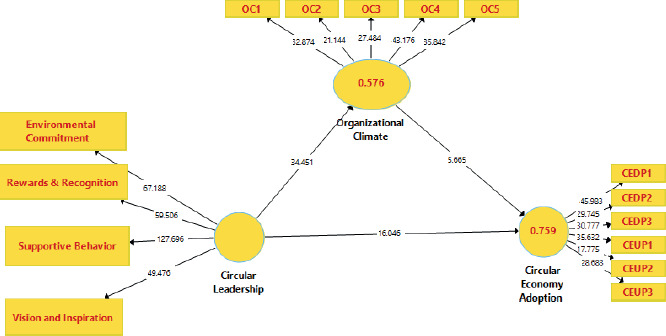
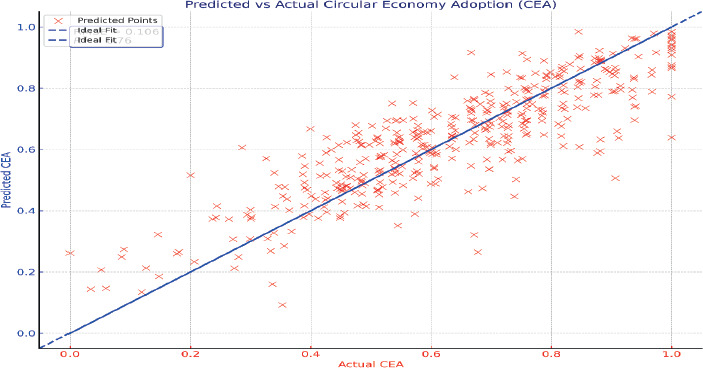
Table 7 presents the performance metrics of the ANN model used to predict CEA. The ANN model explains 70.7% of the variance in CEA (R2 =0.707). The RMSE of 0.296 and MAPE of 0.221 suggest that the model has a good fit with acceptable prediction error. In terms of predictor importance, CL had the highest normalised importance (100%), followed closely by OC (93.3%), indicating that both variables significantly contribute to predicting CEA, with CL having a slightly more substantial impact . Addition-ally, the model was evaluated using various input configurations – namely, CL as a sole predictor of CEA, the combination of CL and OC predicting CEA, and CL predicting OC – to assess the impact of individual and combined predictors on the accuracy of the predictions. c The combined model (CL + OC → CEA) performed best (see Table 7), with the lowest mean RMSE of 0.1066, indicating that combining both pre-dictors enhances predictive power when used. When CL alone predicted CEA, the mean RMSE slightly increased to 0.1117. The highest RMSE (0.1231) was observed when CL was used to predict OC alone, indicating that OC partially mediates the relationship between CL and CEA. These results reinforce the value of considering both CL and OC when modelling organisational influences on CEA.
Table 7
Performance of the ANN Model
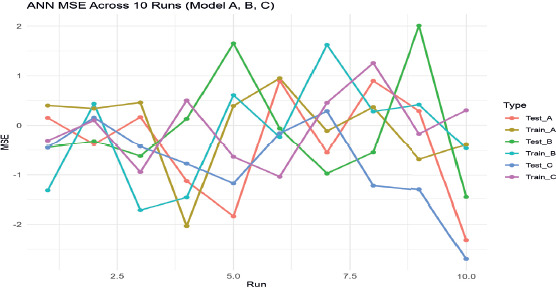
The study employed three ANN models to understand how CL and OC contribute to CEA. Model A, which includes both CL and OC, exhibits the best performance, with CL having a more substantial hid-den neuron weight (3.84) compared to OC (2.18). This model converged at an error of 2.40, indicating it effectively captured the complex, non-linear relationships. Model C, which tested the direct effect of CL on CEA, also performed well, with satisfactory convergence. In contrast, Model B, which examined the in-fluence of CL on OC, showed greater error fluctuations, suggesting lower reliability and generalizability. Furthermore, the analysis of the Garson and the Olden method of variable importance reveals that Circular Leadership (CL) is more influential than Organisational Climate (OC) in predicting Circular Economy Adoption. Garson’s method indicates a slight dominance of CL (52%), while Olden’s method highlights a much stronger influence of CL (80.5%) over OC (19.5%). These mixed results imply that both constructs are important, but CL may play a more strategic and driving role in enabling circular practices within Organisations.
Finally, the models were tested over 10 independent runs to assess consistency (Figure 3). Model A showed the most stable performance with minimal differences between training and testing errors. Model C also performed consistently, whereas Model B exhibited high variability in errors. The ANN mod-el overall explained 70.7% of the variance in CEA (R2 = 0.707), with low RMSE (0.296) and MAPE (0.221), confirming a good model fit (Table 7). These findings consistently demonstrate that combining CL and OC leads to better predictive outcomes, with CL serving as the central factor in promoting the adoption of the adoption of Circular Economy.
Discussions and Implications of the Study
The present study is a pioneering study, which attempts to explore, test, and empirically validate the concept of Circular Leadership. The study proves that Vision & Inspiration, Supportive Behaviour, Rewards & Recognition, and Environmental Commitment are the influential factors of CL. By signalling the factors of CL composition, the present study offers a noteworthy contribution to the theoretical ad-vancement of this emerging construct and also demonstrates its role in the context of circular economy transitions. Earlier, only a limited number of studies introduced the term Circular Leadership.
The study offers a pioneering integration of Circular Leadership (CL), Organisational Climate (OC), and Circular Economy Adoption (CEA) within a unified framework, grounded upon Goal Setting Theory (GST) and validated using a dual-stage analytical approach combining PLS-SEM and Artificial Neural Networks (ANN). The adoption of the dual-stage method – primarily estimating path relationships using PLS-SEM and then refining prediction accuracy via Artificial Neural Networks (ANN) – has never been tested in the Circular Economy literature. Therefore, the study makes a significant methodological con-tribution, as the use of explanatory power (PLS) and predictive robustness (ANN) enhances reliability and application potential.
The results of the study suggest that circular leadership functions as an intangible asset, strengthen-ing a company’s capability to embrace circularity. In addition, leadership committed to circular principles may indirectly affect circular economy adoption through organisational practices and norms. The study affirms that leadership style sets the tone for an Organisation to embrace circularity principles. Besides, companies must cultivate an innovative and flexible work culture that aligns with circular principles. Thus, industry leaders should concentrate on leadership development programs and a transformation to a flexible and innovative organisational culture to reap the benefits of circular economy practices.
The study results provide strong empirical support for the relationship between circular leadership and the adoption of CE, which is directly and indirectly connected through Organisational Climate. H1: (path coefficient .659, p = 0.000) states that leadership commitment plays a crucial role in the imple-mentation of circular economy practices. The finding aligns with previous research, which teaches that leadership is a key determinant in sustainability transitions(Geissdoerfer et al., 2017). Prior research has also confirmed that leadership fosters a work culture that prioritises sustainability and long-term goals (Kiron et al., 2017). Thus, the findings imply that CL is recognised as a critical success factor for organ-isations that intend to integrate circular principles in their strategies and operations (Shayganmehr et al., 2021) Leaders with a circular mindset prioritise long-term, sustainable thinking, along with a focus on innovation, adaptability, and openness to change, as well as multi-stakeholder collaboration (Awan et al., 2019; Luqman & Abdullah, 2011). At the organisational level, leadership is responsible for sensing op-portunities, seizing them through proper resource allocation, and transforming internal capabilities. In the context of this study, a circular leader will be able to restructure operations and reform the strategies around reuse, remanufacturing, closed-loop systems, and sustainable design(Fernandez & Gallardo-Gal-lardo, 2020). Moreover, a circular leader acts as the anchor that initiates and sustains changes, moving away from linearity.
The present study confirms similar insights by demonstrating the impact of circular Leadership on organisational climate (H2; path coefficient 0.759, p = 0.000), suggesting that circular leadership signifi-cantly shapes a work environment conducive to circular practices. While leadership provides strategic direction, it is the organisational climate that ensures meaningful follow-through by embedding circular values into the everyday behaviours, norms, and routines of the organisation (Schneider et al., 2013; Zhou et al., 2019)the purpose of this paper is to examine the effect of personality on entrepreneurial intention and success. Previous research has focused on why individuals become entrepreneurs and why some are more successful than others. However, most studies have investigated only single factors or primary per-sonality traits. The current study investigates not only the strength of the personality-entrepreneurship link, but also clarifies the nature of the relationship. Design/methodology/approach: Using two indepen-dent samples and an innovative regression-based pattern recognition procedure, the study investigates whether the nature of the personality-entrepreneurship relationship is driven by individuals’ absolute trait levels or by their idiosyncratic configuration of personality traits. The non-entrepreneur sample consisted of 225 business students in Eastern China, specializing in a variety of business subjects. The entrepreneur sample consisted of 120 business owners in a university entrepreneurial park in Eastern China. Findings: Results support hypotheses that the two different types of entrepreneurship criteria are predicted by different personality profile effects. Entrepreneurial intentions are driven by individu-als’ personality patterns (peaks and valleys in profiles.An organisational climate which is conducive to circularity, characterised by learning orientation, open communication, flexibility, adaptability, and risk tolerance (Gong et al., 2022).In addition, OC plays a crucial role in knowledge sharing and application, which often depends on cross-departmental coordination and the configuration of material and knowl-edge flows(Del Giudice et al., 2021; Pappalardo et al., 2019). In an organisational climate that rewards innovation on circularity, employees are more likely to innovate circular solutions for the organisation. Furthermore, the mediating role of Organisational climate in the relationship between circular leadership and circular economy adoption, as evidenced by the path coefficient 0.258, p-value = 0.000, highlights the role of Organisational dynamics in the transition to circular economy adoption. The find-ing is consistent with (Bocken et al., 2016; Hagsten & Falk, 2020), who stressed the need for an enabling Organisational climate to foster circular innovation. Additionally, the lower magnitude of organisational climate and circular economy adoption compared to direct Circular Leadership and circular economy practices suggests that while Organisational climate is an important mediator, leadership remains the primary driver of circular economy adoption. This finding is consistent with those of (Nawi et al., 2017) , who argued that while cultural transformation within firms is essential, the role of leadership in setting sustainability-oriented strategic objectives remains paramount. Alternatively, few studies recommend that organisational climate may exert dominance over leadership in the transition towards circulari-ty(Ghisellini et al., 2016). Such perspectives affirm that while leadership brings change, Organisational climate exerts a dominant influence over adherence to circularity practices(Ghisellini et al., 2016). OC serves as a mediating bridge between top-down leadership directives and bottom-up operational orien-tation. In addition, the study offers a combined synergistic advantage of CL and OC in adopting CE, which implies that neither CL nor OC is sufficient in isolation. This aligns with the GST in such a way that CL will be engaged in exploring circularity and implementing it through OC. Moreover, the study affirms that CL initiates macro-level transformation, whereas OC ensures micro-level operationalisation, as shown in the results of ANN. While CL holds the most substantial weight, the best predictive outcome emerges when OC is included. These findings are strongly consistent with Goal Setting Theory (Locke & Latham, 2006) which posits that specific, challenging goals, when supported by commitment and contextual factors, lead to improved performance. Circular Leadership (CL) provides strategic direction by articulating clear sustainability goals, while Organisational Climate (OC) fosters a supportive environment that enhances employee commitment and collaboration. The mediating role of OC reflects the theory’s emphasis on environmental conditions that sustain motivation and goal pursuit. Furthermore, the synergistic effect of CL and OC, confirmed by both SmartPLS and ANN analyses, underscores GST’s principle that goal achievement is maximised when leadership and contextual support mechanisms align. Methodologically, the hybrid approach of combining SEM and ANN provides a richer understanding; SEM confirms causal linkages, while ANN uncovers complex, non-linear dynamics that are often hidden in traditional models. Goal Setting Theory (GST), proposed initially by Locke & Latham,(2006)posits that clear, specific, and challenging goals enhance performance by directing attention, sustaining effort, and encouraging persistence. In line with this, the study finds that Circular Leadership (CL) has a significant direct impact on Circular Economy Adoption (CEA), highlighting the role of leaders in articulating ambitious sustain-ability goals – such as zero waste or closed-loop systems – and motivating Organisational alignment to-ward these objectives. Additionally, Goal Setting Theory emphasises the importance of commitment and feedback, which is reflected in the mediating role of Organisational Climate (OC). A supportive climate fosters openness, learning, and collaboration, thereby reinforcing employee engagement and enabling ongoing adaptation toward achieving goals. The synergistic effect of CL and OC on CEA, as revealed by the superior predictive performance of Model A (CL + OC → CEA) in the ANN analysis, further supports GST’s assertion that goals are best achieved when both task clarity (from leadership) and contextual support (from climate) are present. Moreover, the ANN results mimic the feedback loops emphasised in GST, where the relative importance and predictive strength of CL and OC indicate dynamic reinforcement and strategy recalibration. Collectively, these insights affirm that both leadership and climate are critical mechanisms through which goal setting translates into sustainable organisational outcomes.
The study provides empirical support that organisations seeking to transition toward circularity must invest not only in leadership development but also in cultivating a flexible, innovative, and sus-tainability-oriented work culture. Industry leaders should prioritise integrated leadership and cultural transformation programs to embed circular principles into core organisational behaviour. The combina-tion of SmartPLS and ANN modelling offers a comprehensive lens for understanding both the structural causality and the complex, non-linear interactions that underpin circular economy adoption.
Theoretical and Managerial Implications
The present study offers a significant theoretical advancement of Goal Setting Theory (GST) by ex-tending its foundational premise to define Circular Leadership. GST (Locke & Latham, 1990) posits that clearly articulated, challenging goals enhance performance by focusing attention, sustaining effort, and guiding behaviour. By empirically modelling the effect of Circular Leadership (CL) on Circular Economy Adoption (CEA) through Organisational Climate (OC), the present research reconceptualises goal-setting not as a top-down directive but as a dynamic social mechanism shaped and diffused through the Organi-sational Climate. The strong empirical support – CL → OC (β = 0.760, p < 0.001) and CL → CEA (β = 0.657, p < 0.001) – combined with the mediating role of OC (OC → CEA, β = 0.260, p < 0.001), underscores how leaders’ circular visions are internalized into shared norms and values that actively drive environmental action. This reframing enriches GST by introducing Organisational climate as a collective cognitive-emo-tional channel through which leadership goals are socially constructed, reinforced, and translated into systemic behavioural change. While other theories, such as Institutional Theory (DiMaggio & Powell, 1983)and Stakeholder Theory (Freeman, 1984) contextualise external pressures that drive CE adoption, GST – through this expanded lens – uniquely captures the internal psychological and behavioural align-ment fostered by leadership within Organisations. As such, this study offers a refined understanding of GST’s applicability in circular leadership, particularly in emerging and resource-constrained economies. Moreover, the use of the dual-stage model, including PLS-SEM and ANN using R, sets a new benchmark for methodological rigour in Circular Economy or any sustainability-related research. This approach allows for both causal inference and predictive validation, thereby enhancing the generalizability of the study.
Practical Implications
Company leaders should act as role models, inspiring eco-friendly activities through their vision, strategies, and actions for a less polluted and cleaner world for present and future generations. In an emerging economy like Bangladesh, where a hierarchical culture prevails, employees are extremely leader-centric and reluctant to engage in non-task-related roles. Thus, the adequate and timely demon-stration of CL would encourage them to be proactive in CEA. When a favourable Organisational climate complements Circular Leadership, it will be feasible for policymakers to achieve national agendas for the Circular Economy.
The present study also demands the immediate attention of the board of directors and decision-level executives, who should consider spending on shaping an Organisational climate that supports circu-lar practices. It involves promoting a work culture that supports knowledge sharing, cross-functional collaboration, experimentation, innovation and adaptability. Prior research has shown that companies embedded in circular principles are more successful in achieving long-term benefits(Kiron et al., 2017). Besides, regulators and policymakers can leverage the findings to tailor leadership development programs that will focus on CE adoption. Government and concerned bodies can introduce certifica-tion programs for circular leadership to incentivise firms to align their leadership strategies with CE objectives.
This study presents a novel and integrated model that intertwines circular leadership, Organisa-tional climate, and circular economy adoption, framed within Goal Setting Theory and validated using PLS-SEM and ANN in R. The results make a significant contribution to both academic discourse and managerial practice, offering a replicable model for firms seeking to integrate circularity into the core of their operations.
Avenue for future research
The present study considers two highly environmentally sensitive industries of Bangladesh: the Pharmaceutical and textile industries. Future research may focus on multi-group analysis between the two industries in order to understand the differences in findings between the two studies. Such an anal-ysis will help develop industry-specific policies. Additionally, other environmentally sensitive industries can also be considered to collect responses, thereby enhancing the acceptability and generalizability of the study. Additionally, future research may explore other moderating factors, such as regulatory pres-sures and technological capabilities, to provide a more comprehensive understanding of the circular leadership-Circular Economy relationship.
Declarations
The authors declare that no funds, grants, or other support were received during the preparation of this manuscript. They also declare that they have no conflicts of interest or competing interests. All authors of the manuscript have read and agreed to its content and are accountable for all aspects of the accuracy and integrity of the manuscript. Furthermore, the submitted article is the one presenting orig-inal work that is not being considered or reviewed by any other publication and has not been published elsewhere in the same or a similar form.