1. Introduction
Globalization has several aspects in different fields. One of the most arguable topics is whether globalization reduces the state’s economic role. Specifically, different opinions can be encountered on the nexus between globalization and the welfare state. In the post-World War II era, the welfare state regime has reached its apogee in Western democracies. Centralized labour movements and traditional class voting provide the prestige to left governments. In line with the Keynesian perspective, redistribution, economic efficiency, and growth have been successful, resulting in full employment and the promotion of universal wages. However, by the late 1970s, Western capitalist economies experienced slow economic growth, stagflation (Stryker, 1998). However, globalization has weakened the welfare state in various ways. Firstly, financial globalization increased the dependency of the economies on capital. Secondly, globalized capital and production may shift economic resources to where they find profitable conditions. Thirdly, financial globalization imposes pressures on both left and right-wing governments to adopt fiscal austerity, reducing social expenditures, and contractionary inflation policy (Stryker, 1998).
The effects of globalization on the welfare state and government expenditure are examined in terms of efficiency and compensation hypothesis (Cengiz, Manga, 2020). On the side of the efficiency hypothesis (or race to the bottom hypothesis1), globalization causes pressure on policymakers to reduce tax rates. Hence, it constrains the government resources used in social policies (Haelg, Potrafke, Sturm, 2022). More importantly, globalization may cause a shifting tax burden from mobile factors to immobile factors. It changes the dependency on taxation types. For example, tax structures become less progressive, and the tax burden may increase on dependency for indirect taxes, such as consumption taxes, which are relatively less progressive than income, profit, and asset taxes. Furthermore, along with globalization, countries which aim to attract capital tend to reduce income tax rates compared to capital-exporting countries (Asher, Rajan, 2001). Furthermore, the pressure of the globalization process compels decision-makers to reduce corporate income tax, which may deprive some less developed countries of trade tax revenue (Genschel, Seelkopf, 2016).
In this framework, globalization has a diminishing effect on the welfare state. As international competition pushes countries to liberalize their markets, it leads to downward social expenditures (Stryker, 1998; De Simone, Gaeta, Ercolano, 2012). In contrast, the compensation hypothesis asserts that countries may face external risks and shocks along with globalization. Hence, government expenditures, including social protection and welfare, rise to mitigate the negative influences of external risks (Rodrik, 1998; Sáenz, Sabaté, Gadea, 2013). Therefore, from the compensation hypothesis, a positive association between globalization and SPE is expected.
Thanks to globalization, competition between countries has emerged for different purposes. Since competition among countries triggers, many countries tend to reduce tax rates and subsidies for firms in order to capture competitive power. Demands for maintaining competitiveness and profitability push policymakers to reduce wages, which has a negative effect on social protection (Euzéby, 2000).
Moreover, the behaviour of politicians is important in the nexus between globalization and social protection. The partisan politics theories argue that left-wing governments are more intended for SPE than right-wing ones. The main idea behind this is that enhancing income equality and protecting low-in-come people are the main parts of their left-wing politician’s motivation. On the contrary, the political business cycle theories assert that politicians tend to increase SPE before elections to capture more voting. Therefore, the impact of globalization on SPE emerges role of political background (Haelg et al., 2022).
Additionally, in the era of globalization, the world economy is becoming more digital. As a new economic model, the digital economy transforms and shifts the traditional sectors to integrate more digital tools, including big data and artificial intelligence (AI) (Pan, Li, Wu, 2024). Although there is no common definition of digitalization, several approaches highlight its key properties and characteristics. For instance, De Clerck (2017) describes as “digitalization means turning interactions, communications, business functions and business models into (more) digital ones which often boils down to a mix of digital and physical as in omnichannel customer service, integrated marketing or smart manufacturing with a mix of autonomous, semi-autonomous and manual operations.” Innolytics (2025) defines as “digitalization is the generic term for the Digital Transformation of society and the economy.” And Brennen and Kreiss (2016) define it as a “the material process of converting individual analog streams of information into digital bits.” As part of the digitalization, the usage of robots is increasing progressively. According to the International Federation of Robotics’s (2024) report, more than 4 million industrial robots are used worldwide. Oxford Economics (2019) also emphasized that the number of robots in the world will reach 20 million by 2030. Due to robotization, it is also expected that 20 million manufacturing jobs, representing 8.5% of the global manufacturing jobs, will be displaced by 2030.
Despite the great attention to the impact of digitalization on the economy, studies investigating the relationship between digitalization and government expenditures are very limited. It is possible to explain the association between digitalization and government expenditure through some mechanisms. First, since the digital economy is expanding, people can access more information for their rights to knowledge, participation, and benefit from public policy. Namely, digitalization enhances transparency and allows people to demand public rights (Yan, Tu, Zheng, 2023). Second, the effects of digitalization on the economy on jobs or employment are arguable in the relevant literature. From the point of view of adverse effects on employment, it is claimed that new technologies can replace the traditional sectors, and the unskilled labour force can be displaced. In contrast, it raises the demand for skilled labour forces (Zhao, Tang, 2024). However, Acemoglu and Restrepo (2018) argue that the effects of digitalization on labour markets depend on the displacement effect and productivity effect. The displacement effect occurs when robots or AI replace the labour force that they are employed in a given task. The displacement effect indicates the declining share of wages and demand for labour (Greve, 2019). In contrast, productivity affects incentives for the rising demand for labour in different ways. For example, capital accumulation caused by automation positively affects labour demand, and since the cost of producing automated tasks decreases, the whole economy expands, and non-automated tasks also contribute to raising the demand for labour. The influence of digitalization on the labour market also leads to some effects on welfare states. One of the prominent effects occurs when new technologies replace workforces and increase unemployment (Greve, 2019). Thereby, digitalization imposes pressures to increase social security. Moreover, rising unemployment due to the digitalization of the economy may decrease government tax revenue. This situation is attributed to the fact that welfare state policies are funded mainly by taxes and duties. As employment declines, tax revenues from income decline as well (Greve, 2019).
Along with the digital economy, both job displacement and creation may result in different sectors. The World Economic Forum (2023) predicts that between 2023 and 2027, 83 million jobs will disappear and 69 million new jobs will be created. Specifically, in recent times, there have been extensive arguments regarding job risks caused by automation and digitalisation in the European Union (EU).
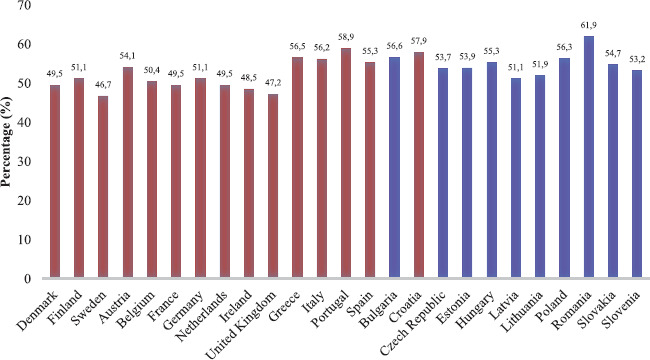
The number of jobs risks due to automation is highlighted in Fig. 1., and it is inferred that the Central and Eastern European countries (CEECs) will face many jobs at risk in future decades. It is estimated that Romania will face the highest job destruction among European countries, 61.9%, and Sweden will face the lowest job risk, 46.7%. Importantly, Greve (2019) discussed that the pressure on the welfare state is also linked with the welfare regime. For example, countries with more generous welfare regimes will have more considerable pressure than countries that have liberal welfare regimes. However, in Eastern and Southern Europe, it is predicted that there will be the highest pressure on losing jobs (Greve, 2019).
Figure 1
Jobs at risk of automation in the EU
Source: authors’ own drawing based on data from Greve (2019).
Since digitalization has the potential to transform the economy, social policies towards groups that have been negatively affected become crucial. Because some groups may not integrate into the digital economy, their requirements for social protection may also increase.
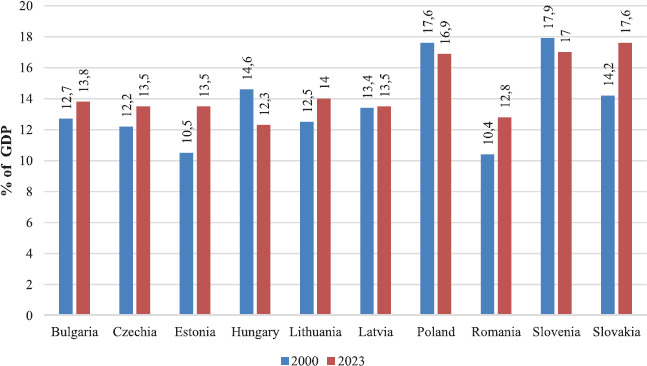
Fig. 2. indicates the SPE in the CEECs from 2000-2023. Overall, it is possible to say that there is a minor change in SPE, and it has declined in Hungary, Poland, and Slovenia. However, SPE has risen in Bulgaria, Czechia, Estonia, Lithuania, Latvia, Romania, and Slovakia in the same period.
In contrast, the adoption of digitalization by the CEECs has risen dramatically over the last two decades. Digitalization and innovation have a crucial importance for the CEECs. The CEECs can benefit from EU markets to improve their digital infrastructure. In contrast, the traditional sectors and the presence of low-level technological development may pose challenges (Tutak, Brodny, 2024).
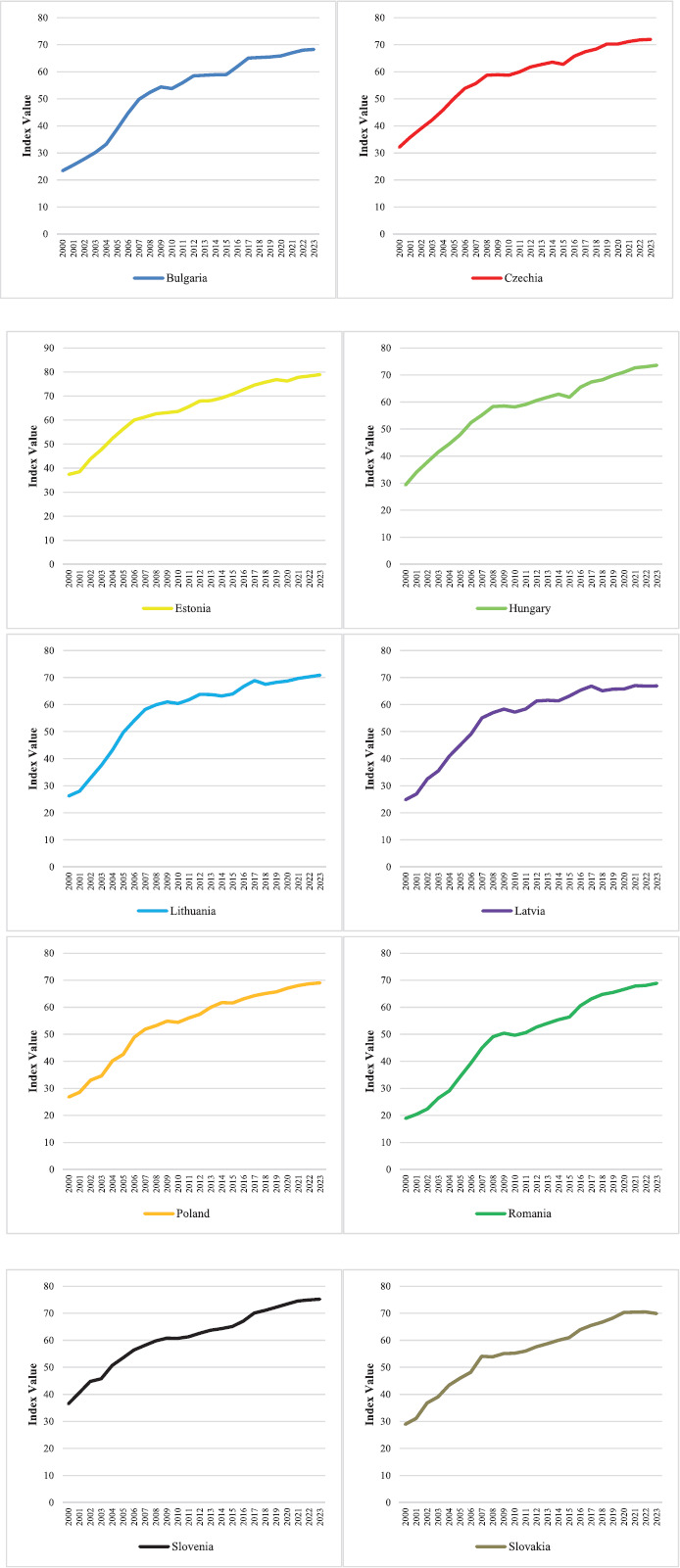
Fig. 3. displays the improvement of ICT in CEECs in the last two decades. It is depicted that digitalization has significantly risen in all CEECs in terms of ICT. All countries have an upward trend, and the ICT index has increased at least twice. Moreover, these countries have experienced increasing globalization in economic, social, and political dimensions. The KOF globalization index rose in Bulgaria, Czechia, Estonia, Hungary, Lithuania, Latvia, Poland, Romania, Slovenia, and Slovakia from 2000 to 2023 (Gygli, Haelg, Potrafke, Sturm, 2019). It is well known that after the collapse of the Soviet Socialist Republics (USSR), post-socialist countries opened their economies to integrate into the globalized world (Sutlović, Matassi, 2023).
Figure 3
Information and communication technologies (ICT) index2 in CEECs
Source: authors’ preparation based on data from UNCTAD (2026).
It is clear that globalization and digitalization are important for CEECs and open a new angle on how these two factors affect SPE. Following the theoretical discussion, the empirical findings for exploring the association between globalization, digitalization, and SPE may enlarge our knowledge in this regard.
For this target, the main objective of our paper is to estimate the effect of digitalization and globalization on SPE in the CEECs, using annual data over 2000-2023 with feasible generalized least squares (FGLS) and panel corrected standard errors (PCSE) estimators that take into consider CSD, heteroscedasticity, and autocorrelation.
It is expected to contribute to the existing literature from the current study in two ways. To the best of our knowledge, this is one of the limited studies analyzing the effect of globalization and digitalization on SPE in these country groups. Secondly, we perform FGLS and PCSE estimators that provide robust findings in the presence of CSD, autocorrelation, and heteroscedasticity. In the case of the CEECs, performing a suitable estimator that considers the CSD is crucial. Most members of the CEECs share common economic, political, and historical relationships. In the era of high connectivity and globalization, countries are highly interdependent.
The remaining parts of the paper consist of the following sections. Section 2 reviews the existing literature. Section 3 details the data, model, and empirical methodology. Section 4 presents the empirical findings. Section 5 concludes the paper with policy recommendations.
2. Literature Overview
Globalization and digitalization have significantly influenced social protection systems worldwide, presenting both opportunities and challenges (Santos, Simões, 2021; Bird, Hanedar, 2023). Globalization has led to increased economic interdependence, affecting labour markets and social policies (Cengiz, Manga, 2021). The “race to the bottom” phenomenon illustrates how countries may reduce labour standards to attract investment, potentially undermining social protection measures (Haelg et al., 2022). Conversely, globalization has facilitated the exchange of best practices and the adoption of international labour standards, promoting the development of more robust social protection systems. The International Labour Organization (ILO) emphasizes the need for social protection floors to ensure basic income security and access to essential services for all. However, it should be underlined that the studies researching the association between globalization and welfare state provide mixed results.
Furthermore, digitalization has transformed the delivery and management of social protection services. The integration of digital technologies enables more efficient targeting and distribution of benefits, reducing administrative costs and enhancing transparency (Hosny, Sollaci, 2022). For instance, digital payment systems and biometric identification have streamlined benefit distribution, minimizing fraud and ensuring timely assistance (Bird, Hanedar, 2023). However, digitalization also presents challenges. The rise of non-standard forms of employment, such as gig and platform work, complicates traditional social protection frameworks, which are often designed for standard employment relationships. This shift necessitates the adaptation of social protection systems to cover workers in diverse employment arrangements (Behrendt, Nguyen, Rani, 2019).
The rise of new work patterns, along with digitalization, may pose a challenge to the social security system. Particularly, as self-employment workers rise thanks to platform work and opportunities to work without any borders, it changes the labour relationship. Hence, platform workers may not be covered by sufficient social protection. Based on this, the EU recommends that its members provide social protection for standard workers, non-standard workers, and platform workers in the scope of the social security system (SSS) (Schoukens, 2020). Moreover, the developed SSS plays a key role in the alleviation of poverty. According to the income effect theory, social security benefits increase individuals’ disposable income and provide opportunities to compensate for basic needs. Risk reduction theory discusses that the SSS offer protection against economic shocks. Finally, the capability approach suggests that poverty is a lack of capabilities rather than a lack of income. Hence, the SSS incentives aim to enhance the capabilities of individuals (Li, Huang, 2025).
Han, Hai, Wu, Zhou (2023) demonstrate that digital infrastructure reduces healthcare costs by improving service efficiency and accessibility, especially in underserved regions. Additionally, the International Monetary Fund (IMF) has highlighted how digital technologies can enhance social safety nets by improving identification, verification, and payment processes, thereby supporting rapid expansion and efficiency in social protection systems (Bird, Hanedar, 2023). Digitalization influences labour market structures, with mixed outcomes. While it creates jobs in tech-oriented sectors, it also risks displacing low-skilled workers. Zhao and Tang (2024) highlighted the role of enterprise resilience in ensuring employment sustainability amid digital transformations. Table 1 summarizes existing empirical studies on the association between globalization, digitalization, and public policy.
Table 1
Empirical literature summary
| Study | Country | Method | Findings |
|---|---|---|---|
| De Simone et al. (2012) | 16 European OECD countries | Ordinary Least Square (OLS) | There is a convergence trend in total welfare expenditures, unemployment compensation, family, and health expenditures in the globalization era. |
| Cengiz and Manga (2020) | 28 EU Countries | Panel ARDL | Globalization is positively associated with SPE. |
| Cengiz and Manga (2021) | 14 middle-income countries | Augmented mean group (AMG) estimator | The public sector downsizes as openness increases |
| Santos and Simões (2021) | OECD countries | System Genera-lized Method of Moments (GMM) | Various dimensions of globalization - economic, social, and political - positively affect total social expenditure and most of its components. |
| Haelg et al. (2022) | 31 OECD countries | Extreme bounds, Bayesian Model averaging | Trade globalization is negatively associated with social expenditures. |
| Han et al. (2023) | China | Differences-in-dif-ferences (DID) model | Digital infrastructure can save up to 18.8% on healthcare expenses. |
| Yan et al. (2023) | China | Fixed effects | The digital economy positively affects income distribution by enhancing the capacity of fiscal expenditure. |
| Pan et al. (2024) | China | Two-way fixed effects model | The digital economy increases basic endowment insurance and health insurance funds revenue. |
| Zhao and Tang (2024) | China | Fixed effects | Digitalization is positively associated with sustainable employment. |
In the relevant literature, the nexus between globalization and welfare state policies is widely investigated across different samples. Moreover, in recent times, the influence of digitalization on the labour market has also been examined by researchers. However, there are few studies in the existing literature focusing on the simultaneous impact of globalization and digitalization on SPE. Hence, this paper aims to fill a gap in the existing literature.
3. Materials and Methods
To empirically estimate the association between digitalization, globalization, and SPE, we utilized various indicators. In Table 2, we list the concept, measurement, and sources of data.
Table 2
Concept, measurement, and sources of data
| Variable | Definition | Measure | Source |
|---|---|---|---|
| PRO | Social protection expenditures | General government expenditure on social protection, % of GDP | Eurostat (2026) |
| GDP | Economic growth | GDP constant ($ 2015 price) | World Bank (2026) |
| KOF | Globalization | KOF overall globalization index | Gyli et al. (2019) |
| DIG | Digitalization | Information and communication tech-nologies (ICT) index | UNCTAD (2026) |
| TAX | Tax Revenue | Total receipts from taxes and social contributions, % of GDP | Eurostat (2026) |
| AGE | Age dependency | Age dependency ratio, old (% of wor-king-age population) | World Bank (2026) |
| UNEMP | Unemployment | % of the total labour force | World Bank (2026) |
To reveal the long-run relationship between SPE and explanatory variables, we constructed our empirical model as follows:
The Eq. [1] is converted to full-logarithmic form as given:
where φ1, φ2, φ3, φ4, φ5 and φ6 represents long-term coefficients for lnGDP, lnKOF, lnDIG, lnTAX, lnAGE, and lnUNEMP, respectively. In addition, i denotes to number of countries, t refers to the time, and uit is the error term. In our model, we used the ICT index as a proxy for digitalization, following the studies of Sassi and Goaied (2013), Habibi and Zabardast (2020), Myovella, Karacuka, Haucap (2020), and Nguyen (2021). The KOF overall globalization index was used to represent globalization. In some cases, trade openness and foreign direct investment are considered indicators of globalization. However, globalization is a multidimensional phenomenon that encompasses not only economic, but also social, political, and institutional dimensions (Leibrecht, Klien, Onaran, 2011). Thus, following the studies of Dreher (2006), Dreher, Sturm, Ursprung (2008), Leibrecht et al. (2011), Potrafke (2019), Cengiz and Manga (2020), and Çakmakoğlu and Çavuşoğlu (2025), the KOF globalization index was adopted in the model. Additionally, GDP per capita was included in the model following the studies of Sepalika, Sudasinghe, Patmasiriwat (2014), Herrero-Alcalde and Tránchez-Martín (2017), Mina (2018), and Ko and Min (2019). The taxation was adopted into the model following the studies of Sepalika et al. (2014) and Tashevska, Makreshanska-Mladenovska, Trpkova-Nestorovska (2022). The unemployment rate was incorporated into the model based on studies by Chaffin and Corder (2018) and Hong (2014), and age dependency was adopted following Szymańska (2023).
Our paper consists of three empirical stages. Firstly, descriptive statistics and a correlation matrix were provided. Secondly, we tested the presence of CSD. Moreover, we scrutinized the Wooldridge test and Levene-Brown and Forsythe test to check the autocorrelation and heteroscedasticity in the model, respectively. In the third stage, we utilize the FGLS and PCSE estimators to estimate long-run coefficients. In the presence of the CSD, heteroscedasticity, and autocorrelation, the empirical findings may be inconsistent. Therefore, convenient econometric techniques are crucial for obtaining reliable results. Hence, we utilized the FGLS and PCSE estimators considering the CSD, heteroscedasticity, and autocorrelation (Chen, Chen, Lyulyov, Pimonenko, 2023).
The FGLS estimator works well if the number of periods (T) exceeds the number of cross-sections (N). More importantly, it consistently estimates the large error covariance matrix and considers serial correlation, CSD, and heteroskedasticity (Amponsah, 2023; Çeliköz, Yildiz, Arslan, Kirmizioğlu, 2022). The model specification of the FGLS model can be expressed as follows (Mumuni, Mwimba, 2023):
where yit denotes the dependent variable indicating SPE, xit is a kx1 vector of the explanatory variables (economic growth, globalization, digitalization, tax revenue, age dependency, and unemployment), β is coefficients of explanatory variables, i denotes to countries, t refers to the time, α is the constant term, and εitis the error term (Mumuni, Mwimba, 2023). The FGLS estimator allows for varying standard errors across cross-sections (Arshed, Hameed, Saher, Yazdani, 2022).
Another estimator used in the study to check the robustness of the FGLS is the PCSE estimator, which was developed by Beck and Katz (1995) to determine the relationship between variables. The PCSE estimator is also robust against heteroskedasticity, autocorrelation, and CSD. Moreover, it is expressed as the following equation (Jóźwik, Gürsoy, Doğan, 2023):
Next to the summarization of the estimation strategy, the following section continues with the empirical findings and the discussion section.
4. Empirical Findings and Discussions
Our empirical findings begin with descriptive statistics of variables and the correlation matrix of variables.
According to the descriptive statistics presented in Table 3, mean values of lnPRO, lnGDP, lnKOF, ln-DIG, lnTAX, lnAGE, and lnUNEMP are 2.60, 25.01, 4.32, 3.99, 3.48, 3.21, and 2.03, respectively. Maximum values of lnPRO, lnGDP, lnKOF, lnDIG, lnTAX, lnAGE, and lnUNEMP are 2.98, 27.18, 4.41, 4.36, 3.68, 3.53, and 3.00, respectively. Moreover, the lnGDP has the highest standard deviation with 0.94, and lnKOF has the lowest standard deviation among variables with 0.06. Further, the distributions of lnKOF, lnDIG, lnTAX, lnAGE, and lnUNEMP are negatively skewed, whereas the distributions of lnPRO and lnGDP are positively skewed.
Table 3
Descriptive statistics of the variables
The correlation matrix results from Table 4 indicate that lnTAX, lnGDP, and lnKOF are three indicators that have the highest positive correlation with lnPRO. Also, lnDIG shows a possible positive correlation with lnPRO. Furthermore, lnUNEMP has a negative correlation with lnPRO, lnGDP, lnKOF, lnDIG, lnTAX, and lnAGE.
Table 4
Correlation matrix
The diagnostics test results are indicated in Table 5. The CSD test results reject the null hypothesis of no CSD. In other words, a strong CSD among countries indicates that a shock or unexpected case may spread to each other. Moreover, the Wooldridge test and Levene-Brown and Forsythe tests show the presence of autocorrelation and heteroscedasticity in the model, respectively. Therefore, robust estimators must be applied in the presence of CSD, autocorrelation, and heteroscedasticity to capture reliable and consistent results. For this purpose, we perform the FGLS and PCSE estimators considering the CSD, autocorrelation, and heteroscedasticity.
Table 5
The Diagnostics tests results
The long-run coefficients are reported in Table 6. According to the results, economic growth, digitalization, tax revenue, age dependency, and unemployment positively affect SPE in both estimators. However, globalization has a negative effect on SPE. Depending on these results, an increase of 1% in economic growth, digitalization, tax revenue, age dependency, and unemployment increases social protection by 0.102%, 0.301%, 0.712%, 0.190%, and 0.209%, respectively. In contrast, a 1% increase in globalization reduces SPE by 1.105%.
Table 6
Panel FGLS and PCSE results
Our empirical findings for all variables can be explained from the theoretical perspectives. First, economic growth’s positive effect on SPE is associated with the welfare state regime. According to Wagner’s Law, government expenditure increases during the economic expansion (Karaalp-Orhan, Evcim, Deyneli, 2024). Hence, with an increase in economic development, government expenditure can be used as an important tool. Our positive effect of economic growth on SPE is in line with the study of Murshed, Badiuzzaman, Pulok (2017), and Gnangnon (2020).
Second, digitalization positively affects SPE. This result can be attributed to the displacement of workforces thanks to digitalization resulting increasing demand for social benefits. As argued by Eichhorst and Rinne (2017), the standard employment relationship changed due to increasing digitalization and automation. Since platform workers classified as self-employed or freelancers rise along with digitalization, they are not often included in social security, unlike workers who are employed in a workplace. Hence, platform workers become more dependent on tax-financed basic welfare or social security. In addition, increasing ICT usage among citizens significantly improves governance quality. For example, since ICT has become widespread and adopted by people, they offer possibilities to cultivate citizens’ awareness and increase their attention to public policies. Hence, ICT may enable rapid action against misallocated and unnecessary government expenditures (Erum, Sohag, Said, Musa, Asghar, 2024).
Third, globalization negatively affects SPE. This supports the efficiency hypothesis (or race-to-the-bottom hypothesis), indicating that, alongside globalization, national governments are forced to reduce tax rates, thereby decreasing SPE (Haelg et al., 2022). Our findings are in the same direction as those of Rudra and Haggard (2005), Liberati (2007), and Dura and Yalçintaş (2022).
Fourthly, tax revenue, age dependency, and unemployment rate are positively associated with SPE. In the context of tax revenue, it is expected that government receipts from taxation and other social contributions may provide sources for allocating to government expenditures (Mina, 2021). Furthermore, SPE is closely associated with demographic structures. For example, age dependency is a crucial factor affecting SPE. Hence, it is assumed there is a positive association between age dependency and SPE. Our findings are consistent with Potrafke (2009) and Szymańska (2023). Also, the relevant literature argues that, despite unemployed people seeking employment, they need greater social assistance during their unemployment period (Tashevska et al., 2022). Our result is consistent with the studies conducted by Haelg et al. (2022), Tashevska et al. (2022), and Chaffin and Corder (2018).
5. Conclusions and Policy Implications
Social welfare policies have been adopted in many countries following World War II. Although it is recognized that the role of the state has declined in the era of globalization, recent developments indicate that it remains crucial for developing countries. In addition, the world has entered a phase of digitalization and automation, which has also been adopted by the CEECs. Over the past three decades, the CEECs have experienced significant liberalization while also acquiring digital tools. Therefore, policymakers increasingly need to understand the impact of digitalization and globalization. This paper explores the impacts of digitalization and globalization on SPE in the CEECs. The estimation results indicate that while globalization tends to decrease SPE, digitalization has a positive effect.
Furthermore, economic growth, tax revenue, age dependency, and unemployment increase SPE in these countries. Our empirical evidence suggests that public policies are crucial for maintaining social welfare. As digitalization increases, SPE tend to increase in the CEECs. Policymakers should improve coordination capacity in the digital economy across people, cities, and regions. Moreover, the negative impact of globalisation on SPE suggests that greater openness could lead to a reduction in government size to attract foreign capital. However, in the 21st century, government policy performs a key role in tackling external risks.
Policymakers should be especially focused on disadvantaged groups who are negatively affected by globalization and digitalization. For example, low-skilled workers vulnerable to job displacement by automation; older workers who face barriers to adapting to new technologies; young people trying to enter gig or platform-based employment; and people with limited access to digital infrastructure and few economic opportunities. Moreover, policymakers should develop comprehensive policies that cover digital inclusion initiatives, strengthen unemployment insurance, and develop upskilling programs to help workers build digital competencies.
Limitations and Suggestions for Future Research
This study has some limitations. First, due to a lack of data, we could not estimate the impact of digitalization and globalization on SPE on a country-specific basis. Second, we used overall SPE as the primary indicator. As data becomes available, future research should explore the individual effects of both factors for each country to capture country-specific effects. Moreover, the sub-indicators of SPE such as unemployment benefits, family allowances, health expenditure, and pensions may deepen our knowledge to understand which types of programs are most sensitive to globalization and digitalization. Finally, incorporating more specific measures of digitalization and robotization could yield deeper insights into how technological change affects welfare policies.