Introduction
Food security has become increasingly vulnerable to systemic and overlapping shocks. Climate change, pandemics, geopolitical conflict, and economic instability have exposed structural fragilities in both global and local food systems. Climate-related events have intensified the frequency and severity of droughts, floods, and extreme weather phenomena, directly affecting agricultural production, supply chains, and local food prices (Haile et al., 2017; Paudel et al., 2023; IPCC, 2023; Narayan et al., 2024). At the same time, the COVID-19 pandemic generated widespread economic disruption, reducing employment, income stability, and household purchasing power (Gentilini et al., 2022). The war in Ukraine has further amplified supply chain disruptions and food price volatility in Eastern Europe, underscoring the growing relevance of multi-shock exposure in the region (Kovács et al., 2022). In post-socialist transition economies, characterized by structural transformation, labor market informality, and uneven social protection systems such disturbances may have particularly pronounced consequences for household food access (Hegedüs, 2011; Polese et al., 2014; Praščević, 2023; Nae et al., 2024; Novotný et al., 2026). By post-socialist transition economies we refer to the 28 countries covered by LiTS IV that have undergone the transition from centrally planned to market-based economic systems.
A substantial empirical literature documents the relationship between climate variability and food insecurity, particularly in low-income agrarian contexts. Cross-country evidence shows that households exposed to climate shocks are significantly more likely to experience food insecuritythrough agricultural production losses and livelihood instability (Niles & Salerno, 2018; Hadley et al., 2023). Systematic reviews identify disruptions in food availability and market functioning as dominant mechanisms (Baptista et al., 2022), while . conceptual frameworks link climate change, food security, and economic vulnerability through . cascading pathways across interconnected systems (Raj et al., 2022; Tambo et al., 2023; Tuholske et al., 2024; Saccone & Vallino, 2025; Galanakis et al., 2025). Despite the increasing prevalence of overlapping disturbances, much of the empirical literature continues to examine climate and pandemic shocks separately.Evidence from Central and Eastern Europe and post-Soviet contexts indicates that institutional structures and market integration shape vulnerability and adaptation capacity. Small-scale farming systems and policy environments in transition economies exhibit distinct characteristics affecting food security outcomes (Toma et al., 2021). Research from Bosnia and Herzegovina demonstrates how asset constraints and institutional fragility influence adaptation to climate stress (Žurovec & Vedeld, 2019), while studies from post-Soviet Central Asia highlight how climate variability affects food availability through intertwined agricultural and macroeconomic channels (Ibraeva et al., 2025). Recent evidence from the Western Balkans further shows that economic crises significantly exacerbate food insecurity in structurally vulnerable transition contexts (Jámbor & Varga, 2024). Despite these contributions, systematic cross-country quantitative evidence on how environmental and macroeconomic shocks jointly affect household food insecurity in transition economies remains limited.
Several gaps therefore remain. Each gap reflects a specific limitation of the existing literature that this study addresses directly. First, most empirical research focuses on rural smallholder systems in low-income countries, with less attention to structurally transforming economies characterized by mixed agricultural-industrial structures and substantial urban-rural interdependence. Urban food system dynamics and informal food access mechanisms are comparatively underexamined in these contexts (Poulsen et al., 2015). Critically, transition economies combine partially liberalized markets, weakened inherited social protection systems, and high informality, an institutional configuration that frameworks developed for sub-Saharan Africa or South Asia do not capture. This renders direct extrapolation from that literature problematic and motivates the use of the LiTS IV, which provides comparable cross-country microdata for 28 transition economies. Second, while multi-shock environments are increasingly acknowledged, there is limited evidence on whether climate-related and pandemic-induced shocks operate through distinct transmission channels or reinforce one another. Emerging research on multi-shock exposure highlights the importance of household coping strategies, yet cross-country evidence remains scarce (Ulimwengu, 2025). Existing multi-shock studies, including Béné (2020) and Saccone and Vallino (2025), rely primarily on qualitative frameworks or single-country case analyses, leaving channel-specific mechanisms empirically unidentified. This study addresses that limitation by distinguishing price-based from income-based outcomes and using interaction terms to explicitly test for compound amplification. Third, although resilience is widely discussed in policy-oriented analyses (Haji & Himpel, 2024), there is comparatively little quantitative evidence on whether modest household savings capacity mitigates different types of shocks and whether its buffering role differs across price-based and income-based transmission pathways. Carter and Lybbert (2012) argue theoretically that liquidity buffers should be more effective against idiosyncratic price shocks than against systemic income disruptions, a prediction consistent with the permanent income hypothesis, yet this differentiated moderating role has not been tested empirically across post-socialist household samples. The interaction specifications in Section 3 are designed explicitly to fill this gap.
This study addresses these gaps by examining how climate-related damage and pandemic-induced economic shocks differentially transmit into household food insecurity across 28 transition economies. Using nationally representative microdata from the fourth wave of the Life in Transition Survey (LiTS IV), the analysis distinguishes between two transmission channels: a price-based channel, reflected in vulnerability to food price increases, and an income-based channel, reflected in consumption reductions and affordability constraints. The study further evaluates whether household savings capacity – defined as the ability to save at least five percent of income – attenuates shock transmission.
Guided by this framework, four hypotheses are tested. First, climate-related damage is associated with food insecurity predominantly via price-based mechanisms. Second, pandemic-induced economic shocks increase food insecurity predominantly through income-based channels. Third, joint exposure to both shocks may generate compound effects if income and price constraints interact nonlinearly. Fourth, household savings capacity reduces baseline vulnerability and moderates the transmission of both shock types, with stronger buffering effects expected for price-based disturbances than for systemic income shocks.
By explicitly modeling differentiated transmission pathways and moderating savings capacity within a unified empirical framework, this study contributes to a more precise understanding of how overlapping environmental and economic shocks shape food insecurity in transition economies. Such differentiation is critical for designing policy responses in contexts characterized by increasing systemic volatility.
The study makes three specific and novel contributions. First, it provides cross-country quantitative evidence on differentiated shock transmission channels in transition economies, a regional and institutional context that has received limited attention in the food security literature, which remains dominated by studies from sub-Saharan Africa and South Asia. Second, by separately identifying price-based and income-based food insecurity outcomes and linking each to a theoretically distinct shock type, the study operationalises a channel-specific transmission framework that goes beyond the binary food-secure/insecure classification common in prior cross-country work. Third, it offers the first systematic evidence that household savings capacity moderates price-based and income-based shock pathways differently, providing micro-level empirical support for the theoretical asymmetry proposed by Carter and Lybbert (2012) and generating concrete, targeted implications for social protection design in transition economies.
The rest of the paper is organized as follows. Section 2 establishes the conceptual framework, grounding the study in economic theories of shock transmission and consumption smoothing. Section 3 details the data source and the empirical strategy, including the logistic regression specification. Section 4 presents the empirical results, focusing on the differentiated impact of climate and pandemic shocks. Section 5 discusses the broader policy implications of these findings for transition economies. Finally, Section 6 concludes with a summary of the structural insights and directions for future research.
2. Conceptual Framework
Household food security fundamentally depends on income, food prices, and the ability to smooth consumption over time (Becker, 1965). Within the standard household utility framework, food consumption is determined by disposable income, relative food prices, and access to coping mechanisms such as savings or credit (Singh et al., 1986; Deaton, 1991; Morduch, 1995). Exogenous shocks can undermine food security by disrupting one or more of these determinants (Sen, 1981; Dercon, 2002). This study conceptualizes food insecurity as the outcome of two distinct shock transmission mechanisms: the price channel and the income channel. Climate-related shocks and pandemic-induced economic shocks represent external disturbances, but they are expected to affect food security through different mechanisms (Barrett & Dorosh, 1996).
Figure 1 presents the conceptual framework of the study. Climate-related shocks are modeled as supply-side disturbances that influence household food security primarily through food price volatility and market disruptions. Climate-related damages, including droughts and floods, affect households through direct and indirect mechanisms. In agricultural contexts, climate shocks reduce crop yields, lowering household income for producers (Rosenzweig & Parry, 1994). Among non-agricultural households, localized supply disruptions lead to food price increases, especially in transition economies with imperfect integration (Fackler & Goodwin, 2001). In transition economies, climate shocks may generate heterogeneous effects. Rather than immediate income collapse, these damages often manifest as idiosyncratic price volatility (Timmer, 1989). Thus, the price channel is particularly relevant here, increasing perceived vulnerability even if caloric intake remains temporarily stable.
Figure 1
Conceptual Framework: Shock Transmission and Household Food Insecurity Source: prepared by the author.
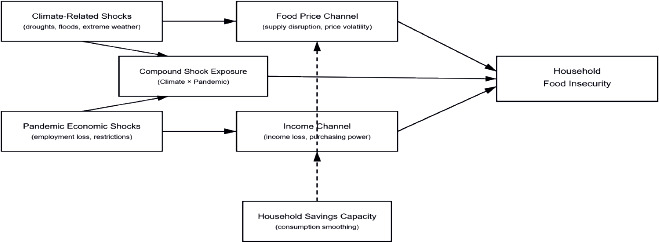
In contrast, pandemic-induced economic shocks are conceptualized as income-side disturbances that reduce employment opportunities and household purchasing power. The COVID-19 pandemic disrupted labor markets and lowered household earnings globally (Laborde et al., 2020). Unlike localized climate shocks, pandemic restrictions were broad-based and simultaneous (Arndt et al., 2020). Income losses are associated with reduced purchasing power, forcing households to substitute toward cheaper staples or reduce protein intake (Béné et al., 2021). Consequently, pandemic shocks are expected to exert stronger effects on income-based indicators, such as the inability to afford meat.
Simultaneous exposure to climate and economic shocks may generate compound effects on household food security if income and price constraints occur at the same time. Such shocks may reinforce each other and produce nonlinear impacts on vulnerability (Zseleczky & Yosef, 2014). A positive interaction effect would imply that the combined impact exceeds the sum of individual effects (Bigsten et al., 2003). However, such amplification is not guaranteed. If shocks operate through distinct transmission channels or households adjust expenditure patterns toward essential goods, their effects may remain partially independent (Ansah et al, 2021; Awoke et al, 2026). Empirical analysis is therefore required to assess whether shocks interact or operate separately.
Household savings capacity serves as a critical moderating factor in shock transmission, primarily by enabling consumption smoothing. Drawing on the Permanent Income Hypothesis (Friedman, 1957) and Intertemporal Consumption Theory, households are expected to utilize savings to stabilize consumption during periods of income fluctuation.
In this framework, the ability to save at least a modest portion of income functions as a vital liquidity buffer. This buffer allows households to maintain essential food consumption despite temporary declines in income or spikes in food prices. Conversely, liquidity constraints – where such buffers are absent – force households to adjust their consumption sharply in response to exogenous shocks, often leading to food insecurity (Zeldes, 1989).
However, the efficacy of this buffer is contingent on the nature of the shock. While modest savings can effectively insulate households from localized, temporary climate disturbances, they are often insufficient against systemic, broad-based disruptions like pandemics. Because systemic shocks often simultaneously reduce income streams and erode existing savings, they effectively „exhaust” the liquidity buffer, thereby limiting its role as a stabilizer (Carter & Lybbert, 2012).
Based on this framework, the empirical analysis tests four hypotheses:
H1: Climate-related damage increases the probability of household food insecurity, primarily through price-based transmission.
H2: Pandemic-induced economic shocks increase food insecurity through income-based transmission.
H3: Simultaneous exposure to climate and pandemic shocks generates compound effects that amplify food insecurity.
H4: Household savings capacity reduces the probability of food insecurity and moderates the impact of external shocks.
Each hypothesis maps directly onto specific elements of the empirical specification in Section 3. H1 is tested through the main-effect coefficient on climate-related damage, using the food-price vulnerability indicator as the primary dependent variable, consistent with the price-based transmission channel theorised above. H2 is tested through the main-effect coefficient on pandemic-induced economic shock, using the staple consumption reduction and protein affordability indicators that capture income-based adjustment. H3 is evaluated through the Climate × Pandemic interaction term, which tests whether joint exposure amplifies food insecurity beyond the sum of the two individual effects. H4 is assessed through both the main effect of savings capacity and the Climate × Savings and Pandemic × Savings interaction terms; the theoretical framework predicts that the buffering effect will be larger for the price-based outcome (H1) than for the systemic income-based outcome (H2), since savings are posited to smooth idiosyncratic price volatility more effectively than broad-based income disruptions. This direct mapping from framework to specification ensures methodological coherence between the theoretical and empirical components of the study.
3. Empirical Strategy
Given the binary nature of the dependent variables, this study estimates weighted logistic regression models to test the differentiated shock transmission hypotheses. The dependent variables capture multiple dimensions of food insecurity, including consumption-based indicators and perceived vulnerability to food price increases, thereby allowing separate identification of income-based and price-based outcomes. For household i in country c, the probability of food insecurity is specified as:
Where f (.) denotes the logistic cumulative distribution function. Climate ic captures self-reported climate-related damage and operationalizes the price-based transmission channel. Pandemic ic measures household-level negative economic impact from COVID-19 and represents the income-based transmission channel. SavingsCapacity ic is defined as the household’s ability to save at least five percent of income and captures a minimum liquidity buffer reflecting short-term consumption-smoothing capacity.
The interaction term Climate ic X Pandemic ic tests for compound exposure and potential nonlinear amplification (H3). The interactions Climate ic X SavingsCapacity ic and Pandemic ic X SavingsCapacity ic ssess whether household savings capacity moderates shock trans-mission (H4), indicating attenuated effects of price-based and income-based disturbances among households with liquidity buffers.
The vector Xic includes household demographic and socioeconomic controls, such as household size, employment status, gender composition, and urban residence. Country fixed effects ( ) are included to account for time-invariant institutional and macroeconomic heterogeneity across transition economies, ensuring that identification relies on within-country variation across households.
3.1 Data Sources1
This study uses micro-level data from the fourth wave of the Life in Transition Survey (LiTS IV), which covers 28 transition economies. LiTS IV provides nationally representative household-level information on socioeconomic characteristics, exposure to climate-related and economic shocks, employment conditions, and financial capacity.
After excluding observations with missing values on key variables, the final analytical sample consists of approximately 28,000 households. The sample includes countries grouped into four regional clusters reflecting shared historical and institutional trajectories. Central Asia comprises Kazakhstan, the Kyrgyz Republic, Tajikistan, Uzbekistan, and Mongolia. Southeastern Europe (Western Balkans) includes Albania, Bosnia and Herzegovina, Kosovo, Montenegro, North Macedonia, and Serbia. Central Europe and the Baltic States consist of Bulgaria, Croatia, Czechia, Estonia, Hungary, Latvia, Lithuania, Poland, the Slovak Republic, Slovenia, and Romania. Eastern Europe and the Caucasus (EEC) encompass Belarus, Moldova, Armenia, Azerbaijan, Georgia, and Russia. This classification captures broad structural similarities while preserving substantial cross-country heterogeneity within the transition context.
3.2 Dependent Variables1
The empirical analysis examines four dimensions of household food insecurity, constructed as binary indicators from LiTS IV survey responses. The measures are designed to capture both income-based consumption adjustments and price-based vulnerability, consistent with the theoretical framework.
The first dependent variable identifies whether the household reduced consumption of basic food items such as milk, fruit, vegetables, or bread, during the previous two years due to income decline or other economic difficulties. The indicator equals one if the household reports reducing staple food consumption and zero otherwise. This measure reflects income-based food insecurity through direct consumption adjustment.
The second outcome captures difficulty in affording protein-rich foods. It is based on whether the household can afford meat, chicken, fish, or a vegetarian equivalent every second day. The indicator equals one if the household reports difficulty or inability to afford such consumption and zero otherwise.
The third variable represents a stricter form of protein deprivation and equals one if the household reports being unable to afford meat or its equivalent. Together, the second and third indicators capture varying degrees of income-constrained nutritional access.
The fourth dependent variable measures perceived vulnerability to food price increases. It is constructed from respondents’ expectations regarding the impact of anticipated food price increases over the next twelve months. The indicator equals one if the household expects to be “quite affected” or “strongly affected,” and zero if it expects to be affected “little” or “not at all.” This measure captures price-based vulnerability rather than realized consumption reduction.
By distinguishing between realized consumption constraints and perceived price exposure, the dependent variables align with the differentiated transmission mechanisms outlined in the conceptual framework.
3.3 Key Independent Variables1
The main explanatory variables capture exposure to exogenous shocks operating through distinct transmission channels. Climate-related damage is defined as a binary indicator equal to one if the household reports having experienced loss or damage due to climate-related events, such as floods, droughts, or other natural disasters, and zero otherwise. This variable represents a supply-side disturbance that may reduce local production and increase food price volatility, thereby operationalizing the price-based transmission mechanism. Pandemic-induced economic shock is measured as a binary indicator equal to one if the respondent evaluates the economic impact of COVID-19 on the household as negative or very negative during the previous two years, and zero if the impact is neutral or positive. This variable capture income-side disruptions through employment loss, reduced earnings, and diminished purchasing power. To evaluate potential compound effects, an interaction term between climate-related damage and pandemic-induced economic shock is included. This specification tests whether simultaneous exposure generates amplification beyond additive effects.
Household savings capacity is constructed from the survey item measuring the household’s current financial situation. Respondents classify their household into ordered categories ranging from “able to save over 40 percent of income” to “running into debt.” A binary indicator is created equal to one for households reporting the ability to save at least five percent of their income, and zero for households reporting savings below five percent, inability to save, drawing on savings, or running into debt.
This measure captures a self-reported positive savings margin reflecting short-term liquidity and consumption-smoothing capacity rather than accumulated wealth or formal financial inclusion. Interaction terms between savings capacity and each shock variable are included to assess whether households with a positive savings margin experience attenuated transmission of both price-based and income-based shocks into food insecurity outcomes.
3.4 Control Variables1
The empirical models include a set of socioeconomic controls associated with food insecurity risk. Household composition is captured by the percentage of female household members, calculated as the number of women divided by total household size and expressed as a percentage. Alternative specifications incorporate either total household size or the dependency ratio to account for demographic burden.
Employment status is measured by an indicator equal to one if the respondent was currently employed or had worked within the previous twelve months. An urban residence indicator controls for spatial differences in labor markets, market access, and food availability.
Country fixed effects are included in all specifications to account for time-invariant cross-country heterogeneity in institutional structures, social protection systems, agricultural dependence, and market integration. Consequently, identification relies on within-country variation across households. All regressions apply survey weights to ensure national representativeness, and standard errors are clustered at the primary sampling unit level to account for intra-cluster correlation arising from the survey design.
3.5 Identification and Robustness1
The analysis identifies associations rather than causal effects. Both climate-related damage and pandemic-induced economic shock are self-reported measures and may reflect heterogeneous exposure intensity across households. Nevertheless, several features strengthen internal consistency. First, extensive household-level controls reduce omitted variable bias related to demographic composition and employment status. Second, country fixed effects absorb time-invariant institutional and macroeconomic differences across countries. Third, the application of survey weights ensures representativeness at the national level.
Robustness checks are conducted by estimating alternative specifications that replace household size with dependency ratio and vice versa. Results remain stable across these specifications, indicating that findings are not sensitive to alternative measures of household composition. Additional models excluding interaction terms confirm that the inclusion of compound shock specifications does not materially alter the baseline relationships.
4. Results
Table 1 presents average marginal effects from weighted logistic regressions examining the association between climate-related damage, pandemic-induced economic shocks, and household savings capacity, and multiple dimensions of food insecurity. Because coefficients from nonlinear logit models do not directly represent marginal probability changes, the analysis reports average marginal effects (AMEs) for all key variables. All models include country fixed effects, and are estimated using survey sampling weights to ensure national representativeness. Standard errors are clustered at the primary sampling unit level to account for intra-cluster correlation arising from the survey design. All reported associations reflect cross-sectional co-variation and should not be interpreted as causal effects.
Table 1
Average Marginal Effects of Climate and Pandemic Shocks on Household Food Insecurity (Weighted Logit Estimates)
[i] Notes: Standard errors clustered at the primary sampling unit level are reported in parentheses. *** p < 0.01, ** p < 0.05, * p < 0.10. Sampling weights are applied to ensure national representativeness. Full estimation results are available upon request. Source: authors’ calculation based on LiTS IV data.
4.1 Baseline Effects of Climate and Pandemic Shocks1
Climate-related damage is positively associated with household food insecurity across several outcomes, with the strongest effect observed for perceived vulnerability to food price increases. Households reporting climate-related damage are approximately 4 percentage points more likely to report vulnerability to food price shocks. The magnitude of this effect exceeds its association with consumption-based indicators, such as reduced staple consumption and inability to afford meat, where effects are smaller but statistically significant in selected specifications.
These findings are consistent with the conceptual framework, which posits that climate shocks primarily operate through supply-side and price-based transmission channels. Rather than generating immediate and uniform reductions in food consumption, climate-related disturbances appear to increase exposure to price volatility and perceived future risk. This pattern supports Hypothesis 1, emphasizing the predominance of price-based vulnerability in the climate transmission pathway.
In contrast, pandemic-induced economic shocks exhibit substantially larger and more consistent effects on income-based food insecurity outcomes. Households reporting a negative economic impact from COVID-19 are 16.3 percentage points more likely to reduce staple food consumption and 9.3 percentage points more likely to report difficulty affording meat. The effect on perceived food price vulnerability is statistically significant but smaller in magnitude.
This evidence strongly supports Hypothesis 2 and aligns with the characterization of pandemic shocks as income-side disturbances. By disrupting employment and reducing earnings, pandemic-related shocks are associated with reduced purchasing power, leading to observable consumption adjustments. Compared to climate-related damage, pandemic shocks produce broader and more immediate effects on consumption-based indicators of food insecurity.
Taken together, the evidence reinforces the theoretical distinction between price-based and income-based transmission channels. Climate-related damage appears to increase perceived price vulnerability, whereas pandemic-induced economic shocks directly reduce consumption capacity through income loss.
4.2 Compound Shock Effects1
A central objective of the study is to test whether simultaneous exposure to climate-related damage and pandemic-induced economic shocks generates compound effects. The interaction term between the two shocks evaluates whether joint exposure amplifies food insecurity beyond additive impacts.
The estimated interaction effects are generally small and statistically insignificant across outcomes. These results provide limited support for Hypothesis 3. While each shock independently increases the probability of food insecurity, their joint occurrence does not systematically produce nonlinear amplification.
This finding suggests that climate and pandemic shocks operate through partially distinct channels rather than mutually reinforcing mechanisms. One possible interpretation is that households experiencing pandemic-induced income loss may already adjust consumption behavior, leaving limited scope for additional amplification through climate-related price pressures. Alternatively, households may priori-tize essential food consumption when exposed to multiple constraints, thereby preventing multiplicative deterioration.
The absence of strong compound effects is substantively important, as policy discourse often assumes that overlapping shocks inevitably produce nonlinear escalation of vulnerability. The results instead indicate predominantly additive effects within transition economies.
4.3 Household Savings Capacity as a Buffer1
Household savings capacity emerges as one of the most robust predictors of food security outcomes. Households able to save at least five percent of income exhibit significantly lower probabilities of food insecurity across all indicators. The magnitude of these effects is substantial: savings capacity reduces the predicted probability of food insecurity by approximately thirteen to thirty percentage points, depending on the outcome.
These findings align with intertemporal consumption theory. A positive savings margin functions as a liquidity buffer that enables short-term consumption smoothing in response to temporary income or price fluctuations. Savings capacity therefore acts as a protective factor against both price-based and income-based transmission mechanisms.
Interaction estimates further clarify the moderating role of savings capacity. Savings capacity partially attenuates the impact of climate-related damage on food price vulnerability. The negative interaction suggests that households with a liquidity buffer are less sensitive to climate-induced price risk, consistent with Hypothesis 4.
However, the buffering role of savings capacity appears weaker in the context of pandemic-induced economic shocks. Although households with savings remain less likely to experience food insecurity overall, the interaction between pandemic shock and savings capacity is less consistently significant. This pattern suggests that systemic income disruptions may reduce the effectiveness of liquidity buffers, particularly when shocks are widespread and prolonged.
4.4 Household Characteristics and Structural Controls1
Beyond shock exposure, household characteristics significantly influence food insecurity outcomes. Larger households exhibit higher probabilities of food insecurity, reflecting greater consumption needs relative to earning capacity. Employment of the respondent is strongly associated with lower food insecurity, underscoring the central importance of stable income.
Urban residence does not consistently predict food insecurity once country fixed effects are included, suggesting that institutional and macroeconomic conditions at the national level may dominate simple urban-rural differences. Country fixed effects reveal substantial heterogeneity across transition economies, indicating that structural and institutional contexts shape baseline food security conditions. Countries in Central Asia exhibit the largest positive baseline food insecurity effects relative to the sample average, consistent with greater agricultural exposure and limited social protection coverage. EUCEE countries show predominantly negative fixed effects, reflecting higher baseline household incomes and more developed welfare states. Eastern Europe and Caucasus countries occupy an intermediate position, while Western Balkans countries show heterogeneous patterns consistent with variation in market integration and institutional development. These regional differences reinforce the importance of country-level institutional context in shaping baseline food security conditions, independent of individual shock exposure.
Importantly, inclusion of these controls does not materially alter the estimated effects of climate-related damage, pandemic-induced economic shocks, or savings capacity, reinforcing the robustness of the main findings.
Overall, the results demonstrate that climate-related damage and pandemic-induced economic shocks transmit into food insecurity through differentiated channels. Climate shocks primarily increase price vulnerability, while pandemic shocks primarily reduce purchasing power through income loss. Household savings capacity provides a meaningful protective buffer, particularly against climate-related price risk, though its moderating role is more limited in the face of systemic income shocks.
The absence of strong compound effects indicates that overlapping shocks produce additive rather than nonlinear escalation of food insecurity within the transition economies examined. These findings underscore the importance of distinguishing shock types when designing policy responses and highlight the central role of household-level liquidity buffers in enhancing resilience.5. Discussion and Policy Implications
The findings demonstrate that climate-related damage and pandemic-induced economic shocks shape household food insecurity through structurally differentiated channels. Rather than operating through identical mechanisms, climate shocks primarily drive price-based vulnerability while pandemic shocks drive income-based deprivation. This distinction aligns with the Exchange Entitlement framework (Sen, 1982), suggesting that treating these shocks as homogeneous risks misdirects policy responses. For instance, interventions designed to offset income loss may not sufficiently address price volatility,and measures targeting price stabilization alone may not mitigate the consumption collapse caused by sudden unemployment.
The study also finds that the interaction between climate and pandemic shocks does not generate systematic nonlinear amplification. Although each shock independently increases the probability of food insecurity, their combined effect remains additive. Given that a negative COVID-19 economic impact is associated with a 16 percentage point increase in the probability of reducing staple food consumption and a 9 percentage point increase in difficulty affording protein-rich foods, demand-side interventions such as targeted income transfers are warranted.
This suggests that households partially adjust expenditures to absorb overlapping constraints, preventing a total multiplicative collapse of resilience mechanisms. This provides a more nuanced perspective on compound vulnerability, indicating that while dual exposure strains household resources, it does not necessarily lead to an exponential escalation of food insecurity in transition contexts.
Household savings capacity functions as a critical protective factor by enabling consumption smoothing (Friedman, 1957). Households able to save at least five percent Households able to save at least 5% of their income are between 13 and 27 percentage points less likely to report food insecurity across the four outcomes examined, underscoring the importance of liquidity buffers as a protective mechanism during temporary disturbances. While this buffer effectively attenuates price vulnerability from climate-related damage, its moderating effect is weaker against systemic pandemic shocks. This indicates that widespread economic crises may simultaneously erode earnings and deplete household-level buffers, rendering individual savings an incomplete substitute for broader social protection.
Effective policy requires a layered approach to resilience. Climate adaptation should prioritize market integration, storage infrastructure, and price stabilization to mitigate supply-side volatility. Conversely, pandemic-style disruptions require demand-side interventions such as wage subsidies and targeted cash transfers to restore purchasing power. While promoting household savings enhances resilience to moderate shocks, institutional safety nets remain essential for managing systemic crises. Ultimately, monitoring systems must integrate both price and income dimensions to improve early warning and policy targeting across diverse institutional contexts.
6. Conclusion
This study examines how climate-related damage and pandemic-induced economic shocks transmit into household food insecurity across transition economies. The findings demonstrate that these shocks operate through differentiated mechanisms rather than a unified vulnerability channel. Climate-related damage primarily increases price-based vulnerability, particularly exposure to food price fluctuations, while pandemic-induced economic shocks primarily correspond to reduced purchasing power and income-based food insecurity.
Evidence of nonlinear compound amplification is limited. Although each shock independently elevates food insecurity risk, their joint occurrence does not systematically intensify vulnerability beyond additive effects. This suggests that households adjust consumption behavior in ways that partially absorb overlapping constraints, even when resilience mechanisms are strained.
Household savings capacity emerges as a significant protective factor. Households reporting the ability to save at least five percent of income exhibit substantially lower probabilities of food insecurity across all dimensions. A positive savings margin appears to function as a liquidity buffer that facilitates short-term consumption smoothing, particularly against climate-related price shocks. However, its moderating role is weaker in the face of systemic income disruptions such as those induced by the pandemic.
Overall, the results highlight the importance of distinguishing between price-based and income-based transmission pathways when designing resilience strategies. Strengthening market stability, protecting incomes during systemic crises, and supporting household savings capacity represent complementary policy pillars. By clarifying differentiated shock transmission in transition contexts, this study contributes to a more precise understanding of food insecurity dynamics in transition economies.
While the cross-sectional design and reliance on self-reported measures limit causal interpretation, the evidence underscores the structural differentiation of shock transmission and the central role of liquidity buffers in moderating vulnerability. Future research incorporating longitudinal data and objective shock measures would further strengthen causal inference and deepen understanding of resilience dynamics. The magnitude of the estimated effects is instructive in this regard. The pandemic shock increases the probability of staple consumption reduction by approximately 16 percentage points – four times the effect of climate-related damage on price vulnerability (approximately 4 percentage points) – underscoring that systemic income shocks pose a qualitatively larger threat to household food access than localized price disturbances. The buffering effect of savings capacity is correspondingly asymmetric: reducing food price vulnerability by up to 15 percentage points, but with weaker and less consistent moderation of pandemic-induced consumption loss. This asymmetry has direct policy implications: promoting household savings is a cost-effective strategy for building resilience against climate-related price shocks, but it cannot substitute for institutional income support during systemic crises. Future research should test whether these patterns hold across different shock intensities, use panel data to disentangle persistent from transitory vulnerability, and integrate objective climate exposure measures – such as subnational drought or rainfall indices – to sharpen the identification of the price transmission channel.