Introduction
The years 2019-2024 were marked by significant socio-economic disruptions that profoundly affected European societies. The COVID-19 pandemic, which emerged in 2019, triggered an economic crisis, exacerbated social inequalities (Benedetti and Crescenzi, 2023; Bernardi et al., 2021) and increased global poverty level (Michálek, 2023). Shortly thereafter, Russia’s invasion of Ukraine in 2022 further destabilised economic conditions, principally through a surge in energy prices that affected European economies (Astrov et al., 2022).
Pandemic-induced inflation initially raised living costs, and the energy crisis brought on by the war compounded financial pressure on households. Although various national policies aimed to mitigate the effects of these shocks, the degree to which they have shaped household outcomes across regions remains unclear (Sgaravatti et al., 2023). Indeed, regional characteristics, economic structures, and demographic factors can modulate the impact of these overlapping crises, particularly among the most vulnerable households (Benedetti and Crescenzi, 2023).
In this context, reducing disparities between countries and regions, often framed in terms of territorial cohesion and convergence, has for decades been a central policy goal of the European Union (Farkas and Szabó, 2018). In light of these overlapping crises, questions of socio-economic convergence have gained renewed importance. Efforts to foster cohesion across European regions – long considered a cornerstone of EU integration – are now challenged by uneven vulnerabilities and recovery trajectories. The concept of convergence provides a useful perspective for assessing how regions respond to common shocks. Convergence analysis makes it possible to examine whether poorer regions are catching up with wealthier ones in terms of poverty reduction, or whether crises have instead reinforced existing disparities (Crespo Cuaresma et al., 2022; Ravallion, 2012). More broadly, convergence has long been regarded as a central mechanism for achieving socio-economic cohesion in the European Union (Alcidi, 2019). Within this framework, the idea of poverty convergence has emerged as a way to test whether regions with higher poverty initially tend to experience faster reductions over time. Such processes are generally linked to wider trajectories of economic development, including rising incomes, better living standards, improved access to healthcare and education, and the expansion of welfare systems (Zhou et al., 2021).
The existing literature offers extensive analyses of poverty and social exclusion in European regions. However, most studies focus on periods before these recent crises or on a limited number of countries. For example, Cartone et al. (2024) observe regional convergence in poverty between 2005 and 2015 in 223 NUTS2 regions using conditional poverty β-convergence and quantile regression. Benedetti and Crescenzi (2023) examine income inequality in NUTS2 regions of Germany and Italy in 2018, comparing poverty indicators across small areas and highlighting significant regional differences in living conditions. Longford et al. (2012) find considerable regional differences in Italy and France, versus greater uniformity in Spain and the Czech Republic in 2006, whereas Jędrzejczak (2015) reports divergent regional income inequality patterns in Poland and Italy in 2009. Next, Savoia (2024) analyses income inequality convergence in NUTS2 regions from 1989 to 2013 using conditional convergence and shows that these regions converge, but at a higher level of inequality. However, Ravallion (2012) investigates absolute poverty convergence in a global perspective, analysing household data from 90 developing countries between 1977 and 2007, and shows that higher initial poverty does not necessarily translate into faster reductions over time. Complementary to this, Crespo Cuaresma et al. (2022) refine the concept of poverty-growth elasticity and test alternative formulations of convergence, further developing the framework introduced by Ravallion. At the policy level, Copeland and Daly (2012) analyse the EU’s ‘Europe 2020’ strategy, focusing on the goal of reducing poverty and social exclusion by 20 million people by 2020. They show that while the target was politically important, it also had weaknesses, such as unclear definitions and the risk of poor coordination across the EU. However, despite providing valuable insights into anti-poverty strategies, these studies do not capture the effects of the most recent crises (COVID-19, energy crisis) or offer a comprehensive regional perspective across Europe.
The primary objective of this paper is to analyse trends in the risk of poverty rate in NUTS2 regions across European countries from 2019 to 2024. In particular, we examine whether changes in the risk of poverty rate are primarily driven by country-specific or region-specific factors, and whether regional convergence in poverty indicators – both the risk of poverty rate and the AROPE measure – has occurred despite the disruptive shocks of the recent crises. By focusing on this period, the paper sheds light on how overlapping health, energy, and inflationary crises have interacted with long-term processes of socio-economic cohesion in the European Union.
This study contributes to the literature in three key ways. First, it provides one of the earliest systematic assessments of how the latest crises have affected poverty risks at the regional level, with a particular focus on both the risk of poverty rate and the broader risk of poverty or social exclusion (AROPE) indicator. Second, it evaluates the coherence of poverty risk trends at national and regional levels, assessing the extent to which regional dynamics align with or diverge from national trajectories despite uniformly applied policies. Third, it applies a three-level hierarchical modelling framework to disentangle regional and national sources of variation in poverty risk and to test for convergence patterns over time. Collectively, these contributions advance understanding of how crises interact with existing disparities and offer new insights into the resilience of socio-economic convergence in Europe.
The paper is structured as follows. Section 2 describes data and methods employed in the study. Section 3 reports the main empirical findings. Section 4 provides robustness check. Finally, Section 5 concludes the paper.
1. Data and methods
In our analysis, we collect data from Eurostat, describing the risk of poverty rate levels and risk of poverty or social exclusion (AROPE). The at-risk-of-poverty rate is the share of people with an equivalised disposable income (after social transfers) below the at-risk-of-poverty threshold, which is set at 60% of the national median equivalised disposable income after social transfers1. Next, AROPE indicator refers to the total number of individuals who are either exposed to poverty risk, experience severe material and social deprivation, or reside in households characterised by very low work intensity2. These data cover 24 European countries (Albania, Belgium, Bulgaria, Croatia, Czech Republic, Denmark, Finland, France, Germany, Greece, Hungary, Ireland, Italy, Lithuania, Netherlands, Norway, Poland, Portugal, Romania, Slovakia, Slovenia, Spain, Sweden and Switzerland) and 246 regions at the NUTS23 level, spanning the years 2019-2024. To provide a detailed overview of the variable characteristics, Table 1 presents the descriptive statistics of the risk of poverty rate and the AROPE indicator, which show moderate variability during the studied period. For the risk of poverty rate, the average value decreased from 17.09 in 2019 to 16.47 in 2024, suggesting a general trend of declining poverty risk. The median remained relatively stable, fluctuating around 14.70-15.60. While the lowest values of the indicator did not exhibit a clear trend, the maximum values increased significantly in 2023 (from 41.40 to 53.00) and remained relatively stable in 2024, which may suggest a worsening situation in certain regions. The same statistics for AROPE indicator exhibit a similar trend to the first indicator, but at a higher level. For instance, in 2019, the AROPE minimum was 6.80 versus 2.90 for the risk of poverty rate, the median 19.70 versus 14.70, and the maximum 55.40 versus 41.40.
Table 1
Descriptive statistics for the risk of poverty rate and AROPE indicator
To analyse the variability of the risk of poverty rate and AROPE indicator at both the NUTS2 regional level and the national level, we employ three-level hierarchical models, which allow for the consideration of differences across different levels of aggregation (Finch et al., 2019). The first-level model equation can be expressed as follows:
where ROPij represents the estimated risk of poverty rate (or AROPE) for region I, country j and year t, xijt includes the independent variable(s), such as time or its interaction with initial risk of poverty levels, U0jt and β1jt are intercept or slop, respectively, a εijt is a random error term.
At the second level (NUTS2 regions) and the third level (countries), the intercept and slope coefficients are defined as follows:
where α00 i α10 fixed effects (the overall mean intercept and slope), and γ0j, γ1j, u0ij, u1ij random effects at the country and region levels, respectively. Notably, hierarchical models allow for the comparison of regional and national variability and enable the analysis of unbalanced data.
2. Results
3.1. Comparison of risk of poverty levels across NUTS2 regions
Figure 1 illustrates the distribution of changes in the risk of poverty rate across all regions within each country from 2019 to 2024. Each box represents the interquartile range (Q3-Q1), the black line indicates the median, and black dots denote outliers. As shown, there are substantial differences in the changes in poverty risk levels across countries. In nearly all countries, some regions experienced a decline in poverty risk, while others saw an increase. However, it is evident that some countries were significantly more affected by the crises than others. France, Germany, Belgium, and Croatia recorded a notable increase in the risk of poverty rate across regions, suggesting a deterioration in economic conditions over the six-year period. In contrast, countries such as Albania, Switzerland, Portugal, Sweden, Romania, Poland, and Norway predominantly experienced a decline in the indicator, which may present an improvement in poverty risk levels.
Figure 1
The distribution of changes in risk of poverty between 2019-2024
Source: compiled by authors.
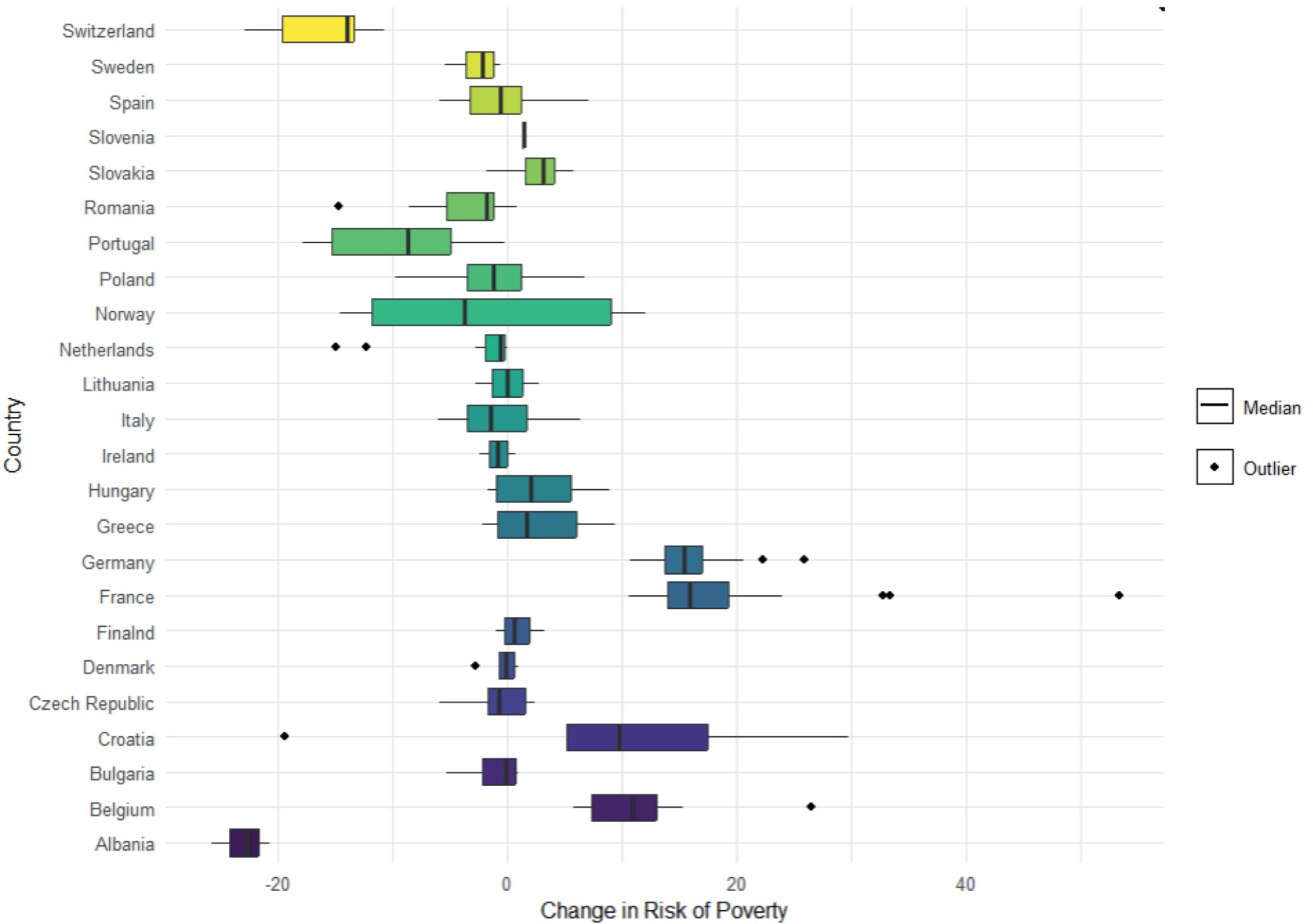
These cross-country differences likely reflect varying exposure to and recovery from recent economic shocks. The increase in poverty risks observed in France, Belgium, Germany, and Croatia may be related to the combined effects of the COVID-19 pandemic, rising energy prices, and inflationary pressures that disproportionately affected low-income households. In addition, countries such as France and Germany host large migrant populations, who were often more vulnerable to labour market disruptions, further amplifying overall poverty risks (Fassani and Mazza, 2020). In contrast, countries such as Portugal, Romania, Poland, and Albania introduced a combination of targeted social transfers and energy price mitigation measures, which may have helped to partially cushion the effects of the crises for certain groups. For instance, according to Bruegel’s estimates of fiscal responses to the energy price shock (Bruegel Dataset, 2023), the scale of support directed to households and firms between September 2021 and January 2023 amounted to approximately 4.2% of GDP in Portugal and 3.8% in Romania, compared with 3.7% in France. However, the scope and effectiveness of these policy measures varied, and their long-term impact on poverty reduction remains subject to further evaluation. Similar findings are reported by Bobrovnikova et al. (2023) and OECD (2023), which highlight the uneven socioeconomic consequences of the pandemic and the war in Ukraine across European countries.
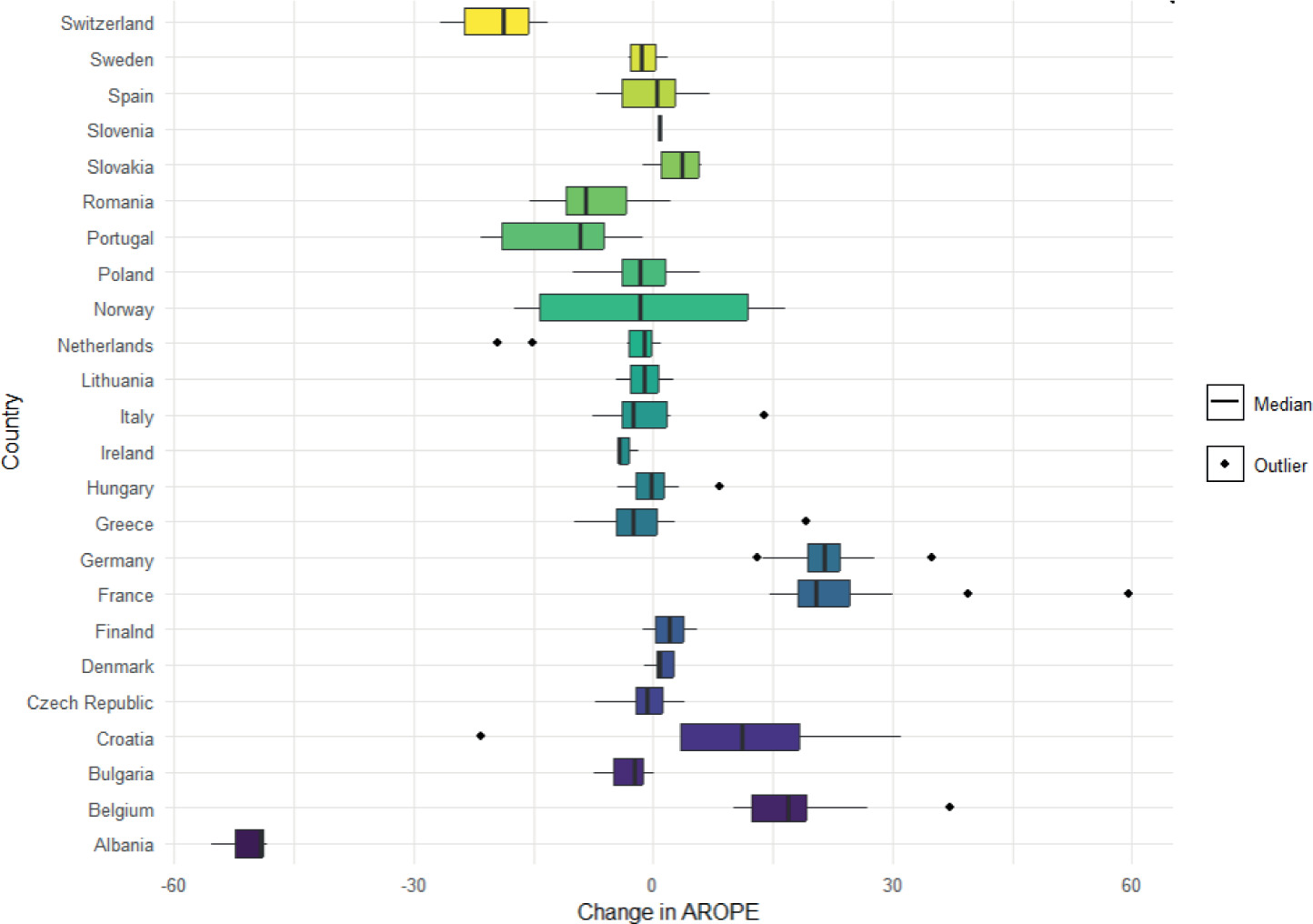
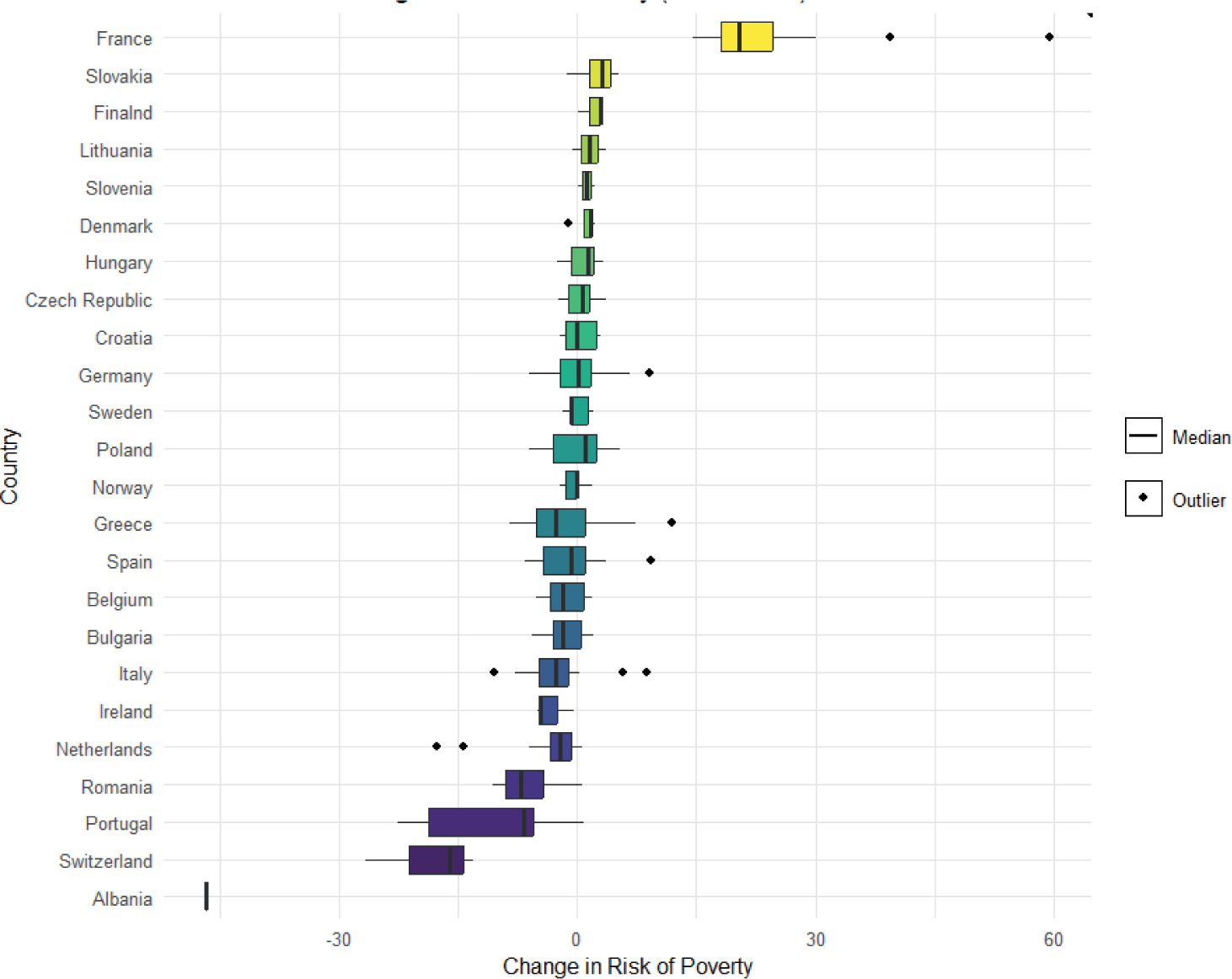
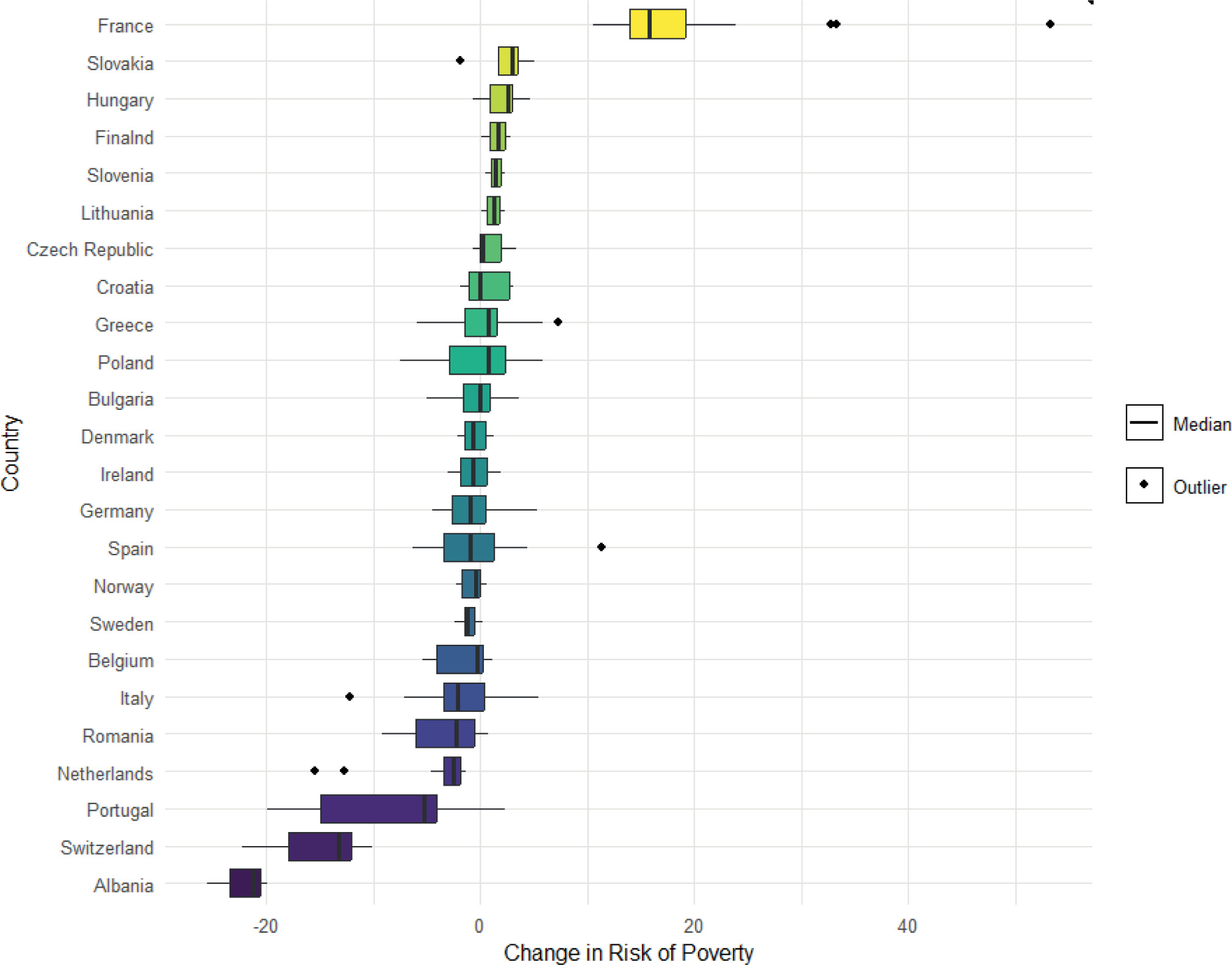
We also separately analyse the period 2021-2024 (Figure 2), taking into account major global events such as the war in Ukraine and the resulting energy crisis. France emerged as having the most pronounced overall increase in the risk of poverty rate. Additionally, several countries including Slovakia, Hungary, Finland, Slovenia, and Lithuania also experienced notable increases or heightened volatility in their poverty risk levels, likely reflecting the intensified economic pressures arising from disruptions in energy supply chains and heightened energy costs in the region. In contrast, the risk of poverty rate declined in some countries despite the occurrence of energy-related crises, including Italy, Romania, Netherlands, Portugal, Switzerland, and Albania. Figures 1A and 2A (see Appendix) present the same distributions, but for AROPE indicator. A similar pattern is observed for the AROPE indicator, with the same countries standing out. Yet, the changes occur at a higher level, with increases or decreases generally more pronounced than those observed for the risk of poverty rate.
3.2. Risk of poverty trends
To analyse changes in the risk of poverty rate from 2019 to 2024 within European countries and their regions, and to determine whether they exhibit a tendency toward convergence, we apply mixed-effects models. The models incorporate random effects for both the intercept and the trend, allowing for an assessment of regional and national variability in the initial risk of poverty rate as well as its subsequent changes over time. Both Model 1 and Model 2 indicate a negative but non-significant trend in the poverty rate over time (-0.09 in Model 1; -0.05 in Model 2). The random effects estimates highlight substantial variation in poverty across countries, with country-level variance decreasing from 16.19 in Model 1 to 12.83 in Model 2, suggesting that regional differences explain part of the country-level variation. However, Model 2 reveals even greater variability at the regional level (variance is 43.38), indicating significant disparities within countries. Similarly, while variation in the poverty trend is relatively small at the country level (0.14), it is more pronounced at the regional level (0.28). Finally, the residual variance drops sharply from 37.58 in Model 1 to 2.95 in Model 2, demonstrating that the inclusion of regional effects substantially improves model fit. To assess whether these improvements in explaining the variability of the risk of poverty rate are statistically significant, we conduct an ANOVA test (Table 3). The results, alongside information criteria, confirm that Model 2 provides a better fit, consistent with the reductions in residual variance noted earlier.
Table 2
Two – and three – level random intercept and slope models (Model 1 and Model 2)
Table 3
ANOVA comparison of model 1 and model 2
| AIC | BIC | Chisq | Df | Pr(>Chisq) | |
|---|---|---|---|---|---|
| Model 1 | 8131.7 | 8162.4 | |||
| Model 2 | 6140.1 | 6186.3 | 1997.5 | 3 | < 2.2e-16 *** |
To better understand changes in poverty risk levels, we introduce an additional model incorporating an interaction between the time variable and the initial 2019 poverty risk level. In this setup, a negative coefficient suggests that regions with higher initial poverty risk experience smaller increases over time, indicating convergence. Conversely, a positive coefficient would imply larger increases in already high-risk regions, suggesting divergence. This approach allows us to determine whether regions have become more homogeneous in poverty risk or if disparities have widened. Table 4 presents the results of Model As shown, the coefficient for the interaction term is negative (-0.04) and significant, confirming that regions starting with higher poverty risk are catching up with lower-risk regions over time. These find-ings align with similar regional convergence patterns noted by Cartone et al. (2024) in their analysis of poverty and social exclusion across European regions.
Table 4
Two-level random intercept model with interaction between time and initial level (Model 3)
Table 5
Two and three level random intercept and slope models (Model 1a and Model 2a)
3. Robustness check
To assess the robustness of the results, we employ the AROPE indicator and analyse the same models as in the previous step. First, we observe that the trend in the AROPE indicator over time is negative (-0.22), and in the case of the second model (-0.23), statistically significant. Second, there is considerable cross-country variation (74.56) in the level of the AROPE indicator. Third, the variability of the AROPE trend is greater at the regional level (0.52) than at the national level (0.16). Fourth, the ANOVA test (Table 6) indicates that the second model (Model 2a) provides a better fit than the first model (Model 1a). Finally, we can observe similar regional convergence patterns (-0.04) in AROPE indicator levels (see Table 7). Overall, the robustness check confirms that these findings are consistent with the earlier results obtained for the risk of poverty rate.
Table 6
ANOVA comparison of Model 1a and Model 2a
| AIC | BIC | Chisq | Df | Pr(>Chisq) | |
|---|---|---|---|---|---|
| Model 1a | 8417.8 | 8448.5 | |||
| Model 2a | 6428.5 | 6474.6 | 1995.2 | 3 | < 2.2e-16 *** |
Table 7
Two-level random intercept model with interaction between time and initial level (Model 3a)
4. Conclusion
This study examines trends in the risk of poverty rate and AROPE indicator in NUTS2 regions across 24 European countries from 2019 to 2024. Using hierarchical models, we assess whether changes in poverty risk are primarily driven by country-level or region-specific factors and investigate whether regional convergence in the risk of poverty rate has taken place despite the recent crises. The analysis reveals several important findings. First, the research demonstrates that shocks such as the pandemic and the war in Ukraine had highly asymmetric effects: while France, Germany, Belgium, and Croatia recorded notable increases in poverty risk, several countries including Portugal, Romania, Switzerland, and Albania observed improvements. Second, hierarchical models reveal significant disparities both between and within countries, underlining the importance of regional factors in shaping poverty outcomes. Third, analysis confirms the presence of convergence, as regions with initially higher poverty risk are catching up to their lower-risk counterparts. This suggests that national policies may have contributed to overall reductions in poverty risk, even amid disruptions in energy supply and rising energy costs. These findings highlight the need for further research on how region-specific interventions, particularly in the face of volatile energy markets, can enhance economic resilience across diverse local contexts.