1. Introduction
Regional investment attractiveness is a key concept in the literature on spatial economics, regional development, and socioeconomic geography. Generally speaking, it refers to the degree to which a given area is perceived as favorable for locating a business, both by domestic and foreign investors. Contem-porary regional development challenges require an innovative approach to assessing their investment potential. Growing competition between local government units in attracting investment requires the use of comprehensive, interdisciplinary analytical tools. The aim of this study is to present the results of research on the identification and analysis of factors influencing the assessment of investment at-tractiveness of municipalities in the Świętokrzyskie region from a social, economic, legal, technological, environmental, and infrastructural perspective.
In addition to classical theories, this study incorporates modern frameworks such as Dunning’s OLI paradigm (Ownership, Location, Internalization) and Ozawa’s Investment Development Path (IDP), providing insights into how multinational enterprises structure their international production. These approaches highlight that regional investment attractiveness is shaped not only by resource and cost factors but also by institutional maturity, market potential, and integration within global value chains (GVCs). Recent literature (e.g., Baldwin, 2016; Gereffi, 2020; UNCTAD, 2023) emphasizes the importance of nearshoring, reshoring, and regional supply chains in response to global production fragmentation and economic resilience goals within the EU. According to Dunning (1998) and Ozawa (2016), multina-tional enterprises’ location choices evolve dynamically under the Ownership–Location–Internalization (OLI) and Investment Development Path (IDP) frameworks. Recent contributions by Baldwin (2016), Gereffi (2020), Beugelsdijk et al. (2019) further highlight the role of digitalization and supply chain re-configuration in shaping investment behavior. From a European perspective, the European Commission (2023), UNCTAD (2023) underline the strategic importance of EU cohesion policy, structural funds, and regional value chains in improving competitiveness and resilience of local economies.
2. Investment location paradigms – classic and contemporary approaches
The theoretical foundations of investment attractiveness stem from classical location theories, pio-neered by von Thünen (1826), Weber (1929), and Christaller (1933). These theories focused on analyzing transportation costs, raw material availability, market availability, and spatial conditions as the main determinants of business location. Classical models were dominated by a purely economic approach, assuming rational investor decisions based on profit maximization and cost minimization.
Contemporary approaches expand this scope, emphasizing a systemic approach to the investment environment (Porter, 1985). Investment attractiveness is understood here as a function of synergy be-tween hard resources (e.g., infrastructure, human capital, availability of land) and soft resources (e.g., quality of institutions, social openness, culture of innovation). Investors are guided not only by costs but also by the availability of knowledge, the degree of regulatory risk, quality of life, and development potential.
The literature identifies two main approaches to measuring regional investment attractiveness. The quantitative-based approach utilizes a set of variables representing various dimensions of attractiveness (e.g., unemployment rate, road infrastructure density, capital availability, education level, tax rates). Ag-gregation of indicators leads to the creation of synthetic indices that allow for interregional comparisons (e.g., the Polish Investment and Investment Agency index, the World Bank index).
The qualitative approach relies on subjective assessments by investors, local experts, entrepreneurs, or residents. It enables the identification of so-called „soft” aspects of attractiveness that are difficult to capture in statistical data, such as the quality of cooperation with local government, regulatory stability, and access to social dialogue.
Hybrid approaches are increasingly used, combining hard statistical data with soft qualitative as-sessments. This approach underlies the analytical model presented in this paper.
The investment attractiveness of the region can be analyzed through the prism of six main dimensions:
a) Economic: level of economic development, tax policy, capital availability, industry structure, inflation, local purchasing power. According to the endogenous growth theory, investors are guided by long-term growth potential and market dynamics.
b) Infrastructure: transport accessibility (road, rail, air), development of technical infrastructure (me-dia, telecommunications), availability of investment land. Neoclassical theories consider infrastruc-ture a necessary condition for the flow of capital and resources.
c) Social and demographic: quality of life, safety, social capital, social integration, civic participation, age structure, and education levels. These aspects are crucial, especially for long-term and knowl-edge-based investments.
d) Institutional and legal: transparency of local law, length of administrative proceedings, investor sup-port policies, and openness of local authorities. Institutional theory emphasizes that strong and pre-dictable institutions are key to reducing investment risk.
e) Environmental: environmental quality, access to resources, environmental awareness of residents, and climate risks. Sustainable development models consider investment’s environmental footprint and ecosystem resilience.
f) Technological and innovative: availability of high-speed internet, level of innovation, presence of R&D centers, and collaboration with the scientific sector. Models of regional innovation systems empha-size the importance of „knowledge density” and the adaptive capacity of regions.
In territorial development theory, investment attractiveness is not a static feature but rather a dynamic one, and can be shaped by public policies and local government strategies. Regions can consciously devel-op so-called smart specialization and create conditions for the development of high-value-added sectors (Perroux, 1955; Friedmann, 1966; Rodríguez-Pose, 1998).
Importantly, attractiveness does not always translate directly into investment inflow . The percep-tion of the region by investors, the reputation of local institutions, the flexibility of the administration’s response, and the quality of investor service are key factors. Therefore, many local governments are developing local investment promotion agencies and investor relationship management tools (so-called after-care services) .
3. Results of empirical analyses
Results of selected empirical studies on regional investment attractiveness reveal diverse method-ological approaches and different perspectives on the factors influencing investment decisions, taking into account socioeconomic and infrastructural aspects, as well as macroeconomic variables and the impact of emergency situations such as the COVID-19 pandemic. Many analyses place particular emphasis on identifying key determinants of investment attractiveness and adapting territorial marketing strate-gies to changing economic and social conditions.
Mustafakulov (2017), in turn, analyzes the investment attractiveness of regions by analyzing the socioeconomic potential and resources of different territories. He emphasizes the importance of effec-tively utilizing regional economic potential and investment flows to increase production, create jobs, and overall economic development. The author reviews existing research on national and regional economic potential, assessing methods for assessing and improving investment attractiveness. He discusses key factors influencing regional investment programs, emphasizing the need for sustainable regional devel-opment and addressing income inequality.
Rodionov et al. (2021) address the transformation of regional investment attractiveness assessment methods in light of the COVID-19 pandemic. According to the authors, the pandemic has fundamentally changed the functioning of businesses, shifting many interactions to digital formats and reducing the importance of territorial connections. As a result, traditional criteria for assessing regional attractive-ness, such as economic infrastructure, are losing importance, while factors related to sustainable devel-opment, the social environment, and digital integration are gaining in importance. The study highlights the need for new methodologies that will comprehensively capture these dynamics and various regional characteristics, such as ecological status and social communication systems. Existing heuristic assess-ment methods have proven insufficient because they are not universal and ignore the cyclical nature of regional development. Therefore, the authors propose a new methodology that includes key indicators for analyzing a region’s investment potential and guiding business development strategies, emphasizing that investment attractiveness is a complex, evolving concept that requires multidimensional analysis that takes into account long-term transformational effects.
Świdyńska and De Jesus (2020) examine the factors determining the potential investment attrac-tiveness of Polish municipalities, analyzing in particular those that significantly impact a municipali-ty’s ability to attract investors. In the study, these factors were divided into five areas: labor resources, technical infrastructure, social infrastructure, administration, and market conditions. Using statistical methods, including Hellwig’s development model, the authors assessed 39 indicators reflecting these areas and identified factors with the greatest impact on investment potential. Their findings show that in the Warmian-Masurian Voivodeship, technical infrastructure had the greatest impact, followed by administration, social infrastructure, labor resources, and market conditions.
Zając et al. (2024) analyze the impact of macroeconomic indicators on the investment decisions of medium-sized and large enterprises in the Polish manufacturing sector. Using unpublished quarterly panel data from 2008 to 2022, the authors employ cointegration analysis and a vector error correction model (VECM) to assess the relationship between the propensity to invest, measured by the investment intensity index, and various macroeconomic factors in five key industrial sectors. The results indicate a significant long-term relationship between corporate investment and these indicators, emphasizing the crucial importance of GDP and other variables in shaping investment strategies. Importantly, the study reveals a clear influence of macroeconomic conditions on investment decisions in sectors such as the chemical and electronics industries, highlighting the complexity and variability of these enterprises’ responses to economic fluctuations.
Strzelczyk (2014) study focuses on analyzing the investment attractiveness of different regions and its impact on business location decisions. He uses secondary research conducted in 2012, analyzing data from 2010, to examine the correlation between potential investment attractiveness and the number of businesses per 10.000 inhabitants in different regions. Using Spearman’s rank correlation coefficient, the study confirms the positive relationship between these variables, indicating that regions with high-er investment attractiveness tend to attract more businesses. The research highlights the importance of location in determining businesses’ competitive advantage and sheds light on how local and regional authorities can influence the investment climate through strategic planning and policymaking.
Jumaev et al. (2019) present a methodology for assessing the investment potential of regions, em-phasizing the importance of the regional economic structure and broadly defined infrastructure. The authors aim to identify priority investment sectors and factors influencing the investment attractiveness of regions, recognizing it as a complex interaction of external influences that influence risk and return on investment. In their research, they describe in detail various methodological challenges related to mea-suring investment attractiveness, including the problem of assigning weights to factors determining the investment attractiveness of regions. The authors p also emphasize the need to develop regional invest-ment policies that will facilitate effective management of investment processes and strategic positioning for economic growth.
A review of empirical analyses reveals that regional investment attractiveness is a complex, dynam-ic concept, strongly dependent on the socio-economic context and changing external conditions. The au-thors of the cited studies emphasize the importance of both hard statistical data and qualitative aspects, such as administrative management, innovation, and the level of digitalization.
4. Research goals and assumptions
Based on over 1.400 reviews of respondents (residents, representatives of local government author-ities, and owners of local businesses) from the Świętokrzyskie Voivodeship - one of the large region in Poland (the map in the Appendix 1) developed a set of key variables that were used to assess the factors determining the investment attractiveness of the region. The study set the following research objectives:
1) Identifying and assessing factors influencing the investment climate from the point of view of the region’s inhabitants, representatives of local government authorities and enterprises operating in the area.
2) Examining the relationship between economic, social, legal, ecological, technological and infrastruc-tural factors and perceived investment attractiveness.
3) Conducting correlation analysis to detect significant relationships between variables.
4) Formulating practical conclusions and recommendations for local government units in order to im-prove the investment attractiveness of the region.
Respondents were asked in 2024, among other things, about their assessments and opinions on various aspects of the investment climate. 1.403 people participated in the study, 52.2% women and 47.8% men. Considering the age of the respondents, 47.3% were between 18 and 30 years old, 42.5% were between 31 and 50 years old, 8.2% were between 51 and 64 years old, and 2.0% were 65 years old and older. Therefore, the largest group was those aged 18-30. Among the respondents, 3.2% had primary education, 3.7% had vocational education, 31.9% had secondary education, and 61.2% had higher educa-tion. Nearly 18% of respondents are unemployed, 31.2% are public sector employees, 9.0% work in the private sector in services, 3.0% in the private sector in production, 5.6% in the private sector in trade, 30.2% are owners of enterprises or companies, 1.3% are pensioners or retirees, and 1.9% are farmers.
Among the respondents, 30.7% live in rural areas, 16.0% in cities with up to 10,000 inhabitants, 18.5% in cities with 10.1 to 50,000 inhabitants, 8.1% in cities with 50.1 to 100,000 inhabitants, and 26.7% in cities with over 100.000 inhabitants. Analyzing the type of commune in which the respondents live, 59.1% live in urban communes, 22.6% in urban-rural communes, and 18.3% in rural communes.
5. The main factors determining the investment attractiveness of municipalities
Based on the presented results of the study on economic factors influencing the investment attrac-tiveness of municipalities, a clear hierarchy of priorities can be identified among institutional investors and local economic decision-makers. The highest-rated determinants are the level of economic develop-ment of the municipality (average score: 7.22) and the inflation rate (7.15). This indicates that investors attach the greatest importance to the overall economic condition and stability – both locally and macro-economically. This means that investment attractiveness is strongly correlated with the predictability of the economic environment and the dynamics of local development. The third most important factor was the municipality’s tax policy (6.25), including the level of local taxes (e.g., real estate) and the avail-ability of tax exemptions and reliefs. This result highlights the significant impact that fiscal conditions offered by local governments have on business location decisions. This was followed by factors such as the number of registered businesses (6.18), access to European Union funds (6.07), and the education level of residents (6.06), which indicates the importance of a well-developed business ecosystem and human capital in building a local competitive advantage. Real estate-related factors , such as property availability (5.65) and utility prices (5.63), were rated moderately high, suggesting that despite their practical importance, they are treated as secondary to the broader economic and fiscal climate. Similar-ly, the presence of a Technology Park and forms of business support received similar scores, indicating their potential importance for investors operating in innovative sectors. The lowest scores were given to factors related to active labor market policy and special forms of support , including support instru-ments offered to the unemployed (5.01), the situation on the labor market (5.05), and the existence of Special Economic Zones (SEZs) (5.27). These results may indicate the limited effectiveness of such tools in building long-term investment attractiveness or their inadequacy to meet the expectations of today’s investors (Table 1).
Table 1
The most important economic factors determining the investment attractiveness of the commune (on a scale of 1 to 10)
In summary, the obtained results confirm that investment decisions are largely determined by the general economic climate, the stability of the environment, and the quality of local policy. Institutional factors are also important, but secondary to macroeconomic conditions and predictable fiscal policy. Lo-cal governments planning investment acquisition activities should therefore focus on creating a coherent and stable development strategy, supported by a competitive tax system and appropriate educational and business support.
Regarding the social factors that determine a municipality’s investment attractiveness , the results of the survey are presented in the table below. In the presented summary of social factors determining a municipality’s investment attractiveness, the highest-rated aspect was resident participation in local elections, which received an average score of 7.53. A high score on this indicator may indicate that inves-tors appreciate social stability and the democratic involvement of local communities, perceiving them as a guarantee of a transparent and predictable institutional environment. Second and third place went to the level of individual and general safety in the commune (6.60) and the activities of non-governmental organizations for local development (6.59). High scores for these factors indicate the importance of both social safety and social capital in perceiving the commune as an attractive investment location.
The activity of the civic sector seems to be of particular importance, as it can support dialogue between residents, investors and local government authorities. Next in line are: grassroots activity of residents (6.45), cultural resources and historical value of the commune (6.39), and tourist attractions (6.22). This indicates the growing importance of the quality of socio-cultural capital and the promotional and image potential of the commune, which may have an indirect but significant impact on investment decisions, particularly in sectors related to tourism, culture, and services. Local authorities’ openness to social initiatives (6.15) and the level of social integration (6.15) were rated moderately high. Although not among the most important factors, their presence at the top of the ranking confirms that favorable con-ditions for social dialogue and public-social partnership constitute an important investment context. The lowest score was given to the municipality’s high quality of life (5.40), which may be surprising given the widespread belief in its importance in location decisions. This can be explained by the fact that, from the investors’ perspective, quality of life serves a complementary function, it is important, but insufficient in the absence of other key factors, such as social engagement, safety or institutional stability (Table 2).
Table 2
The most important social factors determining the investment attractiveness of the commune (on a scale of 1 to 10)
The analysis shows that social aspects , particularly those related to civic engagement, safety, and so-cial capital, have a significant impact on the perceived investment attractiveness of a municipality. Local communities engaged in public life and cooperating with local authorities create an investment-friendly environment by building trust, transparency in decision-making processes, and a willingness to act col-laboratively. Local governments seeking to build their investment competitiveness should also invest in the development of an active and integrated civil society.
Among the political and legal factors influencing a municipality’s investment attractiveness, the highest-rated element was the stability of local legal regulations, which received an average score of 6.90. A high score on this factor highlights the importance of a predictable institutional and legal environment for investors, who prefer locations that minimize the risk associated with sudden changes in regulations or their ambiguous interpretation. Stability of local law builds trust in local government and provides a foundation for long-term investment planning. The length of court proceedings ranked second (6.25), confirming the importance of the effectiveness and efficiency of the justice system as a key element of the investment environment. Although the operation of courts exceeds the direct competences of municipal authorities, it nevertheless influences the overall assessment of investment risk and the sense of legal security. Next in line are the transparency of legal regulations and administrative procedures in the mu-nicipality (5.66) and legal support from the municipality (5.57). Both factors point to the importance of transparency and administrative and legal support for entrepreneurs. Transparent and understandable procedures can significantly facilitate the implementation of investment projects, shortening the time and costs of entering the local market.
Elements rated moderately high included: creating appropriate conditions for entrepreneurship de-velopment (5.42), the municipality’s activity in attracting and supporting investors (5.29), and the use of domestic and foreign investment support programs (5.24). This indicates the need for local authorities to intensify their pro-investment policies and effectively utilize available external support instruments (including EU funds). The final section of the ranking includes the percentage of immigrants in the mu-nicipality (5.23) and, once again, the length of court proceedings (5.23), which may suggest repeating this indicator in the ranking or separating its aspects (e.g., civil and economic). The low rating for the share of immigrants indicates that this factor though important from a labor market perspective is not perceived as crucial to overall investment attractiveness (Table 3).
Table 3
The most important political and legal factors determining the investment attractiveness of the commune (on a scale of 1 to 10)
Given Poland’s EU membership, regional and local investment attractiveness is strongly influenced by European Union rules, cohesion policies, and financial instruments. The Common Market framework, state aid regulations, and Structural and Investment Funds significantly affect regional competitiveness. Access to EU funding for infrastructure, innovation, and environmental initiatives enhances Poland’s local development potential and provides predictability and transparency for investors operating under EU legal and economic frameworks.
The analysis shows that investors highly value regulatory stability, efficient legal procedures, and administrative transparency. Municipalities seeking to attract investment should therefore strive to simplify procedures, ensure clear rules for conducting business, and actively support investors through consulting and the use of available support programs. These actions not only increase the municipality’s competitiveness but also build its positive image as a predictable and friendly business partner.
Analysis of the results presented in the chart indicates that the most important environmental and ecological factor influencing a municipality’s investment attractiveness is atmospheric and climatic conditions (average rating: 7.16). Investors perceive climate as a key element, influencing not only the quality of life of residents and employees, but also the ability to conduct specific types of business (e.g., agriculture, wind energy, tourism). Optimal weather conditions can also mitigate investment risks asso-ciated with natural disasters. Residents’ environmental awareness ranked second (6.85), indicating the growing importance of local community pro-environmental attitudes for investors, particularly those representing environmentally responsible industries or those operating within a sustainable develop-ment framework (e.g., green technologies, ecotourism). High environmental awareness can also foster the implementation of pro-environmental solutions by investors, reducing the social risk of protests and conflicts. Significant importance was also attributed to factors such as ecological safety and rational management of water resources (6.64), landscape values (6.45) and high soil quality (6.42).
These results show that investors appreciate both practical issues (access to resources) and aes-thetic and natural ones, which influence the spatial attractiveness and image of the commune. Moder-ately high scores were given to: the presence of legally protected areas (6.27), terrain (6.18), cleanliness and order in the commune (6.02), and the quality of the natural environment (5.98). These factors may influence investment decisions indirectly , for example, through planning restrictions, but also by creat-ing favorable conditions for specific types of activities (e.g., tourism, agritourism, recreational and sports activities). The lowest ratings were given to factors related to access to renewable energy sources (RES) (4.96) and the transparency of waste collection policies (4.91). Although renewable energy and waste management are gaining importance in public debate and environmental policy, in this case they are not yet considered decisive for investment attractiveness. This may be due to limited availability of RES infrastructure or low awareness of the benefits of using them among potential investors (Table 4).
Table 4
The most important environmental and ecological factors determining the investment attractiveness of the commune (on a scale of 1 to 10)
Environmental and ecological factors, particularly climate, access to natural resources, and resi-dents’ environmental attitudes, are a crucial element in assessing the investment attractiveness of mu-nicipalities. For local governments, this means not only ensuring environmental quality but also promot-ing environmental education and promoting natural and landscape assets as a competitive advantage in attracting investment. At the same time, it is advisable to develop infrastructure that supports sustain-able development, including investments in renewable energy sources and waste management systems. Technological factors are playing an increasingly important role in assessing the investment at-tractiveness of local government units. Analysis of the presented chart shows that the most important technological determinant is the availability of mobile communications and high-speed internet, which received an average rating of 6.95. A high level of digital communications infrastructure is becoming a fundamental requirement for both modern enterprises and investors seeking locations that facilitate digital transformation, remote work, and effective business management. In second place was the mu-nicipality’s level of innovation (6.60), defined as the ability to implement new or significantly improved products, services, or technologies. Investors attach great importance to an innovation-friendly environ-ment, treating it as an indicator of the local economy’s flexibility, adaptability, and potential for long-term development. The functioning of e-services and e-government (6.56) and the availability of modern tech-nologies (6.36) also received high ratings . Both factors indicate growing investor expectations regarding digital public services and the municipality’s technological infrastructure.
Efficient, digital local administration and access to advanced technological solutions increase the ef-ficiency of investment processes and reduce entry barriers for innovative business entities. The technical base for service and manufacturing activities was rated at 5.89, which may suggest a moderate level of modernity in the local production facilities (machinery, equipment, industrial halls). While this element remains important for industrial investors, its significance may be somewhat less compared to digital and innovation factors in the context of the development of a knowledge-based economy. At the bottom of the rankings was the activity of research and development (R&D) centers in the municipality of, with the lowest score of 4.99 . This result may indicate a small number of such centers in most municipalities or limited cooperation with the R&D sector. At the same time, it suggests the need to strengthen local innovation ecosystems, which could act as a catalyst for technological investment (Table 5).
Table 5
The most important technological factors determining the investment attractiveness of the commune (on a scale of 1 to 10)
To increase investment attractiveness in technological terms, investments in digital infrastructure, the development of public e-services, and supporting innovation at the local level are crucial. Particular attention should also be paid to creating conditions for the development of the research and development sector and the implementation of modern technological solutions in the municipal economy.
The contemporary approach to investment location places significant emphasis on the availability and quality of infrastructure, which significantly influences entrepreneurial decisions and the comfort of running a business. The chart below shows which infrastructure aspects were considered most im-portant by respondents. The level of rail infrastructure development ranked first , receiving the highest average score of 7.06. This highlights the growing importance of rail transport as an alternative to road transport, both in terms of ecology and logistical efficiency. Rail accessibility is particularly important for investors in manufacturing and distribution industries that require efficient supply chains. The sec-ond highest-rated factor was high accessibility to public facilities (6.93), which indicates expectations regarding comprehensive development of municipal space, supporting both economic activity and social needs (schools, offices, libraries, etc.). Next in line were access to food and hotel services (6.79), the level of road infrastructure development (6.65), and cultural infrastructure (6.46). These factors confirm that investors are not only considering logistical aspects, but also the broadly understood quality of life and the attractiveness of the local environment for employees and management.
The development of educational infrastructure (6.39) and the availability of public transport (6.28) indicate the importance of human capital and social mobility in the context of the availability of labor and the comfort of life of residents, which translates directly into the investment potential of the commune. Technical factors, such as extensive water and energy networks (6.07), access to district heating (6.07), and availability of investment areas (5.90), proved to be less significant, although still important. Their ratings indicate that they are perceived more as necessary elements (boundary conditions) than factors differentiating attractiveness. The lowest-rated elements were: access to sports infrastructure (5.07) and access to expressways and motorways (5.25). The low rating for sports infrastructure may indicate its marginal importance from the perspective of investors, while the relatively lower rating for express-ways may result from their complementary role to rail transport or from their insufficient development in many municipalities (Table 6).
Table 6
The most important infrastructure factors determining the investment attractiveness of the commune (on a scale of 1 to 10)
The analysis shows that the development of sustainable, multi-dimensional infrastructure , partic-ularly transport (rail and road), public infrastructure, and services, is crucial for increasing the invest-ment attractiveness of municipalities. Considering a broad spectrum of needs, both economic and social, is the foundation of an effective local infrastructure development policy.
Analysis of location factors determining the investment attractiveness of municipalities indicates that the highest-rated factor was distance from rivers and other bodies of water (7.05), which indicates the significant importance of environmental resources in shaping investment attractiveness. Proximity to surface waters can foster the development of tourism, recreation, and water-dependent industries, such as food and energy. This result confirms the growing role of environmental factors in assessing investment potential, which fits into the broader context of sustainable development priorities and the so-called green transformation of the economy. In second place was distance to an urban center (6.90), which demonstrates the importance of integration with metropolitan infrastructure and functions. In-vestors seek locations that provide easy access to labor markets, specialized services, transportation in-frastructure, and technological resources. Proximity to cities also facilitates increased resource mobility and reduced logistics costs, making such locations more competitive. The third highest-scoring variable was access to private and public services within the commune (6.81). This factor refers to the level of social, administrative, and commercial infrastructure such as educational and healthcare facilities, fi-nancial institutions, and offices. Its high score indicates that the quality and availability of services are fundamental not only to the well-being of residents but also to the operations of businesses located in a given area. Therefore, communes with well-developed service infrastructure have a greater chance of attracting investment. An attractive geographical location, rated 6.71, was also considered an import-ant, though not crucial, factor. This term can have many meanings – from landscape values, through investment climate, to proximity to major transportation routes or administrative borders. Although this factor is more general and subjective, its relatively high score indicates that investors are guided not only by technical criteria but also by the general perception of a given territory as a favorable location for conducting business. The lowest score was given to cooperation between municipalities (6.24), which may indicate insufficient development of mechanisms for local government cooperation in investment policy. However, intermunicipal cooperation can generate synergies, particularly in the context of joint economic promotion, infrastructure management, and the implementation of supra-local projects. The results indicate that investors perceive this factor as less important in terms of directly influencing in-vestment location. This may also be due to the low visibility of such collaboration’s effects or institutional constraints in its implementation (Table 7).
Table 7
The most important location- related factors determining the investment attractiveness of the commune (on a scale of 1 to 10)
In summary, analysis of the above data reveals clear investment preferences centered around physi-cal and infrastructural features of the location. The greatest importance is attributed to access to natural resources, proximity to urban agglomerations, and the level of development of local services. Systemic and institutional factors, such as territorial cooperation, remain in the background, which may pose a challenge for future regional development policy. These results are confirmed by previous literature studies, which indicate the predominance of „hard” location factors over „soft” aspects of territorial management in investment decisions.
Evaluation of research results and conclusions
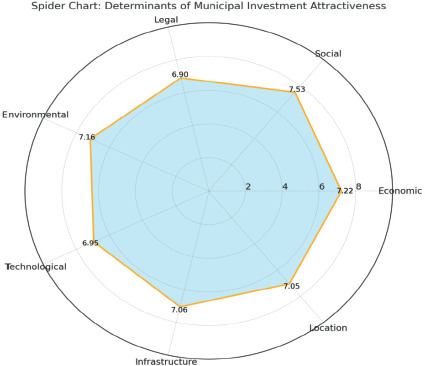
Based on the radar chart illustrating the average ratings for each group of factors determining the investment attractiveness of municipalities in the Świętokrzyskie Voivodeship, a clear differentiation in the weights assigned to the analyzed areas can be observed. The highest-rated factor was social factors (average: 7.53), demonstrating the growing importance of social stability, security, and civic engage-ment in investment decisions. This result indicates that local communities perceived as active, stable, and integrated can be a significant investment asset. Second in line was y factors environmental (7.16), which may be related to the growing importance of sustainable development and concern for the climate and quality of the natural environment. High scores for this group of factors suggest that municipalities offering favorable climatic and environmental conditions are becoming increasingly attractive for in-vestments, especially those in pro-ecological sectors. Economic factors (7.22) and infrastructure (7.06) also received high scores, confirming their fundamental importance in assessing the local investment climate. Economic stability and the availability of technical and transport infrastructure are key factors in selecting investment locations, especially in the manufacturing and logistics sectors.
Technological (6.95) and legal (6.90) determinants received slightly lower ratings. The high ranking of the technological component, which includes access to high-speed internet and e-government, indi-cates the growing value of digital transformation in the eyes of investors. Meanwhile, regulatory stabil-ity and institutional efficiency, despite a slightly lower average, continue to play a significant role, sug-gesting the need for further improvement in investor service quality and procedural simplification. The lowest, although still relatively high, score was obtained by location factors (7.05), which may indicate that despite the great importance of proximity to markets, cities or natural resources, these aspects are currently perceived as more „obvious” and not necessarily differentiating municipalities in a significant way (Figure 1).
Figure 1
Main factors of investment attractiveness of municipalities in the Świętokrzyskie Voivodeship
Source: own study.
Therefore, the investment attractiveness of municipalities is shaped by a number of diverse and in-terrelated factors. Modern investments require not only infrastructure and tax incentives but also a sta-ble and socially engaged environment. Such multidimensional analysis can serve as a basis for designing comprehensive local development strategies and profiling municipalities for attracting specific types of investments.
In order to identify detailed determinants with the greatest impact on the perceived investment attractiveness of municipalities in the Świętokrzyskie Voivodeship, a multiple regression analysis was conducted, in which the dependent variable was the assessment of the overall investment attractiveness of the municipality (measured on a 10-point scale), and the independent variables were the seven high-est-rated factors from different areas of analysis (social, economic, technological, institutional, environ-mental, infrastructural and location).
The analyzed regression model took the following form:
Where:
IA – Investment Attractiveness of region, β 0 – the expression constant e,
X 1 – civic activity (participation in local government elections),
X 2 – the level of economic development of the commune, X3 – climatic conditions,
X 4 – stability of legal regulations, X 5 – digital infrastructure,
X 6 – level of development of railway infrastructure,
X 7 – distance from water reservoirs.
Robustness tests were carried out to validate the regression model. Variance Inflation Factors (VIF) confirmed the absence of multicollinearity among independent variables (all values < 2.0). Residuals were tested for normality and homoscedasticity using the Jarque–Bera and Breusch–Pagan tests, respec-tively, showing no significant deviations. Additional sensitivity analyses confirmed that the estimated coefficients and explanatory power (adjusted R2) remained consistent across alternative model speci-fications, ensuring the robustness of the results. Results of model estimation are presented in the table below (Table 8).
Table 8
Results of estimation of parameters of equation (1)
The value of the estimated regression function was 13.24, which after normalization corresponds to a value of approximately 8.8 points on a 10-point scale, indicating a high assessment of the investment attractiveness of the communes meeting the above criteria.
Civic participation, as the variable with the highest regression coefficient, confirms the importance of social stability and resident engagement as a key signal for investors. Strong local democracy can be in-terpreted as an indicator of transparency, participation, and low institutional risk. The level of economic development, digital infrastructure , and legal stability form the macro- and microeconomic foundations of an attractive location. High coefficients on these variables indicate that investors value not only the current economic environment but also its predictability and capacity for long-term growth. Among the environmental and location factors, climatic conditions and proximity to water bodies stand out . De-spite their relatively lower coefficient values, they are particularly important for sectors dependent on the natural environment (tourism, agriculture, food industry). Rail infrastructure , although tradition-ally considered a factor supporting investment logistics, had a moderate impact in the discussed model, which may indicate a gradual shift in emphasis towards digital mobility and quality of life.
The dataset allowed for differentiation between rural, urban-rural, and urban communes, revealing distinct investment perception profiles. Rural communes emphasized infrastructure and EU fund ac-cessibility, urban-rural communes valued environmental and spatial factors, while urban communes fo-cused on digital infrastructure, governance, and innovation. When viewed from a Foreign Direct Invest-ment (FDI) perspective, EU-based investors prioritized institutional and regulatory stability, whereas non-EU investors were more responsive to fiscal incentives and administrative efficiency. These findings underline the necessity of tailoring local investment strategies to commune types and dominant investor origins.
Based on the analysis of factors influencing the investment attractiveness of municipalities in the Świętokrzyskie Voivodeship, the following recommendations were formulated for local government units in order to increase the investment attractiveness of municipalities:
Ensuring a stable and predictable legal and institutional environment. Local governments should strive for maximum transparency in administrative procedures and the stability of local legal reg-ulations. A high-quality institutional environment minimizes investment risk and strengthens the confidence of economic entities.
Development of critical infrastructure and spatial accessibility. Local governments should increase investment in transport infrastructure (with particular emphasis on railways and local roads), expan-sion of energy, water, and sewage networks, and ensuring the availability of investment areas with appropriate infrastructure.
Strengthening digitalization and supporting technological transformation. Developing digital infra-structure, including broadband internet and modern e-government services, is essential. At the same time, it is advisable to support local innovation ecosystems and create conditions for the develop-ment of research and development activities.
Increasing the human capital and competences of local communities. Municipalities should take steps to raise the education and qualifications of their residents, promoting civic engagement, and social integration. A high level of social and human capital fosters a sustainable investment climate.
Integrating development policy with environmental goals. Local governments should incorporate environmental protection, water management, waste management, and the use of renewable energy sources into their development policies. Concern for the quality of the natural environment strength-ens the region’s attractiveness for investments consistent with sustainable development principles.
Building a coherent investment promotion strategy. It is recommended to develop comprehensive economic promotion strategies for municipalities, based on the identification of local competitive ad-vantages and diversified communication tools with potential investors – both domestic and foreign.
Effective use of external funds. Municipalities should actively seek opportunities to obtain EU and na-tional funds for infrastructure development, entrepreneurship support, and administrative modern-ization. Public-private partnerships and networking with other local government units can further strengthen the implementation potential of investment initiatives.
Conclusion
The analysis allows us to draw a number of important conclusions regarding the factors determin-ing the investment attractiveness of municipalities in the Świętokrzyskie region. The results of the re-gression analysis indicate that the region’s investment attractiveness is most significantly influenced by civic engagement (β=0.30), the level of economic development (β=0.28), digital infrastructure (β=0.26) and legal stability (β=0.25). This clearly indicates that the investment climate is not only a function of economic factors but is increasingly dependent on the quality of social life, regulatory transparency, and modern infrastructure solutions. Environmental and location factors, although less dominant, remain important in the development of environmentally oriented industries and in building a positive image for the municipality. In particular, climatic conditions and proximity to water resources can provide a com-petitive advantage for sectors such as tourism, agriculture, and the green industry.
The applied research approach and multidimensional analysis allow for the formulation of practical recommendations for local decision-makers and institutions supporting regional development. Ultimate-ly, increasing the investment attractiveness of municipalities not only influences capital attraction but also contributes to the sustainable, balanced socio-economic development of the entire region.
The results indicate that an effective investment policy should be integrated, based on cooperation between various stakeholders, and take into account not only hard economic aspects but also soft so-cial and environmental conditions. It is recommended that local government units undertake actions to strengthen their competitive advantages, including by simplifying administrative procedures, support-ing innovation, developing e-services, and promoting local natural and cultural resources.
Declarations: There are no relevant financial or non-financial competing interests to report.
The research was financed by the Ministry of Education and Science under the program "Science for Society II" project number NdS-II/SP/0488/2024/01.