


Introduction
The current conditions of Ukraine’s national economic development are marked by a dual challenge: the need to counteract the consequences of war while simultaneously ensuring digital transformation as a key driver of competitiveness and regional resilience. The digitalisation of economic processes has long been recognised as a global trend, but for Ukraine, it takes on particular significance as a tool for adapting to crisis conditions, accelerating recovery, and creating new opportunities for businesses and society.
Russian military aggression has caused widespread infrastructure destruction, migration, and business relocation from hazardous areas to relatively safer regions. This places additional strain on host regions and exacerbates disparities in their levels of digital readiness. While some regions possess significant capabilities in digital technologies, developed IT clusters, and access to innovations, others require state support to build their digital potential. In such circumstances, the task of levelling digital transformation becomes particularly important, ensuring equitable access to digital services and resources regardless of territorial affiliation.
Studying the regional aspects of digital economic transformation during wartime helps us understand how digital tools can serve as mechanisms for integrating relocated businesses into new environments, supporting entrepreneurship, and stimulating economic activity in host communities. In this context, digitalisation not only enhances the efficiency of public administration and business processes but also becomes a crucial factor in social cohesion and regional resilience.
The working hypothesis of the study is the assumption that better provision of digital infrastructure and greater accessibility of electronic services enhance the digital attractiveness of a region and accelerate the pace of digitalisation, in particular through reducing barriers to interaction between business and the population and public authorities, lowering transaction costs, and expanding opportunities for the relocation and scaling of entrepreneurial activity in host communities.
Thus, the relevance of this topic lies in the need for a comprehensive analysis of regional differences in Ukraine’s digital transformation and the exploration of optimal ways to leverage digital technologies to address the challenges of wartime.
Analysis of recent research and publications
In academic literature, the issue of digital transformation in Ukraine’s regions and its significance for reconstruction and sustainable development is examined from various perspectives. In particular, Panchenko and Moroz (2025) explore the transformation of Ukrainian cities into smart regions, emphasising the importance of digital technologies in the context of post-war recovery. The authors highlight that the implementation of the “smart city” concept creates a foundation for enhancing governance efficiency, transparency, and investment attraction, which are pivotal factors for economic revival (Panchenko, Moroz, 2025). In the work of Ratushniak, Omelchuk, Horbovyy, Hladchenko, and Vyshemirska (2024), an analysis of the Digital Economy and Society Index (DESI) is presented as a key tool for assessing the level of digital transformation in EU countries. This study holds significant relevance for Ukraine, as it enables comparative analysis and the establishment of developmental benchmarks, taking into account European experience in digitalization (Panchenko et al., 2024). The OECD (2024) examines digital business transformation as a means to bolster the resilience of Ukraine’s economy. The report underscores that the active adoption of digital technologies can mitigate risks posed by wartime challenges while laying the groundwork for innovative development (OECD, 2024).
The analysis by Antonova, Seryogin, Litvinov, and Krivenkova (2023) focuses on studying the digital transformation of the public sector. The authors demonstrate that the digitalisation of government bodies and partnership mechanisms at the regional level serves as a prerequisite for creating a conducive environment for business and community development (Antonova et al., 2023). The issue of defining the essence and content of digital transformation in regions is addressed in Zahriichuk’s article (2020). The author attempts to formulate a conceptual framework for digitalisation at the regional level, which is crucial for subsequent applied research and practical implementation (Zahriichuk, 2020). Kizlyar (2024) stresses regional digital transformation as a precondition for implementing the “smart city” concept. The article highlights that regional-level digitalisation determines the potential for effective urban system management and improving the quality of life for the population (Kizlyar, 2024). Kornaha (2025) analyses the evolution of state mechanisms for regional governance in the context of digital transformation. The study emphasises that digital tools facilitate the modernisation of governance processes, making them more transparent and outcome-driven (Kornaha, 2025).
In the International Telecommunication Union (2025) report Ukraine: Digital Development Country Profile, a systematic analysis of Ukraine’s digital development is presented [8]. The report covers key aspects of digital infrastructure development, services, and digital skills, enabling an assessment of the country’s current status and outlining prospects for integration into the global digital space (International Telecommunication Union, 2025). Konovalenko and Chernenko (2025) examine regional development in the context of digitalisation, focusing on the transformation of traditional economic processes and the emergence of new opportunities for business and innovative activity (Konovalenko and Chernenko, 2025). Dziura and Magdich (2024) analyse trends in Ukraine’s digitalisation from a European perspective, highlighting societal and business expectations. The study underscores that for Ukraine, it is not only the adoption of modern digital technologies that matters but also their harmonisation with EU standards and practices (Dziura, Magdich, 2024).
Summarising the aforementioned studies, it can be concluded that digital transformation is viewed as a comprehensive process encompassing the modernisation of public administration, business development, integration into the European digital space, and the creation of smart regions. Scholars and international organisations stress that digitalisation is a key factor in Ukraine’s recovery and long-term competitiveness.
Objective
At present, a pressing task for scientific research is to determine the regional aspects of the digital transformation of Ukraine’s economy amid full-scale military aggression, which necessitates the adaptation of development strategies to new challenges. In light of this, the objective of this article is to assess the peculiarities of the digital modernisation of Ukraine’s regions, taking into account the impact of business relocations during the war and the need to establish effective mechanisms for supporting economic resilience at the local level.
Results of the Study
In 2023-2024, Ukraine has demonstrated significant progress in the development of the IT sector and digital infrastructure, as evidenced by several international rankings (IT Ukraine Association, 2023; 2024). According to Coursera’s Global Skills Report, the technological skill level of Ukrainian professionals reached 76% of the maximum score, indicating a high level of expertise in IT, programming, and cloud technologies (IT Ukraine Association, 2024). This makes the country competitive on the global labour market.
In the Network Readiness Index, Ukraine scored 55.3 out of 100, reflecting an average level of readiness regarding digital infrastructure and actual technology implementation. Meanwhile, in the ICT Development Index, the country achieved a score of 81 out of 100, demonstrating active access to digital technologies and the development of digital skills among the population (IT Ukraine Association, 2024).
According to the Global Startup Ecosystem Index, Ukraine ranked 46th among 119 countries, confirming its growing role as a regional hub for innovative startups. Furthermore, in the field of public digital services, Ukraine shows even stronger results. In the E-Government Development Index, the country scored 0.88 out of 1.0, signifying substantial progress in the development of online services, digital literacy, and state infrastructure. Particularly impressive is the Open Data in Europe indicator, where Ukraine achieved 97% of the maximum level, underscoring its leadership in government data transparency and open governance (IT Ukraine Association, 2024).
Thus, an analysis of the data indicates that in 2024, Ukraine is solidifying its status as a powerful IT centre with high human capital, actively developing digital infrastructure, and fostering a conducive environment for startups. However, achieving even higher results will require strengthening network readiness and implementing modern digital solutions across all sectors of the economy and in every region of Ukraine.
Digitalisation of the regions is one of the key components of Ukraine’s digital transformation. Digitalisation is essential for providing quality medical, educational, social, administrative, and other public services, ensuring access to mobile communication and fixed internet – particularly critical during wartime – and enhancing cybersecurity levels and the functioning of critical infrastructure overall. The regions and communities are key players in driving digital and technological changes, shaping a new decade for digital Ukraine and bolstering its competitiveness on the international stage.
To evaluate the level of digital transformation across Ukraine’s regions, an integrated index was calculated, reflecting the state and dynamics of digital technology adoption in various socio-economic spheres (Ministry of Digital Transformation of Ukraine, 2024). The methodology for constructing the index incorporates several sub-indices, including: regional conditions and quality, institutional environment, infrastructure development, implementation of digital services, digital education, regional distinctions in digitalisation, industrial business clusters, sectoral digital transformation, and the intensity of innovation projects. Each sub-index reflects a specific aspect of a region’s digital maturity, and their combination provides a comprehensive picture of the digital readiness and adaptability of Ukraine’s regional economies.
Table 1 presents the sub-indices of digital transformation for Ukraine’s 23 regions, enabling a comparative analysis of territorial differences in the pace and outcomes of digitalisation. This provides a foundation for formulating regional digital transformation strategies and identifying priority areas for state policy in the realm of digital development (Ministry of Digital Transformation of Ukraine, 2024).
Table 1
Sub-Indices of Digital Transformation Across Ukraine’s Regions
[i] Source: compiled by the authors based on (National Institute for Strategic Studies, 2022).
To assess the interconnections between key indicators of the digital transformation of Ukraine’s regions, we constructed a correlation matrix (Figure 1) based on Table 1. This matrix reflects the degree of interdependence between the development of institutional capacity, digital services, e-governance, digital education, and other components that shape the digital ecosystem of the regions. The obtained results allow us to identify the strongest interconnections between the processes of digital transformation and determine the areas that require additional support and integration.
Figure 1
Correlation Matrix of Digital Transformation Indicators Across Regions
Source: compiled by the authors.
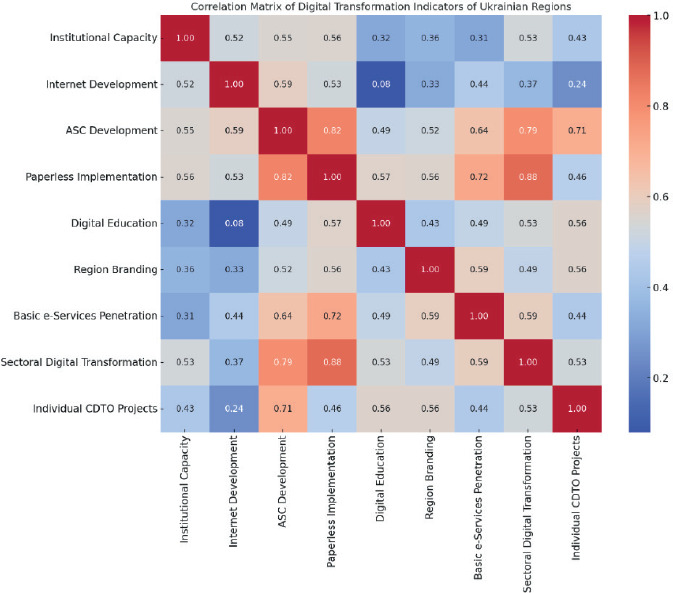
From Figure 1, it is evident that the sub-indices of ASC Development (Administrative Service Centres, or ASCs) and Paperless Implementation exhibit a very high correlation (0.82). This is logical, as the implementation of «paperless» processes directly depends on the development of Administrative Service Centres. The sub-indices of Paperless Implementation and Sectoral Digital Transformation are also strongly correlated (0.88), since digitalisation of sectors is unfeasible without transitioning to a paperless model. The sub-indices of ASC Development and Sectoral Digital Transformation demonstrate a correlation of 0.79, confirming the role of Administrative Service Centres as a foundation for digital transformation.
The Basic e-Services Penetration sub-index shows moderate correlation with ASC Development (0.64) and Paperless Implementation (0.72), indicating that the more effective the Administrative Service Centres and the implementation of «paperless» policies, the more widespread electronic services become. The Digital Education sub-index exhibits medium correlation with all other indicators (0.4-0.56), though not critically high. This suggests that education is important but not always directly linked to other elements of transformation.
The Internet Development sub-index has relatively weaker correlations (0.24-0.59). While the internet serves as fundamental infrastructure, its presence alone does not guarantee digital transformation. Institutional Capacity is well-correlated with Paperless Implementation (0.56) and Sectoral Digital Transformation (0.53), highlighting the stimulating impact of strong institutions on digital reforms. The Individual CDTO (Chief Digital Transformation Officer) Projects sub-index shows medium correlation (0.43-0.71) with most indicators, suggesting that these projects enhance transformation but are not key drivers.
The most critical factors in the digital transformation of Ukraine’s regions are the Development of ASCs, Paperless Implementation, and Sectoral Digital Transformation, as they are most strongly interconnected and correlate with other indicators. The internet and digital education are important, but their influence is more indirect. Institutional Capacity remains the cornerstone for systemic change, as sustainable digital transformation cannot be achieved without robust institutional capacity. Within the framework of the present study, the institutional component of digital transformation is considered not merely as the ‘presence of formal decisions’, but as the measurable institutional capacity of a region to ensure the sustainable implementation of digital changes. Such an approach corresponds to the practice widely used in applied economics of quantitatively describing institutions, whereby institutional potential is interpreted through the existence and maturity of organisational mechanisms, programmes, and responsible structures that ensure policy implementation. At the same time, in order to avoid excessive simplification of institutional analysis, the article emphasises that the formal presence of institutional ‘attributes’ is a necessary but insufficient condition, and the estimates obtained primarily reflect the readiness and governability of digital transformation processes at the regional and local levels.
The relocation of businesses in the context of full-scale military aggression and modern economic turbulence takes on particular significance as a strategic tool for adapting businesses to new challenges (National Institute for Strategic Studies, 2022). In the current reality, business relocation is viewed not only as a means of ensuring operational continuity but also as a critically important factor in guaranteeing personnel safety, preserving capital, and maintaining production capacities. Amid full-scale warfare, relocation emerges as a form of dynamic economic system transformation aimed at reducing entropy, preserving the structural integrity of enterprises, and creating conditions for their future development and post-war recovery.
The Ukrainian Government launched its Enterprise Relocation Programme (hereafter referred to as the Programme) in mid-March 2022 to sustain the country’s economic resilience amid full-scale war (National Institute for Strategic Studies, 2022). The essence of the Programme lies in relocating businesses from areas near or directly within conflict zones to safer regions in western Ukraine. This approach ensures the continuity of production processes, preserves jobs, and lays the groundwork for post-war economic recovery.
As of mid-2022, businesses could relocate to nine regions: Zakarpattia, Lviv, Ivano-Frankivsk, Ternopil, Khmelnytskyi, Chernivtsi, Vinnytsia, and the southern territories of Volyn and Rivne regions. The primary carrier under the Programme is JSC Ukrzaliznytsia (Ukrainian Railways), which facilitates the transportation of equipment and personnel. Simultaneously, JSC Ukrposhta (Ukrainian Post) handles the delivery of production capacities to railway stations and acts as an operator, assisting with checkpoint procedures and document processing. This enables businesses to offset part of their transportation costs, a crucial element of state support.
The regulatory framework for implementing the Programme is outlined in Resolution No. 305 of the Cabinet of Ministers of Ukraine, dated 17 March 2022, titled «On Specific Features of the Operation of JSC Ukrposhta Under Martial Law.» It provides for the free transportation of property belonging to enterprises, institutions, and organisations according to a list compiled by the Ministry of Economy and submitted to the Ministry of Infrastructure. Additionally, Resolution No. 246-r of the Cabinet of Ministers, dated 25 March 2022, «On Approving the Action Plan for Urgent Measures to Relocate Production Capacities of Businesses,» establishes a step-by-step plan for relocating enterprises to safer regions.
The Programme encompasses comprehensive state assistance, extending beyond the transportation of production capacities to include finding new premises for relocated businesses, transporting and resettling personnel, and recruiting new staff in relocation areas. To streamline communication among all participants, a special digital interaction platform has been created using the ProZorro.Sales system and the accredited E-Tender platform, simplifying information exchange and coordination of actions.
The western regions, located far from the front lines, have become active participants in the Programme. Competition has even arisen between regions for the right to host relocated businesses. In particular, the most active participants are Lviv, Chernivtsi, Zakarpattia, and Ternopil regions. Despite the fact that companies continue to pay taxes at their primary place of registration, efforts to integrate them into new regions bring a range of positive effects. This facilitates employment for the local population and internally displaced persons, fosters business connections, and promotes the exchange of experience among entrepreneurs. At the same time, the implementation of such initiatives enhances the investment attractiveness of the regions, improves their business climate, and creates comfortable living and working conditions.
It was precisely in 2022, following the full-scale invasion, that the most significant wave of business relocation began. As of 12 May 2022, within the framework of the Programme, 510 enterprises had relocated their operations, of which 303 had already resumed activities in their new locations. Approximately 50 enterprises were in the process of installing equipment and connecting utilities, while another 192 were preparing to relocate. The leaders in hosting relocated companies were Lviv, Chernivtsi, and Zakarpattia regions. Among the relocating enterprises, the largest share represented the food, light, chemical, metalworking, and woodworking industries. It is also significant that IT-sector companies were among those relocated, underscoring the relevance and importance of the digital economy even amidst wartime conditions (National Institute for Strategic Studies, 2022).
Regions hosting relocated enterprises are introducing additional support mechanisms. For instance, in Lviv region, a financial aid programme for businesses is in operation, under which enterprises receive 100,000 hryvnias on the condition of re-registration, along with an additional 100,000 hryvnias if they create at least 20 new jobs. In Zakarpattia, environmental aspects of business operations are taken into account when reviewing applications. The creation of eco-industrial parks has been identified as a promising direction, which could become new growth points for the regional economy. Additionally, Zakarpattia region is actively facilitating the formation of an IT cluster, providing companies with office spaces, co-working facilities, internet access, and tax advisory services.
Effective communication is also a crucial factor: special chatbots and Telegram channels have been created to facilitate interaction. In Lviv, Khmelnytskyi and Zakarpattia regions, these tools help businesses quickly find available premises for storage or rent and coordinate collaboration with local communities. The „Diia.Business” Entrepreneur Support Centre in Uzhhorod provides consultations on business relocation, staff recruitment, and production launches. In Rivne Region, a Centre for Economic Development and Business Relocation has been established, while in Zakarpattia, the Agency for Regional Development and Cross-Border Cooperation has been engaged in the process.
In addition to organisational measures, the Programme relies on a range of legislative and financial instruments. Ukrainian Law No. 2181-IX „On Amendments to the Law of Ukraine ‚On the Lease of State and Municipal Property’” establishes special lease terms during martial law. The State Employment Service assists businesses with staffing issues, while the State Labour Service of Ukraine provides advisory support on labour legislation. Moreover, grant programmes supporting small and medium-sized businesses are in operation, including „EU4Business: Competitiveness and Internationalisation of SMEs,” funded by the EU and the German government and implemented in cooperation with Deutsche Gesellschaft für Internationale Zusammenarbeit (GIZ) GmbH – the German Society for International Cooperation.
Thus, the Enterprise Relocation Programme has proven to be an effective mechanism for supporting Ukraine’s economy during wartime. It combines state regulation, infrastructure solutions, and financial incentives, enabling job preservation, fostering development in safe regions, and laying the groundwork for the country’s rapid recovery after the cessation of hostilities.
An analysis of the factors that most significantly impacted business operations following relocation reveals that the challenges are multifaceted – ranging from logistics and supply chain issues to cultural differences and legislative barriers (Fig. 2). However, a significant proportion of these challenges are either directly or indirectly linked to an insufficient level of digital transformation within enterprises.
Figure 2
Impact of Factors on Relocated Business Operations (in %)
Source: compiled by the authors based on (Polishchuk, Gernego, & Horbov, 2025).
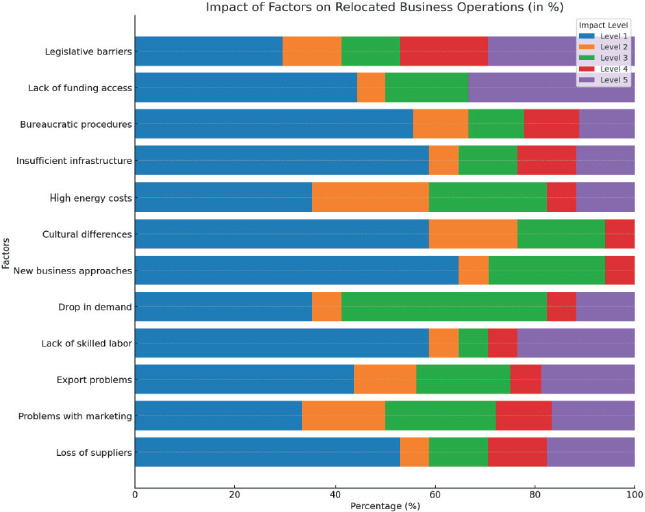
Firstly, problems related to sales and the export of products/services (33.33% and 43.75%, respectively) in today’s environment are heavily reliant on digital channels for promotion, e-commerce, online platforms for export, and B2B communication. An inadequate level of digital presence significantly complicates a business’s adaptation to new markets.
Secondly, high energy costs (58.82%) and insufficient infrastructure (35.29%) can be partially mitigated through digital solutions aimed at energy efficiency, resource consumption monitoring, and production process optimisation. In this context, the absence of appropriate digital tools exacerbates the problem.
Thirdly, excessive bureaucratic procedures (55.56%) and legislative barriers (29.41%) are also closely tied to the level of digitalisation. The development of electronic document management, digital registries, and e-government services could reduce the administrative burden on businesses and streamline their operations in a new region.
Fourthly, limited access to financing (44.44%) is now largely dependent on digital financial services, online lending platforms, crowdfunding, or digital banking products. Insufficient integration of businesses into the fintech ecosystem restricts their ability to attract capital.
The scatter plot showing the average impact of factors influencing business relocation is presented in Figure 2.
From Figure 3, it can be observed that the issues most closely associated with insufficient digital transformation are as follows: bureaucratic procedures and legislative barriers (1); lack of access to financing (2); problems with sales and export of products/services (3); and a reduction in demand for products (4).
Figure 3
Scatterplot of the average influence of factors affecting business relocation
Source: compiled by the authors based on (Polishchuk, Gernego, & Horbov, 2025).
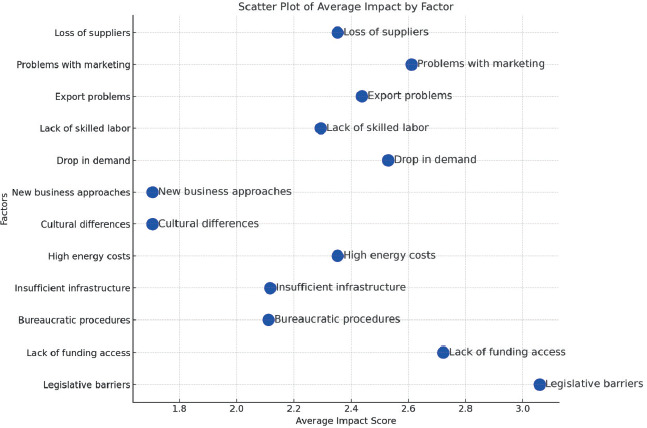
Thus, a weak level of digital transformation reduces business flexibility, limits its adaptive capacity after relocation, and exacerbates a range of traditional challenges, which could have been partially mitigated during wartime through the use of digital technologies.
Table 1 and Figure 1 illustrate the Digital Transformation Index of Ukrainian regions in the form of sub-indices: institutional capacity, internet development, development of ASCs, implementation of paperless processes, digital education, regional branding, penetration of basic e-services, sectoral digital transformation, and individual Chief Digital Transformation Officer (CDTO) projects. When considering these sub-indices from the perspective of the Business Relocation Programme, the most critical ones turn out to be those that directly impact the investment climate, business environment, and the ability to quickly restore or establish operations after relocation.
The most critically important factors are internet development, institutional capacity, development of ASCs, and the penetration of basic e-services. A stable and high-quality internet connection is a fundamental requirement for the operation of modern businesses, especially innovative and IT-oriented companies. Regions with high scores in this indicator – such as Poltava (0.798), Lviv (0.766), and Kyiv (0.863) – gain significant advantages in attracting businesses reliant on online services. The penetration of basic e-services demonstrates the ability to quickly register, file reports, obtain permits, and communicate with the government. High scores in the Kyiv (0.875), Lviv (0.968), and Kharkiv (0.982) regions indicate the minimisation of bureaucratic barriers and better conditions for conducting business. Institutional capacity reflects the readiness of regional authorities to support digitalisation and innovation. The Dnipropetrovsk (0.897), Lviv (0.854), and Poltava (0.937) regions show the highest capacity in this regard, creating a more favourable environment for businesses. The development of ASCs is of critical importance for businesses that need to quickly integrate into a new region by obtaining permits, licences, and documents. Notable performers in this area include the Poltava (0.953), Dnipropetrovsk (0.811), and Lviv (0.818) regions.
Of secondary but still significant importance are sectoral digital transformation and individual CDTO projects. Sectoral digital transformation reflects the degree of integration of digital solutions into key sectors of the regional economy. For manufacturing and agricultural companies, this factor serves as an additional incentive for relocation. High scores are observed in the Kharkiv (0.553), Kyiv (0.524), and Poltava (0.469) regions. Individual CDTO projects, which reflect specific digital transformation initiatives, may serve as a stimulating factor for certain business sectors. The most notable results in this area are seen in the Lviv and Dnipropetrovsk regions (0.882).
Less critical for immediate relocation are digital education, regional branding, and the implementation of paperless processes. Digital education has more of a long-term impact on workforce provision rather than facilitating quick business relocation. Regional branding is important for shaping the region’s image, developing tourism, or implementing reputation-building projects, but it is not a decisive factor for relocation. The implementation of paperless processes is significant for optimising document flow; however, this indicator partially overlaps with sub-indices related to ASCs and e-services.
It is also appropriate to emphasise separately that, in view of the recorded threefold increase in cyberattacks, regional digital policy should include a mandatory minimum standard of cybersecurity for public authorities and businesses (MFA, 3-2-1 backup scheme, regular updates/patch management, network segmentation, and EDR/antivirus). For relocating companies, practical steps to minimise risks include a rapid cyber audit during relocation, staff training in phishing prevention, the use of VPN/Zero Trust access, and the deployment of an incident response plan with clearly defined responsibilities and contacts of regional CERTs/cyber units.
For regions with a medium level of digital transformation, it is advisable to introduce a package of rapid enhancement measures to increase digital attractiveness: to accelerate the development of internet infrastructure and the redundancy of communications/power supply for businesses, as well as to modernise Administrative Service Centres and transition to paperless document management on a ‘single window’ principle for entrepreneurs and relocated companies. In parallel, institutional capacity should be strengthened through the active role of the CDTO/digital office of the region, KPIs for basic e-services, and regular monitoring of index indicators in order to reduce the transaction costs of interaction between business and public authorities. Taken together, this will enable medium-level regions to quickly improve critical sub-indices and compete for business not only on the basis of security, but also in terms of the quality of the digital environment.
Within the framework of rapid relocation, companies primarily focus on the ‘hard’ factors of a region’s immediate suitability – uninterrupted communications and power supply, the availability of basic e-services, logistics, and security conditions – whereas digital education and branding have a more delayed effect. Digital training shapes human capital in the medium term, while relocated businesses typically either bring their key teams with them or address labour shortages remotely; therefore, this factor does not become decisive in the first months. Regional branding also yields to operational criteria due to the high uncertainty of wartime, although it can strengthen a region’s competitive advantages at the stage of business consolidation and the attraction of new investment after initial adaptation.
Thus, for successful business relocation, the most crucial sub-indices are internet development, institutional capacity, development of ASCs, and the penetration of basic e-services. These factors guarantee quick access to administrative procedures, effective communication with authorities, continuity of business processes, and quality digital infrastructure. At the same time, sectoral digital transformation and individual CDTO projects play a strategic role for specific industries and long-term development, while digital education, regional branding, and the implementation of paperless processes remain important but secondary factors.
Results of the study
The conducted research has demonstrated that digital transformation, in the context of full-scale military aggression, serves not only as a tool for economic modernisation but also as a means of survival for individual regions and business structures in Ukraine. Analysis of regional disparities revealed significant unevenness in the development of digital infrastructure. For instance, according to 2024 data, internet coverage in the Kyiv, Lviv, and Dnipropetrovsk regions exceeds 85%, whereas in most eastern and southern regions, this figure fluctuates between 55% and 65%. This directly impacts businesses’ ability to integrate digital technologies into their operations.
A notable trend has been the mass relocation of businesses from frontline territories to central and western regions. Between 2022 and 2023 alone, over 700 companies officially moved their production facilities, with more than 200 relocating to the Lviv and Zakarpattia regions. This has placed additional strain on local infrastructure while simultaneously driving the development of digital services in logistics, finance, and communications. Thus, digitalisation has become a factor in balancing regional disparities and an instrument for integrating displaced enterprises into new economic conditions.
Nationwide programmes, such as «Diia,» have contributed to improved access to digital services. In 2024, approximately 19 million Ukrainians actively used the app, representing over 70% of the adult population. However, levels of digital literacy remain varied: surveys indicate that in rural communities, the proportion of people who confidently use electronic services does not exceed 40%, whereas in urban areas, this figure reaches 65-70%. This underscores the need for targeted educational initiatives to ensure inclusivity in the digital economy.
The economic effects of digitalisation have manifested in increased resilience among small and medium-sized businesses. According to analysis results, companies that adopted e-commerce and online payment systems demonstrated recovery rates 20-25% higher than those that remained reliant on traditional business models. This highlights that digital transformation has become a key factor in business adaptation to wartime conditions.
Nevertheless, significant challenges persist. Firstly, restoring digital infrastructure in affected regions requires substantial investment – estimated at $1.5-2 billion USD. Secondly, inequality in access to digital technologies threatens to exacerbate regional imbalances unless mechanisms for state support and international technical assistance are introduced. Thirdly, cybersecurity has taken on critical importance, as the number of cyberattacks on state resources has more than tripled since the onset of the full-scale invasion.
Thus, it can be concluded that digital transformation in Ukraine during the period of full-scale war has become a strategic resource, determining the competitiveness of regions, facilitating the integration of displaced businesses, and providing innovative pathways for economic recovery. Further progress will require systematic state policies aimed at levelling regional opportunities, investing in digital infrastructure, and fostering a culture of safe and widespread use of digital services. This will form the foundation for long-term economic resilience and Ukraine’s integration into the global digital space.