


1. Introduction
The modern economy, shaped by the dynamic processes of globalisation and digital transformation, presents companies with numerous challenges related to the effective management of logistics processes. One of the key areas directly affecting the operational efficiency of an organisation is warehouse management, whose role has significantly increased in an era of growing customer expectations and intense competition in international markets. Therefore, the issue of optimising warehouse processes, and in particular order picking, which has a direct impact on order fulfilment time and customer service levels, is of particular importance.
In the era of ubiquitous digitisation and the development of tools supporting logistics operations management, the use of simulation modelling as a method to support operational, tactical, and strategic decision-making is becoming increasingly popular. This method allows complex warehouse processes to be mapped in a virtual environment, enabling the analysis of various scenarios and the identification of optimal solutions without interfering with the actual system.
The aim of this article is to present the possibilities and effectiveness of using simulation modelling in the context of optimising warehouse inventory distribution and order picking process organisation. The analysis is based on a case study of an international logistics company with a branch located in Łódź, specialising in, among other things, value-added services (VAS), e-commerce services, and procurement process support. Due to the wide range of services offered and the large number of warehouse units, the company encounters difficulties in the effective management of warehouse space and work organisation.
The article presents an approach based on the use of a low-abstraction simulation model that allows for detailed mapping of the operational processes taking place in the warehouse. Particular emphasis was placed on analysing the impact of goods placement and forklift traffic organisation on order picking time. The simulation results are presented in the form of 3D visualisations, interactive dashboards, and tabular comparisons of results for selected scenarios. This approach allows for the identification of optimal operational solutions that can be implemented in the analysed company, contributing to an increase in its operational efficiency and market competitiveness.
2. Literature review
In the era of digital transformation, inventory and warehouse process management is becoming one of the key areas determining a company’s competitiveness. Globalisation, market unpredictability, and growing customer demands are forcing organisations to implement tools that enable flexible and precise planning and control of material flows. In this context, modern analytical and simulation methods that enable the modelling and optimisation of operational processes, including order picking in the warehouse, are of particular importance.
Inventories are a fundamental component of logistics systems and serve as a buffer that compensates for differences between supply and demand (Dudziński and Kizera, 2002). The classification of inventory includes various types, such as standard, reserve, available, and seasonal inventory. Proper management of inventory is essential to ensure continuity of production and customer service (Zimon, 2012). Inventories should be analysed in terms of their quantity, economic value, and the risk associated with their expiration or excessive accumulation (Sterman, 2000). Inventory management is defined by APICS as an area of business management that focuses on planning, controlling, and monitoring inventory levels (Toomey, 2000). One of the most important challenges in this area is demand forecasting, which is inherently fraught with a high degree of uncertainty. Inventory management models, such as the reorder point system or the review system, assume different replenishment strategies based on historical data, seasonality, and demand variability (Skowronek and Sarjusz-Wolski, 1995).
Nowadays, inventory management increasingly uses analyses based on ABC/XYZ classifications, which enable the segmentation of the product range according to turnover value and demand predictability (Staniec and Stajuda, 2012). This approach allows the inventory level to be adjusted to the importance of a given product from the point of view of logistics strategy. ABC classification is based on the Pareto principle, indicating that a small part of the assortment accounts for most of the warehouse value. XYZ classification, on the other hand, takes into account the variability of demand – from stable, predictable class X goods to goods with high consumption uncertainty (class Z). Combining both classifications in an ABC/XYZ matrix allows for more effective inventory control and selection of appropriate forecasting and replenishment methods (Kaczorowska et al., 2019). One of the key aspects of warehouse management is the organisation of the order picking process. High operational complexity, a large number of SKUs (Stock Keeping Units), and time pressure require continuous improvement of warehouse space organisation and goods movement. The efficiency of this process directly affects the level of customer service, order fulfilment time, and operating costs (Tarczyński, 2016). Warehouse processes, such as goods receipt, storage, picking, and release, should be planned in an integrated and optimal manner using modern data management tools and technical infrastructure (Bartosiewicz, 2017; Szymonik and Chudzik, 2018).
Modern logistics management requires tools that allow different operational scenarios to be tested without risk to the functioning system. Simulation modelling makes it possible to map real processes in a digital environment and conduct experiments to identify optimal solutions (ten Hompel and Schmidt, 2007). Simulations based on discrete event models (DES) allow for detailed analysis of operational processes, including the detection of bottlenecks, assessment of the impact of organisational changes, and testing of resource allocation variants (Šaderová et al., 2018). The advantages of simulation modelling are particularly evident in complex warehouse systems, where not only the spatial location of inventory is important but also the paths of forklifts, the time required to complete individual operations, and the interactions between different elements of the system. Models of this type can take into account real data, such as order distribution, warehouse configuration, and the number of operators. Importantly, simulation results can be presented in graphical form (e.g. 3D visualisations), KPIs (Key Performance Indicators), and comparative scenario reports, which supports managerial decision-making (Halusiak and Uciński, 2013).
Dynamic changes in the environment, such as the COVID-19 pandemic, wars, cyberattacks, and volatility in Asian markets, have exposed the limitations of traditional inventory management concepts, including the just-in-time philosophy (Davis and Inajima, 2021; Ivanov et al., 2017). Companies were forced to change their strategies and diversify their sources of supply and create safety stocks. The need to adapt and respond quickly to changing conditions has made simulation modelling increasingly important as a tool for predicting the effects of operational decisions in an unstable environment (Shih, 2020).
In light of the literature presented, the use of simulation modelling in the analysis and optimisation of warehouse processes is justified. This approach is particularly valuable for companies operating in multiple markets, offering a wide range of services and having a complex logistics structure. Simulation not only enables the optimisation of warehouse operations but also provides a foundation for further automation and digitisation of management processes.
3. Research methodology
The subject of the research was the optimisation of inventory distribution in an international supply chain support company. The research objective was to examine the possibilities of improving order picking times, improving the use of transport resources, and reducing the workload of employees based on a warehouse simulation model. Emphasis was placed on material flow and inventory structure in order to examine the processes actually taking place in the company and to propose rational ways of inventory management.
The study used methodological triangulation, employing three complementary research methods: literature analysis and critique, case study, and computer simulation. The use of these methods made it possible to examine the topic from a theoretical perspective, learn about the company’s case, and achieve the research objective.
Due to the need to accurately map warehouse space and inventory management processes, a low level of abstraction was used, focusing on a narrow scope in the most accurate way possible. The discrete event modelling method was used, which made it possible to focus on the process flow, the impact of individual activities on the operation of the system, and the identification of system bottlenecks.
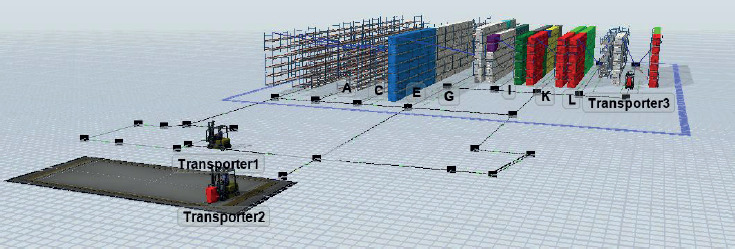
The simulation model was built using Flex-Sim, a dedicated environment for modelling logistics, warehousing, and production processes. The following were modelled: the initial location of goods in the warehouse, the movement of forklifts within the warehouse, and the picking of goods based on picking lists created on the basis of sales orders. The input data for the model included: warehouse stocks, actual picking lists, the number and dimensions of racks, transport route lengths, the number of forklifts, and the time required for loading and unloading goods.
4. Research results
As part of the research objective, 15 simulation scenarios were defined and carried out, differing in the way goods were placed in the warehouse. Each scenario was configured with identical input parameters to ensure comparability of results.
The model’s parameter assumptions included: continuous warehouse operation, fork-lift operation without breakdowns or interruptions, a constant forklift speed of 2 km/h, a loading time of 15 seconds, unloading time of 10 seconds, forklifting speed of 0.62 m/s, and maximum transport capacity of the forklift of 16 boxes. Stocks were generated during the first 180 seconds of the simulation at a frequency of 10 seconds, and the first picking order appeared at 1,800 seconds with subsequent orders every 100 seconds.
The 15 scenarios designed differed in terms of the logic of stock placement. Their impact on the average picking time, minimum and maximum order fulfilment time, as well as resource utilisation (in particular forklifts) was assessed. The stability of the system, understood as fluctuations in fulfilment times and standard deviations, was also analysed. The experiments used ABC classification according to the frequency of occurrence of a given product in picking lists, classification by product groups, random placement, and hybrid solutions (e.g. ABC with priority for specific groups).
Based on the data presented in Tables 1-3, there are significant differences in the effectiveness of different placement strategies. The scenario based on ABC classification according to the number of pickings was characterised by the lowest average order fulfilment time – 251 seconds – and a relatively low standard deviation. This means high predictability and repeatability of the process, which is crucial from the point of view of operational logistics. Compared to random placement, the average time was reduced by almost 100 seconds, which, with 530 orders, results in a total savings of over 14 hours of work.
Table 1
Matrix of average order picking time [s]
Table 2
Minimum order fulfilment time matrix [s]
Table 3
Matrix of maximum order picking time [s]
It is also worth noting the scenario currently being implemented by the company – based on manual placement by operators. Here, a result of 268 seconds was achieved, which also proved to be better than the baseline placement but still less effective than the scenarios planned by the system using ABC rules. This means that the intuitive practice of employees does not ensure maximum efficiency, even though it is not based solely on randomness.
Equally important from the point of view of work organisation are the maximum values and variability of completion times. In the random scenario, the highest maximum time (over 1,500 seconds) was observed, which is more than three times higher than the values recorded in the best scenarios. In practice, this may mean congestion, excessive movement of trucks, and operational inefficiency at peak times. In contrast, in the ABC scenarios, the maximum values do not exceed 470 seconds, which indicates much better warehouse space planning and more efficient work organisation.
For the minimum order fulfilment time, the shortest picking time was achieved in the variant of random placement of goods divided into groups (176 s). This means that when the goods are well located, and there is not a large amount of goods to pick, random placement can be helpful, especially in the case of urgent goods. The worst minimum picking time (238 s) was achieved in the variant of sorting goods by ABC category according to picking volume.
The analysis of maximum order fulfilment times showed that the most stable configurations were those in which the average time was also the lowest. The longest picking time (1,517 s) was observed in the configuration with completely random storage location allocation. The results indicate that for large orders, close proximity between products is crucial for efficient picking.
The experiments showed that the current system of stock allocation by product group is inefficient. In none of the categories studied did it rank among the top 5 configurations. In the most important indicator for the company – average picking time – the currently implemented system ranked 7th among the 15 configurations studied.
The simulation model also provided information on resource utilisation. It was shown that some scenarios led to excessive operator workload, which could have a negative impact on productivity. Analysis of the paths and working time of the trucks showed that the distribution of inventory significantly affects their workload. In disordered scenarios, operators travelled longer distances, which not only increased picking time but also generated the risk of collisions and employee fatigue. In contrast, in the ABC scenario optimised for order frequency, the forklifts worked more evenly and with fewer empty runs. The results clearly indicate that the use of ABC classification based on the number of pickings ensures the highest operational efficiency.
The analysis showed that the optimal placement of goods in the warehouse according to ABC categories based on the number of pickings is 6% more efficient than the currently used system. Over the course of just 530 pickings, this would save 2.5 hours of work. Extrapolating the results on an annual basis (approximately 37,000 pickings), a different arrangement of goods would save almost 175 hours of work, which is more than one full-time position.
5. Discussion of results
The conclusions drawn from the study are practical and applicable. First of all, it should be noted that the implementation of a goods placement strategy based on ABC classification according to the number of pickings brings the greatest time benefits. This type of approach can be easily implemented using WMS tools and historical order analysis. It is also worth noting that simulation allows solutions to be tested before their physical implementation, which reduces the risk of failure and allows for early detection of system bottlenecks.
The results of the study confirm the importance of strategic inventory placement in the warehouse for the efficiency of picking processes. The demonstrated 6% improvement in efficiency through the use of ABC classification according to picking frequency is consistent with classic warehouse management principles, where high-turn-over products should be placed in the most easily accessible areas. The research results are consistent with the concepts of Bartosiewicz (2017), who points out that uncontrolled placement of goods generates operational chaos and increases picking costs. The use of ABC classification – commonly recommended in inventory management (Staniec & Stajuda, 2012) – has been empirically confirmed as an effective optimisation tool.
Another interesting finding was that random distribution can generate short times for small orders, which is consistent with Ivanov’s (2017) observation that resilient systems must allow for flexibility in unusual situations.
It is particularly important to note that random placement of goods leads to a dramatic increase in maximum picking times (up to 1,517 seconds), confirming the crucial importance of a systematic approach to warehouse space organisation. This result is consistent with the theoretical foundations of warehouse management, where organisational chaos directly translates into reduced productivity.
Additionally, it is worth considering the use of dynamic forklift route planning and operator support through location systems. The results clearly indicate that seemingly minor changes in warehouse spatial organisation can lead to significant savings in time and operating costs.
However, the limitations of the study should be taken into account. The model omits important aspects of actual warehouse operations, such as: goods receipt, intra-warehouse movements, production line operation, time constraints on order fulfilment, possible equipment failures, and the human factor. In addition, changing the layout of goods may negatively affect the work of warehouse staff, who, knowing the current layout, can more efficiently match the goods being picked with their location.
The simulation results provide guidance on the direction of optimisation, but the implementation of the proposed solutions requires taking into account the specific organisational characteristics of the company and conducting pilot implementations. The model can also be used to analyse the efficiency of forklifts during working hours, which would make it possible to determine employee productivity and implement measures to improve the functioning of internal transport.
6. Summary
The research confirmed the validity of simulation modelling as an effective research method in management, particularly in the analysis and optimisation of logistics processes. Based on a digital representation of the actual warehouse system, it was possible to conduct an in-depth analysis without the need to interfere with the actual working conditions. This approach allowed for the safe and effective testing of 15 variants of inventory placement scenarios, which would be extremely difficult, costly, or even impossible in real-world conditions.
The results confirm the effectiveness of simulation modelling in optimising warehouse processes. Literature, including that by Šaderová (2018), emphasises the importance of accurately mapping logistics processes to predict the effects of operational decisions.
The use of a simulation environment made it possible to analyse the impact of inventory placement strategies on order fulfilment time, resource utilisation intensity, and process stability. The results obtained, such as the significant advantage of ABC classification-based scenarios over random placement, confirm the practical usefulness of this method in making rational operational decisions.
The most important advantages of simulation modelling include:
−the ability to realistically map complex processes and logistics structures,
−the flexibility to experiment with different organisational variants without operational risk,
−the ability to identify bottlenecks and critical points in the system,
−access to detailed quantitative data and its visualisation to support analysis.
However, it should be noted that this method is not without its limitations. Despite their high level of detail, simulation models do not fully take into account all random factors, especially those related to human behaviour or dynamic organisational changes. Building and calibrating a model also requires significant technical expertise and access to accurate data, which can be a limitation for smaller entities.
Despite these caveats, simulation modelling offers unprecedented research opportunities by creating digital twins of real objects. This makes it possible to subject real systems to controlled stresses in a virtual environment, which opens up new perspectives for diagnosing, designing, and improving management processes. Contemporary management – especially in the area of logistics – gains a tool with enormous exploratory, predictive, and optimisation potential thanks to this method.