Introduction
A prerequisite requirement for sustainable agriculture, organic farming refers to a comprehensive strategy for improving the health of the underlying productivity of soil and plant, which leads to the en-richment of the surrounding ecosystem. The status of organic farming has grown increasingly important in today’s global scenario, indicating a paradigm shift towards sustainable agriculture practices. This holistic approach to agriculture puts natural processes first, avoiding industrial chemicals and geneti-cally engineered organisms in favor of improving soil health, biodiversity, and ecological balance. The status of organic farming has emerged as a key issue in addressing the growing concerns about food safety, environmental sustainability, and the long-term health effects of conventional agriculture. Grow-ing interest in organic farming indicates a global commitment to building robust and sustainable food production systems that cut across borders. According to the Codex Alimentarius Commission, ‘Organic agriculture is a holistic production management system which promotes and enhances agro-ecosystem health, including biodiversity, biological cycles, and soil biological activity.’ Due to the high market de-mand for organic products, their sustainable agricultural methods, and the steady support they receive from institutions such as the European Union and International Federation of Organic Agriculture Move-ments (IFOAM), organic agriculture offers enormous commercial and trade prospects to both developed and developing nations. Since developed nations have stable markets and robust policies, they are cur-rently on top of developing nations in the organic sector. The substantial increase in demand for organic food, particularly from rich countries, has opened up several prospects for many developing countries. Governmental and non-governmental organizations are crucial to the growth of organic agriculture in underdeveloped nations.
India is one of the emerging nations in the organic market. This paper looks at the comparative study of India and other developed countries. It examines their methodologies for improvement and regulation, aiming to enhance our understanding of the current situation and guide the formulation of effective strategies for Indian organic farming. India is recognized as one of the world’s fastest-growing econo-mies. Although India’s primary occupation has historically been agriculture, the country’s workforce has decreased from 89% to 55% as a result of increased industrialization and the tertiary sector. Still, India’s agriculture is vital to the country’s supply of goods, both domestically and abroad.
Methodology
The study examines the current status of organic farming around the globe and India’s potential for organic farming. For this purpose, numerous books and articles written by professionals and in-ternational institutions were examined. This study is based on secondary data sources. Information regarding organic farming and its methods has been collected from a broad range of published sources in both developed and developing nations, including journals, periodicals, newspapers, APEDA (Agricul-tural Processed Food Products & Export Development Authority), PGS India Web Portal, NCOF annual reports, FiBL Statistics (European and Global Organic Farming Statistics), and The World of Organic Ag-riculture Statistics and Emerging Trend (2023, 2024). The data has analyzed using statistical tools such as compound annual growth rate (CAGR), percentage, standard deviation (SD), mean, and coefficient of variation (CV). This study has analyzed the growth rate of an organic farming region, as well as the cul-tivated and harvested areas and the number of producers worldwide.
The study used the following statistical methods:
Compound Annual Growth Rate (CAGR): The study calculated CAGR using the following formula:
Where:
V (final) = end value
V (begin) = initial value n = number of years
Objectives
This study focuses on organic agricultural land and the associated number of producers in India and other economies. Its objective is to provide insights into the significance of organic farming in promoting sustainable agricultural practices.
Conceptual Framework of the Study
A production method that maintains the health of soils, ecosystems, and people is known as organic agriculture. Instead of using harmful inputs, it relies on biological processes, biodiversity, and cycles tai-lored to the local environment. India is one of the countries with the greatest agricultural growth rates, and nowadays, there is an apparent spike in the focus on organic agricultural products. Globally, consum-ers are growing more aware of their health and nutrition. Nowadays, people prioritize their health and take precautions to maintain it. Health consciousness and the public’s willingness to pay for the more ex-pensive products are the main factors influencing the demand for organic food among consumers (Yadav et al., 2013). Organic farmers and food producers do not use antibiotics in their operations, and their prod-ucts are processed naturally without the use of chemicals that have no adverse effects on human health. Compared to developing economies, consumers’ purchasing habits and level of health consciousness in developed economies are significantly higher. Government policies in Europe seek to promote organic farming through consumer education, research, and marketing funds, among other measures. India has cultivated crops for almost 4,000 years, and organic farming is a very old technique. As stated in Artha-shastra, farmers throughout the Vedic era had a basic understanding of soil fertility, plant protection, seed selection, planting seasons, and the sustainability of crops in various regions (Sofia et al., 2006).
Results and Analysis
According to the most recent IFOAM and FiBL survey (The World of Organic Agriculture Statistics and Emerging Trends 2024), almost 96.4 million hectares are currently managed organically by more than 4.5 million producers worldwide. According to the 2024 survey, this represents 2.0% of the total agricultural land in these countries. Oceania (53.2 million hectares, or 55% of the world’s organic agricultural land) and Europe (18.5 million hectares, or 19%) have the largest land areas utilized for organic agriculture. The market has extended thrice from 17.9 billion US dollars (2000) in the last 10 years. This paper analyzes the total organic area and total no. of producers at the world level, with special emphasis on India.
World Scenario of Organic Agriculture
The latest FiBL survey (The World of Organic Agriculture 2024) from 188 nations found that organic cropland and retail sales continue to increase and have achieved new records. In 2022, the world’s total organic agricultural land is 96.4 million hectares, an increase of 20.3 million hectares (26.6 percent) from 76.4 million hectares in 2021, with significant expansion observed in many countries. Australia, India, and Greece saw the biggest boost in absolute terms. Asia and Africa were progressively included in the organic farming movement. IFOAM was instrumental in advancing organic farming as a sustainable and ecologically beneficial practice. It was established in France in 1972. IFOAM is involved in lots of organic farming-related activities and has over 600 member organizations spread across roughly 120 countries, including India. Among these are the members’ knowledge and idea sharing, the movement’s represen-tation in governmental administrations and policy-making, the creation of production, processing, and trading standards, the management of research projects, and the planning of international conferences and seminars. The Food and Agriculture Organization (FAO) of the United Nations also assisted its mem-ber nations in implementing organic farming practices.
Table 1 and Figure 1 show the total organic agricultural land distribution, including in conversion areas and total organic producers worldwide. With 53.2 million hectares, Oceania possessed the largest area dedicated to organic farming, followed by Europe with 18.5 million and Latin America with 9.5 mil-lion. Oceania contains over half (55%) of the world’s organic agricultural land, representing a 47.8% rise from 2021 (35.9 million hectares). Europe, which has seen a relatively steady increase in organic land over the years, accounted for more than 19% of the world’s total organic agricultural land, with Latin America coming in second with about 10%.
Table 1
World Distribution of Organic Agricultural Land (including in-conversion areas) and Organic Producers by Region
Figure 1
Distribution of Organic Agricultural Land (including in-conversion areas) by Region
Source: The World of Organic Agriculture Statistics and Emerging Trend 2024, FiBL and IFOAM – Organics International.
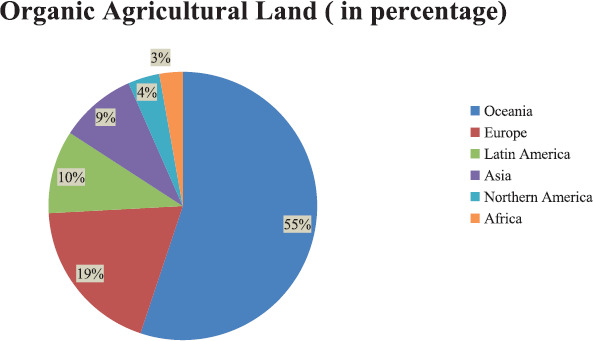
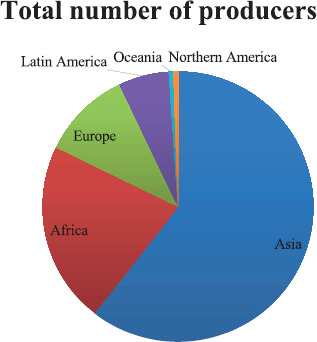
Table 1 and Figure 2 also indicate that the number of organic growers worldwide reached 4.5 million in 2022. Compared to 2021, the number of producers increased by about 919,000, representing a 25.6 percent gain. Based on the data collected, nearly 93% of the producers were located in Asia, Africa, and Europe. Asia accounts for 61% of global organic producers, followed by Africa at 22%, Europe at 11%, and Latin America at 6%. Oceania and Northern America have approximately 0.5 percent of the world’s organic producers, which is a very tiny number. One thing to note from the study is that Oceania has a large amount of organic agricultural area with very few farmers.
Top Ten Countries with the Largest Areas of Organic Agricultural Land and No. of Producers
Organic farming has been effectively implemented in several nations, accounting for 2% to 10% of the total cultivated acreages. In both advanced and developing nations, the market for organic products is expanding at a significant rate of twenty percent each year (Tomar et al., 2023).
The countries with the largest organic agricultural land areas recorded in 2022 are given in Table 2 and Figure 3. This table indicates the countries with the greatest organic agricultural land were Austra-lia (53.0 million hectares), followed by India (4.7 million hectares) and Argentina (4.1 million hectares). Australia leads the world in organic agricultural land, with 53.02 million hectares, up from 35.7 million hectares in 2021, representing an almost 49 percent growth. The 2022 figure represents almost 70% of all organic land globally, indicating the Australian sector’s potential for long-term expansion. India ranks second with 4.73 million hectares of land, followed by Argentina (4.06 million hectares), China (2.90 mil-lion hectares), and France (2.88 million hectares), respectively.
Table 2
Top Ten Countries with the Largest Areas of Organic Agricultural Land and Largest No. of Producers 2022
Figure 3
Top Ten Countries with the Largest Areas of Organic Agricultural Land 2022
Source: The World of Organic Agriculture Statistics and Emerging Trend 2024, FiBL and IFOAM – Organics International.
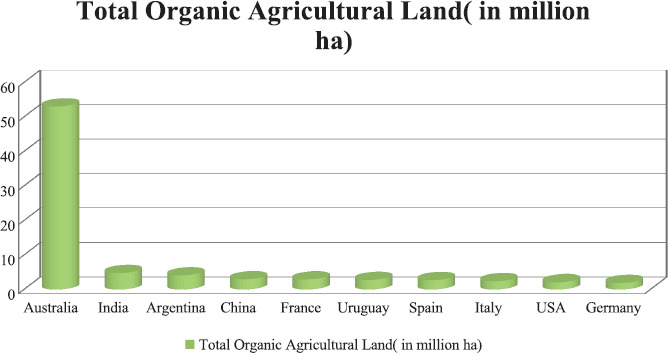
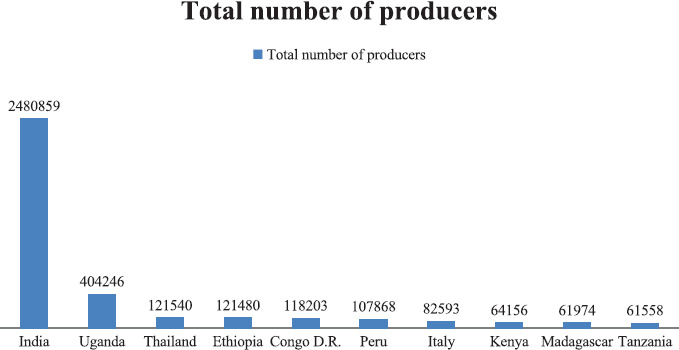
Table 2 and Figure 4 reveal that India has the highest number of organic producers worldwide. India leads the world in terms of producers, with 2480859 farmers, followed by Uganda (404246), Thailand (121540), Ethiopia (121480), and the Democratic Republic of the Congo (118203). This table also reveals that, although having the largest total organic agricultural area (53.02 million hectares), Australia did not place among the top ten countries in terms of producers.
Organic Farming in India
Asian countries account for 7% of global organic land, with China and India making considerable contributions. China came in second with almost 2900000 hectares, Thailand with over 241000 hect-ares, and the Philippines with approximately 229000 hectares. These four nations accounted for more than 91% of all organic cropland in Asia (Musa et al., 2015). India is one of the world’s fastest-growing economies and has untapped potential for significant progress in organic agriculture. India, with 21 agroecological zones, has an advantage in agriculture due to its diverse climate and soil patterns, allow-ing for the production of a wide range of crops and increasing diversity in the organic market. India is already well regarded in the world market for the high quality of several of its products, such as tea, spic-es, specialty rice, and herbs; this gives it further credibility there (Gurung et al., 2013). Agricultural and Processed Food Products Export Development Authority (APEDA) implemented the National Program for Organic Production (NPOP), which was developed with the approval of the National Steering Committee (NSC), NPOP’s duties include handling documentation such as national standards, accreditation criteria for accrediting inspection and certification agencies, accreditation procedure, inspection and certifica-tion procedures (Bhattacharyya & Chakraborty, 2005). India’s low labor costs, significant NGO support for organic farming, and government initiatives, such as a national regulatory framework and assistance schemes, make it a favourable location for organic agriculture.
Growth of organic farming agricultural area and producer in India during 2007-2022
Over 8.8 million hectares of agricultural land under the management of 2.7 million producers were found in Asia in 2022. India is among the nations where organic farming land and the number of producers of organic goods are both rapidly growing. India stands out among the 188 countries that practice or-ganic agriculture. Most of these producers were in India, where between 2021 and 2022, their numbers rose by one million, making a substantial contribution to the rise of organic farmers worldwide. Asia accounted for 9% of the world’s organic agricultural land. Between 2021 and 2022, organic land in Asia rose by almost 2.3 million hectares, representing a 35.9 percent growth (FiBL & IFOAM (2024). India’s total organic agriculture land grew at 77.83 percent from 2021 to 2022 – the country’s biggest increase till now. However, from 2023 (5.39 million hectares) to 2024 (4.48 million hectares), India had a 16.8% decline.
Table 3 shows the total area from the last 18 years and the number of producers in India from the last 16 years. Table 3 and Figure 5 indicate the total area under organic farming for the last 18 years in India. India ranks second in the world in terms of cultivated land under organic certification, with a total area of 4.48 million hectares. The total organic production area in India has increased from 1.03 million hectares in 2007 to 4.48 million hectares in 2024 (FiBL and IFOAM – Organics International, 2024), with a 12% compound annual growth rate (CAGR). However, this annual growth rate is insufficient to satisfy the goal of sustainable agriculture, which is critical for achieving sustainable development. The Indian government has created a number of state-specific plans and incentives to encourage the use of organic agricultural methods. Organic farming in India has a bright future due to its consistent expansion and support.
Table 3
Total Organic Agricultural Land and Number of Organic Producers in India from 2007-2022
Figure 5
Trend of Total Organic Agricultural Land of India from 2007-2024
Source: The World of Organic Agriculture Statistics and Emerging Trend (2009-2024), FiBL and IFOAM – Organics Interna-tional and APEDA (2022-23, 2023-24).
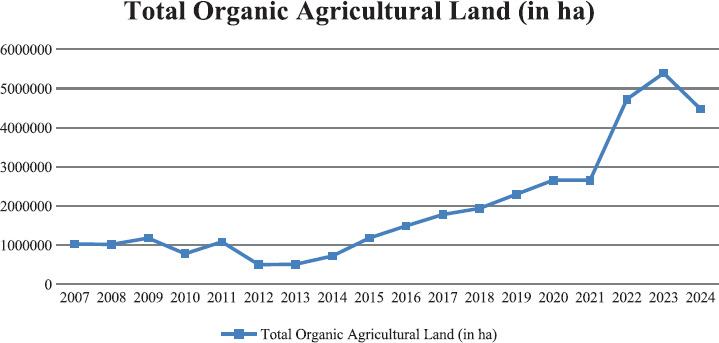
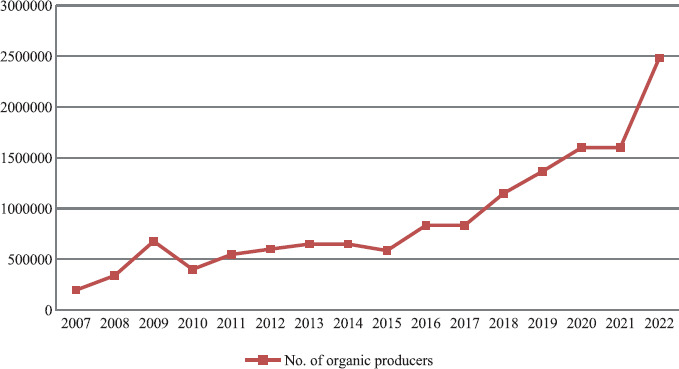
Table 3 and Figure 6 also indicate the number of organic growers in India. The data show a signifi-cant increase in organic producers in India. In 2007, organic producers stood at 0.19 million, which grew to 2.4 million in 2022 with a 13.5% compound annual growth rate (CAGR). The rapid expansion of or-ganic producers in India is attributed to the country’s large population. India, the world’s most populated country, is home to 85% of small and marginal farmers with land under 2 hectares. Organic farming is especially popular among small and marginal farmers due to its lower costs and increased profitability. These factors help farmers adopt organic farming faster (Agriculture Statistics at Glance, 2021).
Conclusion
Organic farming encompasses the economic and social aspects of agricultural production, both lo-cally and globally. It promotes both sustainability and environmental sensitivity. Several regulations and standards were created to fulfill these two objectives. Though India has historically been an organic agricultural nation, the rise of modern scientific, input-intensive agriculture has driven it to the break-ing point. However, as people’s awareness of food safety and quality, system sustainability over the long term, and the only hope for rainfed, resource-poor farmers has grown, organic farming has emerged as an alternative farming system that not only addresses these issues but also guarantees a debt-free, profitable livelihood option. According to this research, with 53.2 million hectares, Oceania has the most significant area devoted to organic farming, whereas 61% of the world’s top organic farmers are in Asia. This study reveals that Australia has the most organic agricultural area worldwide (53.0 million hect-ares), and India has the largest population of organic growers worldwide. In India, the results also show a fluctuating trend in area and number of organic producers from 2007 to 2024. The overall organic area and producers have increased at the rate respectively: 12 and 13.5 percent compound annual growth rate (CAGR). This study examined the current condition of organic farming in India and its various elements. While organic farming is gaining popularity, it is still in its early stages of development. The present sce-nario of organic agriculture in India presents an opportunity for exploring untapped aspects of organic farming (Avinash & Batra, 2023).