1.0 Introduction
Africa continues to face a persistent infrastructure deficit that constrains trade integration and economic transformation. According to estimates based on African Development Bank data, the continent’s annual infrastructure investment needs range between approximately $130-170 billion, with a financing gap of an estimated $68-108 billion per year, particularly in critical sectors such as transport, energy, and logistics that underpin trade facilitation (Africa Policy Research Institute, 2024; African Union Development Agency – NEPAD, 2025). Transport and logistics inefficiencies further exacerbate costs, as transport costs can represent as much as 40% of the final price of goods in some African markets, significantly reducing competitiveness in both regional and international trade (Kuteyi & Winkler, 2022; Mozambique, 2025). This gap slows economic growth and limits the effectiveness of domestic and external finance, and it is reflected in Africa’s limited participation in global commerce. Despite accounting for roughly 16-17% of the world’s population, the continent contributes less than 3% of global merchandise trade, and intra-African trade remains comparatively low (United Nations Conference on Trade and Development [UNCTAD], 2024). These structural constraints are reflected in Africa’s limited participation in global trade. Weak transport networks, unreliable energy supply, and inefficient port and border infrastructure continue to undermine export competitiveness, fragment markets, and limit the ability of African economies to integrate into regional and global value chains (Wu et al., 2023; Economic Commission for Africa, 2024).
Against this backdrop, the Belt and Road Initiative (BRI) continues to serve as a major source of external infrastructure financing for African countries. Since its launch in 2013, the BRI has supported large-scale projects in railways, ports, roads, power generation, and logistics hubs across Africa, with China becoming a key partner in the continent’s infrastructure landscape. Historical examples include major Chinese-financed transport corridors such as the Mombasa-Nairobi Standard Gauge Railway and the Addis Ababa-Djibouti Railway, which are designed to reduce travel times and lower cargo transport costs (Tovar, 2019; Irandu & Owilla, 2020). While comprehensive continent-wide aggregate data on annual BRI commitments are evolving, these individual project investments illustrate the scale and strategic orientation of Chinese infrastructure engagement across the region.
Nevertheless, the rapid expansion of BRI – related infrastructure investment has generated sustained policy and academic debate. Proponents argue that large-scale investments in transport, energy, and logistics infrastructure reduce trade costs, shorten shipment times, improve connectivity, and stimulate trade flows by enhancing access to domestic, regional, and global markets (World Bank 2019a; World Bank 2019b; Ajah & Onuoha, 2025). Empirical and policy studies suggest that improved transport corridors associated with the BRI can significantly reduce trade friction and increase trade volumes, particularly in developing regions with binding infrastructure constraints (de Soyres et al., 2020; Yu et al., 2020).
However, critics caution that the trade gains from BRI – related infrastructure may not be automatic or evenly distributed. Several studies highlight concerns regarding debt sustainability, fiscal risks, and institutional capacity, arguing that without complementary reforms and sound governance frameworks, infrastructure investments may yield limited or delayed trade benefits (International Monetary Fund [IMF], 2017; Bandiera & Tsiropoulos, 2019). In the African context, structural bottlenecks, weak logistics systems, and vulnerability to external shocks, such as the COVID-19 pandemic, may further constrain the extent to which infrastructure investment translates into measurable and sustainable trade outcomes (UNCTAD 2024; Utouh & Kitole, 2025). However, whether BRI-financed infrastructure delivers impactful trade gains remains an empirical question, particularly for African economies where infrastructure deficits are acute but structural constraints persist. To address this question, this study examines the impact of BRI infrastructure projects on trade volumes in Africa, situating the analysis within the broader discourse on globalization and development. Specifically, it examines how BRI infrastructure projects influence trade volume, determines the relationship between specific BRI investments and export/import growth, and assesses the long-term impact of BRI investments on the region’s trade balance and economic growth.
By doing so, this study contributes to understanding how the BRI has been reshaping global trade patterns and addressing developmental inequalities, especially in Africa. The study therefore provides valuable evidence for policy revision and regional development planning in Africa by assessing the trade effects of infrastructure investments through the BRI.
Literature Review
2.0. Sino – Africa Trade Relations
China – Africa economic relations have evolved through distinct historical and structural phases, shaping the contemporary context within which the Belt and Road Initiative (BRI) operate. Early engagement from the 1950s through the 1970s was largely political and diplomatic, characterized by China’s support for liberation movements and symbolic infrastructure projects such as the Tanzania–Zambia Railway (TAZARA) (Nurdun, 2024; Uchime, 2025). This phase established a foundation of political solidarity and development-oriented cooperation that differentiated China’s engagement from traditional Western development models (Zhou, 2023; Yang, 2024).
Since the early 2000s, China – Africa relations have transitioned into a more intensive economic partnership, marked by rapid growth in trade, foreign direct investment, and infrastructure financing. China has become Africa’s largest bilateral trading partner, with trade flows dominated by African exports of primary commodities and Chinese exports of manufactured and capital goods (Mrdaković & Todorović, 2023). While this expansion has increased trade volumes, several studies note that the structure of Sino-African trade remains asymmetric and may constrain Africa’s long-term industrialization and export diversification (Regissahui, 2019; Xu & Song, 2025). These concerns have fueled debate over whether rising trade volumes translate into sustainable development outcomes.
At the same time, empirical evidence suggests that Chinese engagement in Africa is not uniform and that outcomes depend critically on domestic conditions and policy environments. Miao et al. (2020) demonstrate that the growth effects of Chinese investment are significantly stronger in countries with higher institutional quality, indicating that governance plays a mediating role in translating external investment into economic gains. Similarly, Mrdaković & Todorović (2023) emphasize African agency in shaping the terms and outcomes of Chinese engagement, challenging portrayals of Africa as a passive recipient of Chinese capital. This evolving relationship provides the broader political – economic context for assessing the trade implications of BRI-financed infrastructure investments across African economies.
2.1 The Belt and Road Initiative in Africa: An Economic Perspective
The Belt and Road Initiative represents a major expansion of China’s infrastructure-led engagement with Africa, with explicit objectives of improving connectivity, reducing trade costs, and facilitating cross-border trade. From an economic perspective, the BRI aligns with trade and infrastructure theories that emphasize the role of transport networks, logistics efficiency, and energy supply in lowering transaction costs and enhancing market access (Githaiga et al., 2019; Adeniran et al., 2021). Global studies indicate that BRI – related investments in railways, ports, and roads have the potential to reduce shipment times and improve trade efficiency, particularly for landlocked and infrastructure – constrained economies (World Bank, 2019a; de Soyres et al., 2020). Empirical evidence specific to Africa suggests that BRI-financed infrastructure has contributed to improved connectivity and trade facilitation, although results vary by country and project type. Case studies of flagship railway projects such as the Addis Ababa-Djibouti Railway and the Mombasa – Nairobi Standard Gauge Railway indicate reductions in transport time and logistics costs, alongside employment generation and localized spillover effects (Irandu & Owilla, 2020; Maupeu, 2021; Barton, 2022). Cross-country studies have further suggested that Chinese infrastructure investment and financing are positively associated with trade intensity and export performance, particularly where infrastructure addresses binding transport and energy constraints (Wu et al., 2023; Zhang & Mekonnen, 2023).
However, the literature also presents important counterarguments that challenge the assumption of automatic or uniform trade gains. A prominent strand of research highlights concerns over debt sustainability and fiscal vulnerability associated with large-scale infrastructure borrowing, especially in low-income African economies with limited revenue-generating capacity (Bandiera & Tsiropoulos, 2019; Mutai et al., 2024). From this perspective, infrastructure investments may generate short-term trade and growth effects while increasing long-term financial risks, potentially offsetting development gains. Other studies argue that observed trade improvements may reflect pre-existing trade potential or strategic country selection rather than causal infrastructure effects, raising concerns about endogeneity and selection bias (Liu et al., 2018; Komakech & Ombati, 2023).
Recent literature published after the COVID-19 pandemic further emphasizes that global shocks, supply-chain disruptions, and changing trade patterns condition the effectiveness of infrastructure investment in promoting trade resilience (IMF, 2022; UNCTAD, 2024). These studies suggest that infrastructure investments yield stronger and more sustainable trade outcomes when complemented by sound macroeconomic management, institutional quality, and regional integration frameworks such as the African Continental Free Trade Area (AfCFTA). Consequently, while the BRI has significantly reshaped Africa’s infrastructure landscape, its net impact on trade remains context-dependent and empirically contested.
The existing literature underscores both the potential and the limitations of BRI-financed infrastructure as a driver of trade expansion in Africa. While frequent studies document positive associations between infrastructure improvements and trade outcomes, the evidence remains fragmented, often project-specific, and methodologically constrained (Cui & Song, 2019; Taylor & Zajontz, 2020). This creates the need for a comprehensive, Africa-wide empirical assessment that explicitly accounts for heterogeneity, trade persistence, and endogeneity, an objective that this paper seeks to address.
2.2 Empirical Gaps and Contribution of the Study
Despite the growing body of literature on the BRI, key important gaps remain, particularly with respect to its trade effects in Africa. First, much of the existing empirical literature focuses primarily on aggregate economic growth, investment inflows, or debt sustainability, rather than on trade outcomes as a direct channel through which infrastructure investments influence development (Carmody & Wainwright, 2022; Wang et al., 2024). While these studies provide valuable macroeconomic insights, they offer limited evidence on whether BRI-financed infrastructure translates into measurable improvements in trade performance. Second, where trade effects are examined, many studies rely on case-study approaches or bilateral gravity models, often focusing on specific corridors or countries such as Kenya, Ethiopia, or Djibouti (Irandu & Owilla, 2020; Barton, 2022). Although informative, these approaches limit the general-izability of findings across the African continent and do not fully account for unobserved country-specific heterogeneity that may jointly influence infrastructure allocation and trade outcomes.
Likewise, existing cross-country studies frequently employ static estimation techniques, which do not adequately address the dynamic nature of trade flows or the potential endogeneity of infrastructure investment (Liu et al. 2018; Yu et al., 2020). Countries with higher trade potential may be more likely to attract infrastructure financing, raising concerns of reverse causality and biased estimates. Recent critiques further argue that failure to control for persistence in trade flows may overstate the short-run impact of infrastructure investment (Roodman, 2009; Africa Policy Research Institute, 2024). Moreover, the literature presents competing interpretations regarding the developmental consequences of BRI investments. While proponents emphasize reduced trade costs and enhanced connectivity (World Bank, 2019a; de Soyres et al., 2020), critics highlight debt sustainability risks, uneven distribution of benefits, and institutional constraints, particularly in African economies with limited fiscal capacity (Bandiera & Tsiropoulos, 2019; Mutai et al., 2024). These counterarguments suggest that infrastructure investment alone may be insufficient to generate sustained trade gains without complementary policies and sound governance.
This study contributes to the literature by addressing these limitations in a number of ways. Primarily, it focuses explicitly on trade volume as the primary outcome of interest, providing direct evidence on the trade effects of BRI-financed infrastructure. Again, it employs a balanced panel of 49 African countries over the period 2014-2022 (capturing the post-BRI and post-COVID context). Finally, the study adopts a sequential estimation strategy, combining fixed-effects, random-effects, and dynamic System GMM estimators to control for unobserved heterogeneity, trade persistence, and potential endogeneity. By doing so, the analysis responds directly to alternative explanations and methodological critiques raised in existing literature. The study therefore offers more robust and policy-relevant evidence on the role of BRI infrastructure investment in shaping trade integration in Africa.
2.3. Theoretical Framework
Two complementary theories in international trade provided the theoretical basis of this study: the Gravity Model of Trade and the Infrastructure and Trade Facilitation framework. These theories provide a coherent analytical foundation for examining how Belt and Road Initiative (BRI) – financed infrastructure investment influences trade volumes in African economies.
The Gravity Model of Trade posits that bilateral trade flows between countries are positively related to their economic size and negatively related to trade costs, such as distance, transport costs, and other barriers to exchange (Tinbergen, 1962; Anderson & van Wincoop, 2003). Formally, trade volumes increase when economic mass expands or when frictions that impede trade are reduced. Modern formulations of the gravity model explicitly interpret distance as a proxy for a broader set of trade costs, including transport infrastructure quality, logistics efficiency, and border-related frictions (Leitão, 2024). Within this framework, infrastructure investment plays a critical role by reducing effective trade costs. Improvements in transport networks, ports, railways, and energy systems lower shipment times, reduce freight costs, increase the reliability of supply chains, thereby weakening the negative effect of distance on trade flows (UNCTAD, 2023). The BRI, by design, seeks to enhance physical connectivity and reduce economic distance through large-scale infrastructure development. Accordingly, gravity theory predicts that BRI-financed infrastructure investment should lead to higher trade volumes by mitigating trade frictions between African economies and their trading partners.
Alternatively, the Infrastructure and Trade Facilitation framework (Hummels, 2007) complements the gravity model by emphasizing microeconomic mechanisms through which infrastructure quality affects trade performance. This literature highlights that beyond physical distance, trade outcomes depend critically on logistics efficiency, transport reliability, customs procedures, and energy availability (Sénquiz-Díaz, 2021). Poor infrastructure increases transaction costs, delays delivery, and raises uncertainty, all of which discourage trade participation and limit firms’ ability to integrate into regional and global value chains. From this perspective, infrastructure investments under the BRI, particularly in transport corridors, ports, and power generation, improve trade facilitation by lowering logistics costs and enhancing market access. These improvements are expected to have especially strong effects in developing regions such as Africa, where infrastructure deficits represent binding constraints on trade expansion (Kodongo & Ojah, 2016). The theory therefore predicts a positive relationship between infrastructure investment and trade volume, conditional on broader economic and institutional environments.
2.4 Theoretical Implications for Empirical Specification
These theoretical perspectives mutually inform the empirical model employed in this study. Primarily, the gravity framework justifies modeling trade volume as a function of infrastructure investment and economic size variables, such as income levels and population density. The trade facilitation theory, on the other hand, supports the inclusion of infrastructure investment as a key explanatory variable capturing reductions in trade costs and improvements in logistics efficiency. Moreover, both theories recognize that trade outcomes are dynamic and path-dependent, as past trade performance influences current trade through established networks, firm relationships, and accumulated infrastructure use (Olarreaga, 2016; Machado Parente & Moreau, 2024). This understanding provides a theoretical basis for incorporating a dynamic specification in which lagged trade volume affects current trade outcomes. In addition, infrastructure investment may be endogenous, as countries with greater trade potential may attract more infrastructure financing. This consideration stimulates the use of dynamic panel estimation techniques, such as the System Generalized Method of Moments (System GMM), to obtain consistent estimates by addressing endogeneity and persistence.
Thus, the integration of gravity theory and trade facilitation theory offers a strong theoretical foundation for the study’s empirical strategy and supports the hypothesis that BRI-financed infrastructure investment enhances trade volumes in African economies.
3.0 Data and Methodology
The study used annual panel data for 49 African countries. The variables employed in the study are constructed from internationally recognized databases to ensure comparability and data reliability (Table 1). Trade volume (TRV) is measured as the sum of exports and imports in current U.S. dollars and serves as the primary indicator of a country’s trade activity. This variable is sourced from the World Development Indicators (WDI) database published by the World Bank, which provides standardized trade statistics across countries and years. Foreign direct investment (FDI) is measured as net FDI inflows expressed as a percentage of GDP, also obtained from the World Development Indicators. This measure captures the relative importance of external capital inflows in each country’s economy. The key explanatory variable, BRI infrastructure investment (CIV), captures Chinese-financed infrastructure investment under the Belt and Road Initiative. Data for CIV are drawn from the China – Africa Research Initiative (CARI) at Johns Hopkins University and the China Global Investment Tracker by the American Enterprise Institute. These variables measure the annual value of Chinese infrastructure investment commitments in recipient countries, expressed in U.S. dollars. The dataset includes projects in transport (railways, roads, ports), energy (power generation and transmission), and logistics infrastructure, which are directly relevant to trade facilitation. Only projects classified as infrastructure-related are included, and annual country-level values are aggregated to obtain a comprehensive measure of BRI/China infrastructure exposure from 2014 to 2022.
Gross domestic product per capita (GDP) is measured in current U.S. dollars and serves as a proxy for income levels and economic size, while population density (POPD) is measured as the number of people per square kilometer of land area, capturing demographic pressure and market size. Both variables are sourced from the World Development Indicators database. To reduce skewness and allow coefficient interpretation as elasticities, all variables are transformed into their natural logarithmic form before estimation.
Table 1
Descriptive statistics
3.1 Methodology
To examine the relationship between Belt and Road Initiative (BRI) – financed infrastructure investment (CIV) and trade volume (TRV) in Africa, this study specifies a panel regression model that captures both cross-country and time-series variation. Panel data methods are particularly suitable in this context because they allow for the control of unobserved heterogeneity across countries while exploiting temporal dynamics in trade and investment flows (Wooldridge 2010; Baltagi, 2008).
Following the trade – infrastructure literature, trade volume is modeled as a function of infrastructure investment and key macroeconomic controls, including foreign direct investment, income levels, and population density (Limao & Venables, 2001; Portugal-Perez & Wilson, 2012). This specification allows the analysis to capture both the direct role of infrastructure in reducing trade costs and its indirect interaction with broader economic fundamentals.
To facilitate interpretation and reduce skewness in the data, all variables are transformed into their natural logarithmic form. The log–log specification enables coefficient estimates to be interpreted as elasticities, indicating the percentage change in trade volume associated with a one percent change in infrastructure investment or other explanatory variables. The baseline empirical model is specified as follows:
However, this model does not have a natural logarithm. To capture the real effect of the dependent variables on the independent variables, we transformed the data into natural logarithms and reconstructed the equation as follows:
where lnTRVit denotes the natural logarithm of trade volume for country i at time t, lnFDIit rep-resents BRI-related infrastructure investment for country i at time t, lnTRVit captures foreign direct investment as a percentage of GDP for country i at time t. Furthermore, lnGDPit denotes the logarithm of GDP per capita for country i at time t, lnPOPDit represents population density for country i at time εit, and is the error term.
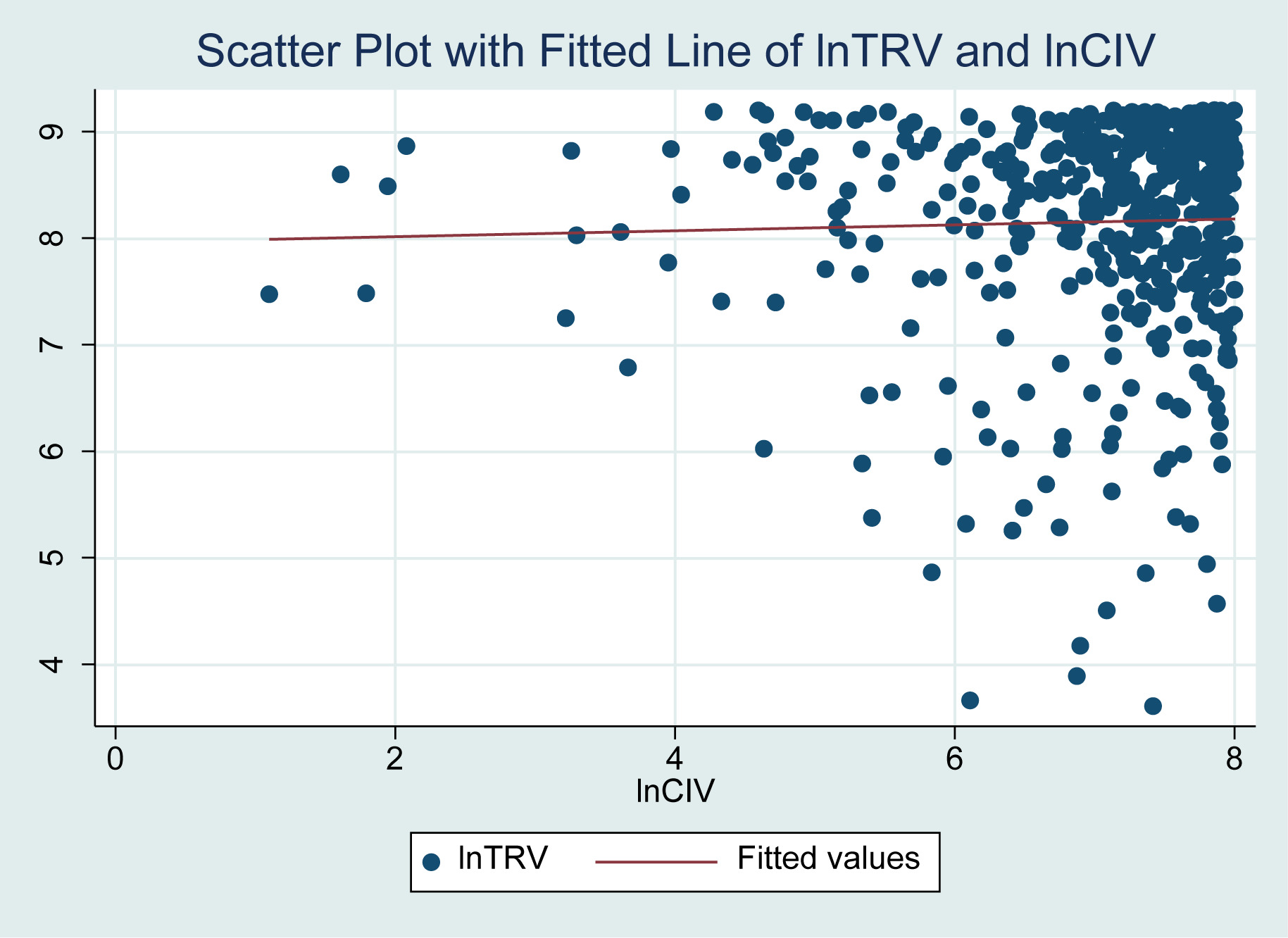
To begin with, a scatter plot showing the association between China’s investment in the infrastructure and the volume of trade in Africa is presented. The distribution of the data points shows a strong upward trend, showing that more Chinese investment in infrastructure tends to be accompanied by an increase in trade activity (Figure 1). Though there is some variation over the different observations, the general pattern supports the argument that infrastructure expansion helps increase regional trade integration by reducing transport and increasing the logistical efficiency of the network.
Figure 1
Scatter plot of trade volume and China’s infrastructure investment
Source: prepared by the authors.
In Table 2, the correlation matrix presented for the data reveals a good relationship between trade volume (lnTRV) and the other variables in their natural logarithmic forms. The correlation between lnTRV and lnFDI is slightly negative (-0.041), suggesting a small inverse relationship between the trade volume and foreign direct investment. The correlation between lnTRV and lnCIV (infrastructure) was very strong (0.729), indicating a stronger association with trade volume. Similarly, lnTRV shows strong positive correlations with both lnGDP (0.521) and lnPOPD (0.719), implying a strong relationship with these variables. Overall, the correlation values suggested that multicollinearity was not a significant issue in the regression analysis. Hence, capturing linear relationships highlights the need for advanced econometric methods, such as panel data or dynamic models, to explore potential causal or nonlinear effects on trade volume, especially in the context of Belt and Road Initiative projects.
3.2 Model Specification and Estimation Approach
This study adopts a sequential panel estimation strategy designed to address unobserved heterogeneity, dynamic persistence, and potential endogeneity in assessing the impact of Belt and Road Initiative (BRI) infrastructure investment on trade volume in Africa. The baseline specification employs a fixed-effects (FE) estimator, which controls for unobserved, time-invariant country-specific characteristics such as historical trade orientation, institutional quality, and colonial legacy that are likely to influence both infrastructure investment and trade outcomes. In the context of Africa countries, these country-specific factors are plausibly correlated with key explanatory variables, rendering pooled ordinary least squares (OLS) estimates biased and inconsistent. Following standard panel data theory, the FE estimator therefore provides consistent within-country estimates under such conditions (Wooldridge, 2010; Hsiao, 2022).
For comparison, a random-effects (RE) model is also estimated. The RE estimator assumes that unobserved country-specific effects are uncorrelated with the regressors, an assumption that may be restrictive in the case of BRI infrastructure allocation, which is likely influenced by structural characteristics such as market size, logistics gaps, and strategic relevance. To correctly evaluate the validity of this assumption, the study applies the Hausman specification test, which compares FE and RE estimates under the null hypothesis that the RE estimator is consistent (Hausman, 1978). Where the null hypothesis is rejected, the FE estimator is preferred and adopted as the baseline specification.
While the FE model effectively controls for time-invariant heterogeneity, static panel estimators may remain biased when the dependent variable exhibits dynamic persistence. Trade volume is typically path-dependent, with past trade performance influencing current outcomes. In the presence of a lagged dependent variable, the FE estimator suffers from the well-known Nickell bias, particularly in panels with a relatively small time dimension (Nickell, 1981). In addition, infrastructure investment may be endogenous due to reverse causality, as countries with greater trade potential may attract more infrastructure financing, or due to omitted time-varying factors such as policy reforms or external shocks. To address these concerns, the study estimates a dynamic panel model using the two-step System Generalized Method of Moments (System GMM) estimator, as developed by Blundell and Bond (1998). This estimator combines equations in first differences and levels and uses appropriately lagged endogenous variables as internal instruments, thereby mitigating endogeneity and dynamic bias. Statistical inference in the dynamic model is based on asymptotic theory and is therefore conducted using z-statistics.
The validity of the dynamic specification is assessed using standard diagnostic tests, including the Arellano-Bond tests for serial correlation and the Hansen test of overidentifying restrictions, which evaluates the joint validity of the instrument set (Arellano & Bond, 1991). To avoid instrument proliferation and weakened inference, the number of instruments is carefully monitored and kept below the number of cross-sectional units, consistent with best practice in applied panel GMM estimation (Roodman, 2009). Finally, to ensure robustness of statistical inference in the static panel framework, additional estimations incorporate two-way fixed effects (country and year effects) and country-clustered standard errors, which account for common time shocks and within-country serial correlation and heteroskedasticity (Arellano, 1987; Cameron & Miller, 2015).
4.0 Panel Regression Analysis Results
This section presents the empirical results examining the impact of Belt and Road Initiative (BRI)-financed infrastructure on trade volume in Africa. To ensure robustness and address potential econometric concerns, the analysis proceeds in three main stages: fixed-effects estimation, random-effects estimation, and dynamic panel estimation using System GMM.
4.1 Fixed Effects Estimates
Table 3 reports the results of the fixed-effects model, which controls for unobserved, time-invariant country-specific heterogeneity. This specification captures within-country variations over time and is appropriate given the structural and institutional differences across African countries.
Table 3
Fixed effect model lnTRV Coef. St.Err. t-value p-value [95% Conf.
The results show that BRI infrastructure investment (lnCIV) has a positive and statistically significant effect on trade volume (lnTRV). The estimated coefficient of 0.304 implies that a 1 percent increase in Chinese infrastructure investment is associated with approximately a 0.3 percent increase in trade volume, holding other factors constant. This indicates a substantial and economically meaningful effect, consistent with trade facilitation and gravity-based arguments that improved infrastructure reduces trade costs and enhances market access. Foreign direct investment (lnFDI) also exhibits a positive and statistically significant relationship with trade volume, although its magnitude is smaller than that of infrastructure investment. This suggests that while FDI contributes to trade expansion, its impact is more limited relative to large-scale infrastructure development. Gross domestic product per capita (lnGDP) displays a weak and marginally significant negative association with trade volume at the 10 percent level, indicating that income growth alone does not robustly drive trade expansion once infrastructure and investment factors are accounted for. Population density (lnPOPD) is positive and statistically significant, suggesting that larger and denser markets are associated with higher trade activity within countries over time. Overall, the fixed-effects model explains a substantial proportion of within-country variation in trade volume (R2 = 0.614), highlighting infrastructure investment as the dominant explanatory factor.
As an additional robustness check, the fixed-effects specification was re-estimated with year fixed effects to control for common macro shocks and with country-clustered (and alternatively Driscoll– Kraay) standard errors to account for heteroskedasticity, serial correlation, and cross-sectional dependence. The sign and statistical significance of the infrastructure coefficient remain unchanged across specifications.
4.2 Random Effects Estimates and Model Selection
Table 4 presents the random-effects estimates for comparison. While several coefficients remain statistically significant, notable differences emerge in both the magnitude and sign of key variables, particularly GDP and population density relative to the fixed-effects model. These discrepancies suggest that the random-effects assumption of no correlation between regressors and unobserved country-specific effects may be violated.
Table 4
Random effect lnTRV Coef. St.Err. t-value p-value [95% Conf.
To formally assess model suitability, a Hausman specification test was conducted (Hausman, 1978). The results of the Hausman test indicate a chi-square statistic of χ2(4) = 16.86 with a corresponding p-value of 0.0004, leading to the rejection of the null hypothesis at the 1 percent significance level. This result suggests that the assumption underlying the random-effects model is violated, as key regressors, particularly infrastructure investment, GDP per capita, and population density, are correlated with unobserved country-specific characteristics. Hence, the fixed-effects model is adopted as the preferred baseline specification for the analysis, as it provides consistent estimates of the impact of BRI infrastructure investment on trade volume in Africa. The random-effects results are therefore reported for comparison purposes only.
4.3 Dynamic Panel Estimates (System GMM)
Having established the fixed-effects model as the preferred specification based on the Hausman test, the analysis proceeds to a dynamic panel estimation to further address persistence and potential endogeneity concerns. Although the fixed-effects model addresses unobserved heterogeneity, it does not account for the potential dynamic persistence of trade flows or for possible endogeneity between infrastructure investment and trade volume. To address these concerns, a dynamic panel model was estimated using the two-step System GMM estimator, as reported in Table 5.
Table 5
Dynamic Panel Data
The coefficient on the lagged dependent variable is positive and statistically significant, confirming the presence of persistence in trade volume over time. This indicates that past trade performance strongly influences current trade outcomes, justifying the dynamic specification. Consistent with the fixed-effects results, BRI infrastructure investment remains positive and highly significant in the dynamic model, even after controlling for endogeneity and trade persistence. Although the magnitude of the coefficient is slightly reduced, this weakening is expected once reverse causality and dynamic adjustments are accounted for, reinforcing the robustness of the infrastructure-trade relationship.
InFDI retains a positive and statistically significant effect, while InGDP per capita and InPOP lose statistical significance in the dynamic framework. This suggests that their effects are largely absorbed by trade persistence and infrastructure dynamics, further highlighting the central role of infrastructure investment in driving trade expansion. The diagnostic tests support the validity of the dynamic model. The Arellano–Bond test confirms the presence of first-order serial correlation and the absence of second-order serial correlation, while the Hansen test fails to reject the null hypothesis of instrument validity. In addition, the number of instruments remains well below the number of cross-sectional units, mitigating concerns of instrument proliferation.
5.0 Discussion
The empirical results provide strong and consistent evidence that BRI-financed infrastructure investment has a positive and economically meaningful effect on trade volume in sub-Saharan Africa. Across fixed-effects and dynamic panel estimations, infrastructure investment remains statistically significant, supporting the core predictions of the Gravity Model of Trade and the Infrastructure and Trade Facilitation framework. In particular, the estimated elasticity of trade with respect to infrastructure investment (approximately 0.30 in the fixed-effects model and 0.29 in the System GMM specification) indicates that improvements in transport, energy, and logistics infrastructure substantially reduce trade costs and enhance market connectivity.
These findings align with corridor-level and cross-country evidence documenting the trade-facilitating role of infrastructure investments under the BRI (de Soyres et al., 2020; Wu et al., 2023). Compared with case-study-based analyses of flagship railway projects (e.g., Irandu & Owilla, 2020; Barton, 2022), this study provides broader Africa-wide evidence that infrastructure effects extend beyond individual projects and persist over time. The significance of the lagged trade variable in the dynamic model further confirms the path-dependent nature of trade flows, reinforcing the relevance of a dynamic specification and validating concerns raised in the literature regarding static estimation bias (Roodman, 2009). Foreign direct investment also exhibits a positive effect on trade, though its magnitude is smaller and less robust than that of infrastructure investment. This suggests that while FDI complements trade expansion, infrastructure investment plays a more fundamental role in addressing structural trade constraints. In contrast, GDP per capita and population density lose statistical significance in the dynamic framework, indicating that macroeconomic size and demographics alone are insufficient to drive sustained trade expansion without accompanying improvements in infrastructure and connectivity. Significantly, the persistence of positive infrastructure effects after controlling for endogeneity directly addresses critiques that BRI-related trade gains merely reflect selection bias or pre-existing trade potential (Bandiera & Tsiropoulos, 2019; Mutai et al., 2024). At the same time, the results do not negate concerns regarding debt sustainability; rather, they suggest that infrastructure investments can generate trade benefits, but their long-term developmental impact depends on financing structures and complementary policies.
6.0 Conclusion
This study provides critical empirical evidence that Belt and Road Initiative–financed infrastructure investment significantly enhances trade volume in Africa. Using panel data for 49 African countries over the period 2014-2022 and employing fixed-effects and dynamic System GMM estimators, the analysis demonstrates that infrastructure investment is a key driver of trade expansion, even after accounting for unobserved heterogeneity, trade persistence, and endogeneity. The findings confirm theoretical predictions that improved infrastructure reduces trade costs and strengthens market connectivity. While foreign direct investment contributes positively to trade, its impact is secondary to that of infrastructure development. These results highlight infrastructure investment as a central mechanism through which external development financing can support trade integration in Africa. However, realizing these gains sustainably requires careful attention to financing strategies and institutional capacity.
6.1 Policy Recommendations
Based on the theoretical context and empirical findings, three policy implications emerge. First, African governments should prioritize infrastructure investments that directly reduce trade costs, particularly in transport and logistics, as these yield the strongest trade returns. Second, sustainable financing frameworks are essential to ensure that infrastructure-induced trade gains are not offset by debt vulnerabilities. This includes improved project appraisal, greater transparency, and selective use of public-private partnerships. Finally, infrastructure investments should be complemented by institutional reforms and regional integration initiatives, such as the African Continental Free Trade Area, to maximize trade spillovers and long-term economic benefits.