Introduction
Road transport infrastructure is one of the most important technical systems having a direct and in-direct impact on the economic development of a country, region or municipality (Karst, 1986; Kamińska, 1999; Dąbek, 2006; Brdulak, Pawlak, 2016; Zakrzewski, 2016). The development of road infrastructure has a positive impact on the creation of so-called demand and supply effects in a given area. In addition, modern transport infrastructure reduces costs in the economy, contributing to the territorially balanced development of the country (Borys, 2008) and reducing pressure on the environment1. Due to Poland’s current geopolitical situation, transport infrastructure is becoming one of the key factors influencing national security2. The security of critical infrastructure is beginning to take on a national security dimension, and access to key services remains a measurable aspect of national security and a state obligation towards its citizens (Zięba, Zając, 2010).
The S16 road corridor is of particular importance for socio-economic development and is a key factor determining the development potential of the counties along which it runs, which has been recognised and taken into account in the Development Strategy for the Warmian-Masurian Province until 2030. The above-mentioned document assumes the importance of road 16 and 52 municipalities located within a 15 km radius of this road corridor for the development of the province, which has been referred to as the ‘Warmian-Masurian Tiger’ and is also one of the nine areas of strategic intervention of the Warm-ian-Masurian Province. This intervention aims to increase the dynamism of development processes and strengthen the region’s competitiveness at the national and international level (Development Strategy... 2022).
The challenge for theorists and practitioners is to assess the economic and social effects of investments in road transport infrastructure. The development of road infrastructure in a given area has a positive impact on the creation of so-called demand and supply effects. Research on the role of infrastructure in most cases confirms the impact of transport networks on the overall increase in economic efficiency in the areas where it is located (Ratajczak, 1999; Kozłowski, 2014). Demand effects are associated with an increase in consumption in a given area, resulting from increased interest in a given infrastructure, and thus an increase in the number of households, enterprises and, consequently, products and services sold. Supply effects are mainly associated with improved production efficiency, increased productivity and output in a given area (Kozłowski, 2012).
The issue addressed in this article is the valuation of the effects obtained from investments in road transport infrastructure. The aim of the article is to provide an economic assessment of the modernisation of the S16 national road, which is crucial for the Warmian-Masurian Province in both economic and social terms. Currently, the S16 national road has been classified by the Polish government as a front road3. The basic method used in the study is the cost-benefit analysis method.
An overview of the literature
Road transport infrastructure is the foundation of modern economies and societies, and is also an important element of the security of a country, region, municipality and, above all, local community. Its links with businesses shape the assessment of industrial defence potential by institutions involved in national defence. They form the infrastructural basis for manufacturing processes and so-called security logistics (Stęplewski, 2016). Road transport infrastructure is also an important element of the country’s spatial development, promoting or limiting the economic and social activity of individual regions. From a general perspective, it determines the country’s economic development and the scale of its international trade, and is now also an important factor in European integration and global cooperation (Koźlak, 2012). Roads, motorways, bridges and ring roads are not just technical elements in space – they are the bloodstream that enables the efficient flow of people, goods and services. Transport accessibility is one of the key factors in the investment attractiveness of regions, affecting the quality of life of residents and promoting social integration processes (Vickerman 1974; Handy, Niemeiera 1997; Spiekermann, Neubauer 2002; World Bank, 2019).
Economically, the road network plays a key role in growth. First, it reduces transportation and logistics costs, which fosters business competitiveness (Kudłacz, 2015; Litman, 2021). Businesses located in well-connected regions have easier access to markets and trading partners, allowing them to plan their operations more effectively. Second, roads become a significant factor in attracting investment. The development of logistics centers, industrial parks, and new production plants often depends on proximity to major transportation routes (Rietveld & Bruinsma, 2018). Transport infrastructure therefore creates conditions for the creation of new jobs, supports employee mobility, and facilitates the development of entrepreneurship. The impact of roads on the tourism sector is also significant. Regions with good road access become more attractive to domestic and foreign tourists, generating additional revenue for local economies (Transport infrastructure and cohesion policy 2021-2027. Brussels 2020).
From a societal perspective, road infrastructure plays an integrative and equalizing role. Thanks to it, residents of remote towns gain better access to public services – such as education, healthcare, and administration (Zawadzka, 2021). This facilitates daily life and strengthens social cohesion. The development of the road network also translates into safety and quality of life. Modern roads reduce the risk of accidents, and efficiently designed bypasses reduce traffic congestion in city centers, reducing traffic jams, noise, and exhaust emissions4. Shorter commuting times to work or school mean more free time for citizens, which positively impacts quality of life. Thanks to road infrastructure, peripheral regions can overcome transport isolation, which helps to level development gaps and improve equal opportunities between the center and the countryside5. A key issue in these times of war is the place of road transport infrastructure in the national security process. These include military and defense security, economic security, and social security. An efficient and modern road network is crucial for the mobility of armed forces, enabling rapid movement of troops, military equipment, and support from allied states in the event of armed conflict. Above all, they are intended to serve as efficient corridors for people to escape from threatened areas (Kuliczkowski, 2013).
Technically and organizationally efficient infrastructure ensures the smooth flow of supplies, stabilizes supply chains, and helps in the event of various disasters and crises. Technically efficient infrastructure primarily reduces road accidents and strengthens territorial cohesion within a given region, municipality, or country. Transport infrastructure along the eastern border plays a special role – it serves as both a trade gateway and a potential military support corridor. According to Shladover (2022), assets flow through roads, connecting producers and consumers across vast geographic areas. Therefore, the reliability, capacity, and condition of these road networks directly impact the efficiency and profitability of asset movement and storage (Çolak, 2023; Sasidharan et al., 2022).
Insufficient access to the transport system of national and international importance is a fundamental factor determining regional peripherality and a serious obstacle to improving the level of socio-economic development of a given region or municipality6.From this perspective, the development of transport infrastructure is a priority for the voivodeships of Eastern Poland. Currently, research indicates that the level of road infrastructure development in the Warmian-Masurian Voivodeship is the lowest compared to other voivodeships in Poland (Jasińska, Jasiński, 2018). Transport accessibility is one of the fundamental metrics used to assess the transport system spatially, which stems from the voivodeship’s geographical location and infrastructure infrastructure (Kwarciński, 2017). The accession of new countries from Central and Eastern Europe to the European Union in 2004 exposed the disparity in development levels between member states. This presented new challenges for EU regional policy, necessitating reform of transport policy. The objectives of the EU’s common transport policy and the construction and modernization of road transport infrastructure are very time-consuming, so to address the challenges outlined in the White Paper by 2050 year, concrete decisions must be made today7.
The methodology for evaluating the effects of investments in road infrastructure currently poses a challenge for researchers, both in theoretical and practical terms.
Proper road allocation brings numerous benefits, including preventing traffic congestion and increasing investment and tourist attractiveness. Transport infrastructure is a key element of logistics chain efficiency. Detailed studies evaluating road investments in terms of economic and social development have been conducted by (Meyer, 2020; Ke et al., 2020; Litman, 2021; Łukasiewicz, Świtała, 2021; Urbański, Sudyka, Grondys, 2021).
Road transport investment research encompasses numerous methodologies and spatial approaches. These include scenario-based strategic modeling (Asgarpour et al., 2023), the transport-environment Kuznets curve (Zhang et al., 2023), data envelopment analysis (Baran, Górecka, 2019), regional market potential (Rokicki, Cieślik, 2023), and decomposition analysis (Tsemekidi-Tzeiranaki et al., 2023).
The use of cost-benefit analysis dominates investment practice (Drobniak, 2008). When considering the methods of analysis and evaluation of infrastructure investments, economic, environmental, social, and strategic aspects must be taken into account. The economic valuation of the effects of infrastructure investments is complex because the economic effects obtained must be expressed in monetary terms. The valuation is based on an informal logical qualitative assessment of immeasurable inputs and benefits, expressed in terms of so-called dual prices (Kujawski, 2016). The social benefits and costs resulting from the implementation of an infrastructure investment, valued based on so-called shadow prices, constitute a fundamental element of the analysis. Common indirect benefits from a macroeconomic perspective include increased consumer demand, decreased unemployment, an increase in the number of businesses, and increased municipal income from personal income taxes (PIT), corporate income taxes (CIT), etc. Social evaluation refers to the measurement of the quality of life of the local community based on questionnaire-based techniques. The fundamental issue is the local community’s assessment of the tangible benefits resulting from the implemented investments, e.g. improved quality of life, increased satisfaction, acceptance, improved health and safety, etc.
The valuation of strategic effects refers to the measurement of strategic benefits that a municipality will gain through the implementation of an infrastructure investment. The basic aspects of the analysis include the promotion of the municipality, raising its rating, perception and creation of an investment climate, and ensuring security in various dimensions (Rogowski, 2018). The final valuation of the effects of an infrastructure investment is therefore the sum of the valuations of individual areas, i.e., financial, economic, social, and strategic, expressed as a monetary value NPVpi. The development of the broadly understood social economy means that the assessment of economic efficiency is currently the main area of interest for theorists and practitioners. The valuation of social benefits in industrial projects creates a good climate for a given investment and is a kind of promotion for the company that implements it.
Research Methods
The issue addressed in this article is the valuation of the economic effects of investments in transport infrastructure. The aim of the article is to assess the economic effects of the modernization of the S16 national road, which is crucial for the Warmian-Masurian Province in both economic and social terms. The specific objectives are:
- Analysis of the potential of the S16 road corridor under study.
- Assessment of the economic benefits resulting from the modernization of the infrastructure under study.
The research methods used in the article are:
- Literature analysis and review studies – a review of existing scientific literature and industry reports on multi-criteria assessment methods and road infrastructure.
- Statistical method – statistical analysis of results to assess the stability and reliability of selected or planned investment solutions.
The research period covers the years 2024-2025. The subject of the study is the 395 km long national road S16, which connects Dolna Grupa in the Kuyavian-Pomeranian Voivodeship with the Polish border at Ogrodniki in the Podlaskie Voivodeship. The S16 is 285 km long within the Warmian-Masurian Voivodeship. The main towns along the road include Grudziądz, Łasin, Kisielice, Iława, Ostróda, Olsztyn, Barczewo, Biskupiec, Mrągowo, Mikołajki, Orzysz, Ełk, and Augustów. The S16 is the main transportation route in Warmia and Mazury. The current route of the S16 national road is illustrated in Figure 1.
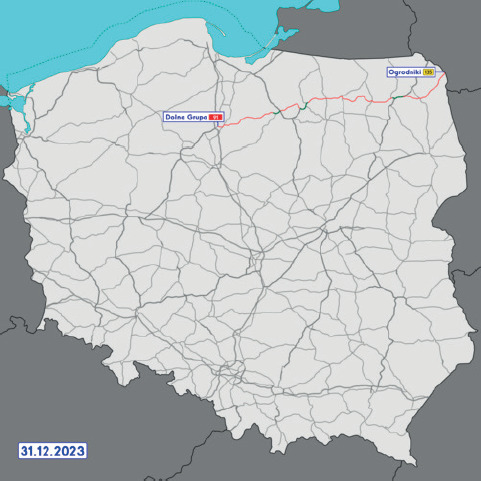
The S16 national road is of strategic importance for the development of the Warmian-Masurian Voivodeship and the 52 municipalities located within a 15-kilometer radius of the road corridor, which is referred to as the „Warmian-Masurian Tiger.” Despite its key role in economic and social development, modernization of the S16 national road has progressed very slowly. The road’s primary problem is that most sections are single-lane, which reduces travel time and traffic congestion on some sections, reducing speed limits and increasing vehicle operating costs. Table 1 presents the capital expenditures for the modernization of the S16 road to date from 2004 to 2023.
Table 1
Total capital expenditures for the S16 road from 2004 to 2023 (PLN million)
| Type of expenditure | 2004-2013 | 2013-2020 | 2020-2023 | Total |
|---|---|---|---|---|
| Road routes | 935 | 900 | 1200 | 3035 |
| Ring roads | - | 3600 | 700 | 4300 |
| Total | 935 | 4500 | 1900 | 7335 |
A total of PLN 7.335 million was invested in the S16 road between 2004 and 2023, modernizing 97.9 km of the road, representing approximately 25% of the total. Considering the strategic nature of the corridor under study, the investments made so far appear insufficient.
Research Results
Analysis of the Road Corridor’s Potential. The S16 road corridor is 395 km long and runs through 52 municipalities. It is also the main transportation route in Warmia and Mazury. The human resources potential located around the corridor represents 50% of the total population of the Warmian-Masurian Voivodeship and 52% of the working-age population (Table 2). In both cases, a downward trend is visible in the number of individual population groups.
Table 2
Population structure within the S16 road corridor in 2020-2023
The largest population along the S16 road corridor under study is located in the city of Olsztyn and Olsztyn County, with a total of 296,325 residents. The largest number of working-age people was also recorded in the city of Olsztyn, with 97,103 people as of December 31, 2023 (Table 2). Key road infrastructure also hosts the largest number of businesses, including those most crucial to the region’s economy: agriculture, industry, construction, and trade (Table 3).
Table 3
Number of national economic entities around the S16, according to the Polish Classification of Activities (PKD), in 2020-2023
The largest number of businesses is found in the Olsztyn (3,292) and Ostróda (2,738) counties, and the city of Olsztyn (8,991). The total number of businesses located along the S16 road corridor at the end of 2023 was 21,886, representing 53% of all businesses registered in the Warmian-Masurian Voivode-ship. Demand analysis for the S16 road corridor. The modernization of the S16 road is associated with a steady increase in demand and, consequently, traffic volume. In 2024, average daily traffic on the S16 road was 118,527 vehicles per day (Table 4), 67% higher than in 2023.
Table 4
Average daily traffic on the S16 road
Given current economic and social trends, a steady increase in traffic volume on the road corridor under study is expected by 8.3% in 2025 compared to 2024, and by 36% in 2030 compared to 2025. This increase in traffic volume requires increased capacity and, consequently, a two-lane roadway.
Valuation of economic effects
The methodology of the Polish Road and Bridge Research Institute8 was used to evaluate the benefits of modernizing the construction of National Road No. 16. It is assumed that the National Road S16 on the Augustów-Grudziądz section will be modernized as a two-lane road, thus allowing for average vehicle speeds of 80 km/h for heavy-duty vehicles and 120 km/h for passenger cars. The direct economic benefits of modernizing National Road No. 16 along its entire 385 km length are presented in Table 5.
Table 5
Analysis of Benefits from Time Savings and Fuel Consumption on the Route Augustów-Grudziądz
Analyzing the benefits of time savings and reduced fuel consumption, it appears that the annual savings for businesses and individuals resulting from the road corridor change will reach PLN 29,578,600 per year. Another benefit of modernizing Route 16 is the reduction in road accident costs. In 2022, the costs of road accidents in Poland were estimated at approximately PLN 52 billion annually9, representing 6.4% of GDP for 2022. Accidents constitute a significant socioeconomic problem due to the mass nature of the phenomenon and its tragic, traumatic consequences.
National roads managed by the General Directorate for National Roads and Motorways (GDDKiA) in the Warmian-Masurian Voivodeship comprise approximately 1,327,000 km. National Road No. 16 is 395 km long, representing 30% of all national roads in the voivodeship. A particularly dangerous section of the S16 national road, the Mrągowo-Orzysz section, is characterized by a high accident risk. In 2022, there were 249 road accidents and 4,016 collisions on the S16 national road, resulting in 26 deaths and 393 injuries. The costs of road accidents on the current S16 are presented in Table 6.
Table 6
Estimation of road accident costs on the national road S16 as of December 31, 2022
Currently, the costs of road accidents on National Road 16 are approximately PLN 620.4 million annually, representing nearly 1% of the Warmian-Masurian Voivodeship’s GDP by 2022. The nationwide costs of road accidents and collisions are estimated at PLN 55 billion, excluding costs related to human deaths and long-term hospital treatment. It is assumed that upgrading the S16 to a two-lane road will reduce the cost of accidents on this road by approximately 70%, which in real terms translates to PLN 452 million annually. In addition to direct benefits, the modernization of Road No. 16 will bring numerous indirect benefits, including (Table 7).
Table 7
Projected indirect economic and social effects of the modernization of the S16 road
Most of the indirect benefits will be achieved through the snowball effect of modernizing individual road sections and may be achieved several years after the road’s modernization. Therefore, there is a need for systematic and continuous monitoring and measurement of the individual benefits obtained from road renovation.
Conclusions
Modernizing the section of National Road No. 16 located in the Warmian-Masurian Voivodeship will contribute to a faster reduction of the disparities between our region and other well-developed regions of our country. The road’s expansion will improve safety, and the improved comfort and speed of travel will increase the region’s tourist and economic attractiveness. Businesses and tourists will travel faster and more safely throughout Warmia and Mazury, and domestic and international carriers will use the new Route 16 to bypass congested cities, reducing travel times and increasing their profits. Indirectly, the reconstruction of National Road No. 16 could create new jobs and provide poorer municipalities with the opportunity to attract new investors. The region will significantly improve its European standing as an attractive area for direct connections to trans-European road corridors. The road’s modernization will bring tangible benefits to the Warmian-Masurian Voivodeship in terms of socio-economic development, including lower travel costs, a reduction in road accidents, increased investment attractiveness, and, consequently, an increase in the number of businesses and employment. The modernization of the S16 road will indirectly contribute to the growth of the Warmian-Masurian Voivodeship’s GDP, estimated at 1.5-3.5% annually. Therefore, it seems necessary to intensify the activities related to the modernization of the S16 national road, which is in the interest of many groups of institutional beneficiaries such as cities, municipalities, as well as enterprises and people living in areas close to the analyzed corridor.