

Introduction
The gambling industry has undergone profound structural transformation over the past two de-cades, largely as a consequence of rapid digitalization, gradual deregulation, and intensifying global com-petition. Online platforms and mobile applications have reshaped conventional business models, rede-fining both operational efficiency and strategic positioning (Adams, 2019; Chiarini & Bag, 2024). These shifts make the gambling sector an appropriate empirical setting for examining managerial trade-off theories, including Williamson’s compromise model, which conceptualizes firm behaviour as a balance between profitability and growth (Williamson, 1963; Chiu, 2020). The central research problem concerns the extent to which gambling firms privilege short-term profit maximization over long-term revenue expansion. Prior studies show that high-growth firms tend to reinvest aggressively, often sacrificing immediate profitability (McCarthy et al., 2021; Xu & Zhang, 2022), whereas profit-oriented firms seek stability through operational efficiency and risk control (Bag & Pretorius, 2023). This tension is partic-ularly pronounced in gambling markets, where regulatory volatility, shifts in consumer behaviour, and technological disruptions generate substantial managerial discretion (Zhang & Yang, 2020; Thompson, 2019).
The objective of the present study is to empirically evaluate how firms operating within the Ukrainian and international gambling industries negotiate the profitability–growth relationship, employing Wil-liamson’s compromise model as the analytical lens. Drawing on firm-level annual profit and revenue growth data, the study aims to classify strategic orientations, test the hypothesis of heterogeneous man-agerial responses, and quantify the strength and direction of the profit–growth trade-off. In doing so, it extends the applicability of Williamson’s framework to a high-risk, heavily regulated industry, offering insights relevant for both scholars of strategic management and policymakers concerned with market stability and regulatory design (Feng et al., 2021; García & Singh, 2022). Importantly, while the research objective is clearly articulated, the formulation of the study’s central hypothesis could be stated more explicitly in the introduction to enhance conceptual coherence and strengthen the theoretical narrative.
1. Literature
Research on the gambling industry has increasingly highlighted the dual challenge of balancing profitability and growth – an issue that aligns closely with Williamson’s compromise model. Early eco-nomic theories emphasized profit maximization as the primary managerial objective; however, subse-quent research demonstrated that growth functions as an equally important driver of long-term compet-itiveness, particularly in dynamic markets (Williamson, 1963; Chiu, 2020). Within the gambling sector, rapid digital transformation, expansion of online platforms, and intensified cross-market competition have further sharpened the strategic tension between immediate profitability and long-term growth trajectories (Gainsbury, 2019; García & Singh, 2022).
A substantial body of empirical work shows that growth-oriented firms tend to reinvest revenues heavily into innovation, customer acquisition, and technological upgrading, frequently sacrificing short-term profit margins for future market share (McCarthy et al., 2021; Xu & Zhang, 2022). In contrast, prof-it-oriented firms emphasize operational efficiency, compliance, and cost control, ensuring stable returns but often limiting their competitive adaptability (Bag & Pretorius, 2023). These divergent strategic pat-terns underscore the heterogeneity of firm behaviour in high-risk industries, where managerial choice plays a decisive role (Feng et al., 2021).
The regulatory environment constitutes another significant driver of strategic variation. Height-ened taxation, licensing obligations, and compliance scrutiny can compress profitability and induce firms to pursue aggressive growth strategies, including digital expansion and entry into foreign markets (Thompson, 2019). At the same time, scholars note that the gambling industry’s unique position – inte-grating elements of finance, entertainment, and public policy – makes it a fertile context for evaluating managerial trade-off models such as Williamson’s (Adams, 2019).
Overall, the literature indicates that traditional profit-maximization frameworks alone cannot fully explain the strategic behaviour of gambling firms. Williamson’s compromise model provides a richer analytical lens, capturing the structural trade-off between growth and profitability in complex, vola-tile environments. However, despite extensive theoretical work, several gaps remain insufficiently ad-dressed—particularly empirical evidence from emerging or transitional economies, the quantification of the profit–growth elasticity, and firm-level behavioural differentiation under regulatory constraints. The present study addresses these gaps by offering a systematic, data-driven assessment of prof-itability–growth trade-offs in the Ukrainian gambling industry, thereby extending existing scholarship into a regulatory context that has undergone significant transformation since 2020.
2. Conceptual Framework
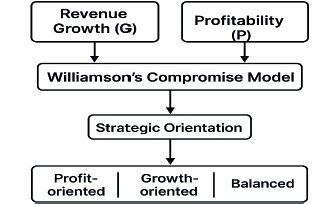
The conceptual framework of this study is grounded in Williamson’s compromise model, which pos-its that managerial decision-making involves a trade-off between profitability (P) and revenue growth (G). In the context of the gambling industry, firms face strategic pressure to balance immediate profit generation with long-term expansion, innovation, and market share acquisition.
Revenue growth (G) reflects the ability of a firm to expand its market presence and capture new cus-tomers, often requiring reinvestment of resources and tolerance for short-term profit reductions. Prof-itability (P), on the other hand, ensures financial sustainability and shareholder returns, but may limit aggressive expansion strategies. Williamson’s model suggests that the relative weights assigned to P and G determine the firm’s strategic orientation – whether profit-oriented, growth-oriented, or balanced.
As illustrated in Figure 1, the framework integrates these two competing objectives. High empha-sis on profitability leads to conservative, profit-oriented strategies, whereas prioritization of revenue growth results in expansion-focused strategies. A balanced orientation emerges when firms seek to op-timize both objectives simultaneously. This framework provides the theoretical foundation for the em-pirical investigation, linking observed financial outcomes to strategic classifications within the gambling industry.
3. Research Methodology
This study employs a quantitative research design to analyze the relationship between annual revenue growth (G) and annual profit (P) of gambling industry firms through the lens of Williamson’s compromise model (Williamson, 1964; Williamson, 1985). The design integrates descriptive statistics, regression analysis, and strategic mapping to identify profit-driven, growth-driven, and balanced strat-egies (Wooldridge, 2016; Chiarini & Bag, 2024).
The dataset consists of financial indicators from ten representative gambling companies operating in Ukraine and internationally. Annual revenue growth (measured in times) and annual profit (measured in billion UAH) were collected from publicly available financial reports and industry databases for the most recent reporting period. The sample provides a heterogeneous mix of firms, including high-growth players (e.g., Favbet, Limon), profit-oriented firms (e.g., Spacex), and conservative actors (e.g., UkrGame Technology, UNL). Similar approaches of sector-specific sampling are applied in empirical studies of firm performance (Penrose, 1959; Coad, 2009).
Two core variables were analyzed:
The model is based on Williamson’s compromise function:
U=αP+βG
where α\alphaα and β\betaβ are weights reflecting managerial preferences between profit maximi-zation and revenue expansion (Williamson, 1964; Marris, 1964).
Analytical Procedures
Descriptive statistics were computed to summarize the distribution of P and G.
Deviation-based calculations.
Regression analysis was performed to test the strength and direction of the relationship between P and G.
Strategic orientation matrix was constructed to classify firms into profit-driven, growth-driven, or conservative models based on their relative positioning (Porter, 1980; Hitt et al., 2011).
To strengthen the empirical validity of the analysis, the sample of ten firms was selected to reflect the structural diversity of the Ukrainian gambling market, including dominant operators, medium-sized companies, and niche entrants. This purposive sampling approach ensures that the model captures het-erogeneous strategic behaviours across different market segments rather than being driven by outliers or size-biased effects. The inclusion of firms with contrasting revenue profiles and business models also improves the robustness of the factor analysis and enhances the generalizability of the findings.
While the sample is representative of the Ukrainian gambling industry, the relatively small dataset (n=10) may limit statistical generalizability. Furthermore, financial performance is influenced by regula-tory, cultural, and macroeconomic factors not fully captured in the model (North, 1990; Zahra & Pearce, 1989). Despite these limitations, the applied methodology provides robust insights into the structural trade-off between profitability and revenue growth (Teece, 2018).
4. Results
4.1. Williamson’s Compromise Model
Williamson’s compromise model remains one of the most influential managerial frameworks for ex-plaining the trade-off between profit maximization and firm growth. Rather than assuming firms act as pure profit maximizers, the model emphasizes managerial discretion in balancing short-term profitabili-ty with long-term expansion objectives (Williamson, 1963). This dual orientation is particularly relevant in industries characterized by uncertainty and rapid structural changes, such as gambling, where firms must simultaneously satisfy shareholder expectations and capture market opportunities (Chiu, 2020; García & Singh, 2022).
Recent research has applied the compromise framework to emerging markets, highlighting that managerial preferences, resource constraints, and institutional pressures shape the balance between growth and profitability (McCarthy et al., 2021; Chiarini & Bag, 2024). Empirical studies further suggest that firms adopting growth-oriented strategies often sacrifice short-term financial stability, whereas profit-oriented firms achieve stability but may lose market competitiveness over time (Feng et al., 2021; Xu & Zhang, 2022).
Thus, Williamson’s compromise model provides a robust theoretical lens to analyze the strategic positioning of gambling firms, where diverse orientations – from conservative to aggressive growth strategies – reflect varying managerial trade-offs in practice (Figure 2).
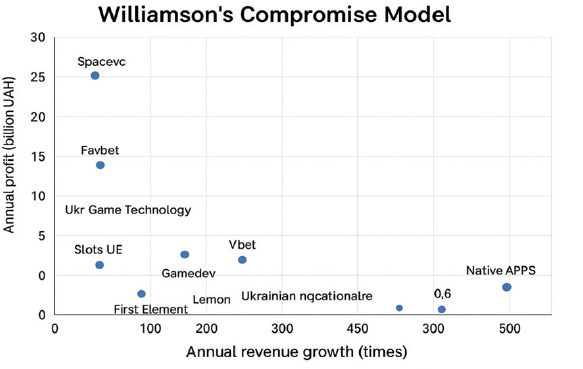
The empirical distribution of firms across the profit-growth space reveals a clear heterogeneity of strategic orientations. Spacex, with an annual profit of P=27.95 billion UAH and a moderate revenue growth rate of G=51, represents a profit-oriented strategy, prioritizing financial stability and efficien-cy over aggressive expansion. In contrast, Favbet, recording P=9.79 and G=425, exemplifies a reve-nue-growth orientation, reflecting a deliberate emphasis on rapid market penetration at the expense of immediate profitability. UkrGame Technology, with P=3.62 and G=4, illustrates a conservative model characterized by low growth and modest returns.
Several mid-range firms, including Slots UA (P=3.42, G=103), Vbet (P=3.10, G=19), Gamedev (P=2.51, G=35), and First Element (P=2.00, G=43), occupy an intermediate position in the spectrum, suggesting balanced strategies that avoid extreme prioritization of either growth or profitability. Limon, with very high revenue growth (G=357) but modest profit (P=1.42), resembles Favbet in its growth-driven orienta-tion, while Native Apps (P=0.60 ,G=55) reflects a lower-tier expansion trajectory. Finally, the Ukrainian National Lottery (UNL), reporting marginal figures (P=0.51, G=2.5), appears almost neutral, with neither growth nor profit being a dominant feature.
According to this formulation, the equilibrium position is achieved through a compromise between profit maximization and market expansion.
According to this formulation, the equilibrium position is achieved through a compromise between profit maximization and market expansion.
This framework underscores the heterogeneity of strategic orientations in the gambling sector, where firms must constantly balance growth ambitions.
4.2. Regression analysis
The analysis of the Ukrainian gambling market based on the dataset of ten representative compa-nies reveals significant heterogeneity in the relationship between revenue growth dynamics and profit-ability levels.
Linear regression results (upper panel of Figure 3) suggest a nearly flat relationship between annual revenue growth (G) and annual profit (P), with an estimated slope close to zero. This indicates that rapid expansion of revenues does not necessarily translate into higher profit volumes. For example, Favbet and Limon demonstrate extraordinary growth rates (G=425 and G=357, respectively) but relatively modest profit levels compared to Spacex, which shows moderate growth (G=51) but outstanding profitability (UAH 27.95 billion).
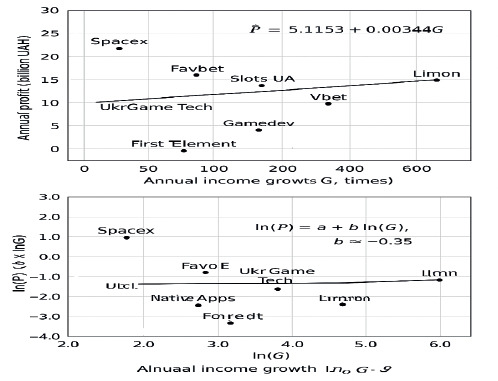
Log-log regression analysis (lower panel of Figure 3) provides additional insight: the estimated elas-ticity coefficient (b≈−0.35) implies an inverse relationship between growth and profitability. In other words, each percentage increase in revenue growth is associated with an approximate 0.35% decline in profit.
This pattern indicates the presence of diminishing returns to growth, consistent with competitive saturation, high reinvestment requirements, and rising operational expenditures typical of the gambling industry.
Overall, the findings highlight the dual nature of the Ukrainian gambling sector:
High-growth companies (e.g., Favbet, Limon) prioritize market expansion.
Profit-driven companies (e.g., Spacex) achieve significant margins with relatively modest growth rates, suggesting a focus on efficiency and possibly market dominance.
Mid-tier operators (Vbet, Gamedev, Slots UA) remain in an intermediate zone, balancing between limited growth and moderate profit performance.
This structural asymmetry suggests that sustainability in the Ukrainian gambling market cannot be evaluated solely on the basis of revenue dynamics. Instead, long-term profitability appears to depend on strategic positioning, operational efficiency, and the ability to manage costs under competitive and regulatory pressures.
The empirical analysis was conducted to investigate the relationship between annual revenue growth (G) and annual profit (P) among ten representative companies. The descriptive statistics and devi-ation-based calculations are provided in Table 1, which served as the basis for the regression estimations. Deviation-based calculations for regression analysis of the relationship between annual revenue growth (G) and annual profit (P). The table reports raw data, deviations from sample means, and squared terms used in the estimation of the ordinary least squares (OLS) model.
Table 1
Deviation-based calculations for regression analysis of the relationship
The aggregated statistics reported in Table 1 provide the foundation for estimating the parameters of the linear regression model. The slope coefficient is obtained as the ratio of the covariance term to the variance of the independent variable:
b^=∑(G−Gˉ)(P−Pˉ)/∑(G−Gˉ)2(3)
b^=715.53/207,978≈0.00344
This estimate indicates that revenue growth exerts a negligible marginal effect on profitability. The intercept is then calculated as:
a^=Pˉ−b^ Gˉ(4)
which adjusts the regression line to the mean values of the dataset, yielding a^≈5.12. The resulting linear specification takes the form: P^=5.1153+0.00344G
The explanatory capacity of the model is summarized by the coefficient of determination:
R2=b^ ∑(G−Gˉ)*(P−Pˉ)/∑(P−Pˉ)2 (5)
R2=(0.00344×715.53)/622.74≈0.004
This result suggests that less than one percent of the variation in profits across companies can be explained by annual revenue growth. The extremely low R2R^2R2 highlights the limitations of the linear model and implies that alternative specifications, such as logarithmic or polynomial transformations, or the inclusion of additional explanatory variables, may be required to better capture the determinants of profitability in the gambling sector.
Regression results are summarized in Table 2. The linear OLS specification yields an intercept of a=5.1153 and a slope coefficient of b=0.00344. However, the slope is statistically insignificant (p = 0.86), and the model explains less than 1% of the variance in profits (R2=0.004). This indicates that simple linear growth is not a meaningful predictor of profitability.
Table 2
Results of the regression analysis for the relationship between annual revenue growth (G) and annual profit (P).
The visualization of these results is presented in Figure 1. The upper panel displays the linear re-gression line P^=5.1153+0.00344G, which reveals only a flat relationship. The lower panel demonstrates the log-log specification, with a negative slope (b≈−0.35) that indicates an inverse relationship between growth and profitability.
Empirical relationship between annual revenue growth (G) and annual profit (P) of selected compa-nies. The upper panel presents the linear regression model P^=5.1153+0.00344G, while the lower panel illustrates the log-log specification ln (P)=a+bln(G)\ with estimated slope b≈−0.35. Company-level obser-vations are labeled for clarity.
Overall, the findings highlight that extremely high revenue growth does not necessarily translate into higher profitability. On the contrary, the log-log model suggests that rapid expansion may be as-sociated with reduced profit margins, a phenomenon often explained by increasing operational costs, competitive pressures, and reinvestment strategies typical for high-growth firms.
The empirical analysis was conducted to explore the relationship between annual profit (P) and annual revenue growth (G) among ten representative firms in the gambling and gaming sector. The re-gression results confirmed the weak explanatory power of a linear specification (R2<0.01), whereas the log–log specification revealed a modest negative elasticity (b≈−0.35; R2≈0.12), indicating that extremely high revenue growth is associated with lower levels of profitability. This finding aligns with theoretical expectations of Williamson’s compromise model, which predicts trade-offs between market expansion and financial performance.
3.3. Typology of gambling firms
Table 3 presents a typology of firms, categorizing them into profit-oriented, growth-oriented, con-servative, and balanced clusters. The classification highlights that Spacex exemplifies a profit-oriented strategy, while Favbet and Limon clearly adopt growth-driven approaches. UkrGame Technology and the Ukrainian National Lottery represent conservative models, characterized by both low growth and modest profits. In contrast, the majority of firms, including Slots UA, Vbet, Gamedev, First Element, and Native Apps, demonstrate balanced strategies, combining moderate profitability with moderate growth trajectories.
Table 3
Typology of gambling firms according to Williamson’s compromise model
The typology presented in Table 3 demonstrates that the gambling industry is characterized by sig-nificant strategic heterogeneity. A small number of firms, such as Spacex, clearly prioritize profitability, whereas others, including Favbet and Limon, adopt aggressive growth-driven strategies despite limited financial returns. Conservative players like UkrGame Technology and UNL pursue a low-risk approach with restricted market engagement. The majority of firms, however, fall into the balanced category, re-flecting a compromise between short-term financial stability and long-term market expansion.
This distribution confirms the relevance of Williamson’s compromise model, as it illustrates how managerial priorities shape heterogeneous outcomes in profit–growth dynamics.
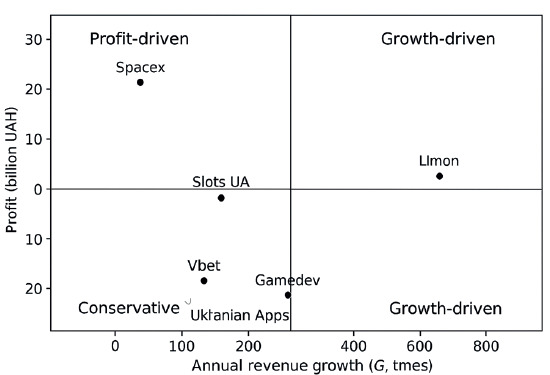
The distribution of firms across the profit–growth spectrum is illustrated in Figure 4, where compa-nies are positioned according to their observed values of P and G. The diagram reveals a clear bifurcation: profit-oriented firms are clustered in the upper-left quadrant, growth-oriented firms in the lower-right, while balanced and conservative firms are scattered around the center and lower-left regions, respec-tively. This visual evidence reinforces the cluster typology, showing that strategic heterogeneity is an inherent feature of the industry.
From a theoretical perspective, these findings validate Williamson’s compromise model by demon-strating the coexistence of multiple managerial orientations within the same sector. Firms such as Spacex embody the logic of α≫β, prioritizing financial returns, whereas Favbet and Limon exemplify the case of β≫α, where expansion is pursued aggressively at the expense of short-term profitability. Balanced firms represent an intermediate orientation, reflecting managerial efforts to optimize both components simultaneously.
Overall, the results suggest that no single strategy dominates the sector; rather, industry dynamics are shaped by the coexistence of heterogeneous orientations. This highlights the strategic flexibility of gambling firms, which must adapt their balance between profit and growth depending on regulatory environments, technological change, and market competition.
5. Discussion
5.1. Descriptive Insights
The analysis of the ten gambling firms reveals significant heterogeneity in their financial strategies. Firms such as Spacex exhibit high profitability (P=27.95 billion UAH) with moderate growth (G=51), clear-ly reflecting a profit-oriented approach. Conversely, Favbet (G=425 P=9.79) and Limon (G=357 P=1.42) demonstrate aggressive growth strategies, prioritizing market expansion over immediate profit realiza-tion. Conservative models, such as UkrGame Technology and the Ukrainian National Lottery, show lower figures in both dimensions, maintaining stability but limited scalability.
At the opposite end, UkrGame Technology and the Ukrainian National Lottery illustrate conser-vative models with low figures in both growth and profitability. These firms emphasize organizational continuity and stability, aligning with risk-averse strategies typically observed in regulated industries (Porter, 1980; Hitt et al., 2011). While such models provide resilience, they also face limitations in scal-ability and market influence.
Taken together, the descriptive analysis underscores the strategic diversity within the gambling sec-tor, confirming that firms adopt differentiated approaches depending on managerial priorities, resource endowments, and market conditions (Williamson, 1985; Zahra & Pearce, 1989).
5.2. Regression Analysis
Figure 2 presents the results of both linear and log–log regression estimations. The linear model (P^=5.1153+0.00344) indicates a weak positive relationship between revenue growth and profit, sug-gesting that rapid growth does not directly translate into higher profitability across the sample.
The log-log specification (ln(P)=a+bln(G), b≈−0.35) highlights a negative elasticity between profit and growth. This implies that beyond a certain threshold, higher growth rates are associated with reduced profit margins, consistent with Williamson’s proposition of trade-offs in managerial decision-making.
5.3. Strategic Classification
The strategic orientation matrix (Figure 3) provides a visual typology of firms.
Profit-driven quadrant. Firms such as Spacex focus on stable profitability.
Growth-driven quadrant. Favbet and Limon pursue aggressive expansion despite lower short-term profits.
Conservative quadrant. UkrGame Technology and UNL maintain balanced but low performance.
Hybrid positioning. Firms such as Slots UA, Vbet, and Gamedev occupy intermediate zones, reflecting partial alignment with both profit and growth objectives.
5.4. Theoretical Implications
The findings empirically validate Williamson’s compromise model in the gambling industry con-text, highlighting its applicability to contemporary managerial strategies (Williamson, 1964; William-son, 1985). The observed trade-off between profitability and growth reinforces the classical managerial dilemma of allocating scarce resources between shareholder returns and long-term market expansion (Chiarini & Bag, 2024). This is consistent with prior evidence that firms emphasizing growth often sacrifice short-term profits to secure innovation-driven advantages and market share (Mullins, 1996; Teece, 2018).
Profit-maximizing firms, as observed in the case of Spacex, prioritize financial stability and imme-diate returns to stakeholders, aligning with theories of shareholder value maximization (Fama & Jensen, 1983). Conversely, growth-driven firms such as Favbet and Limon demonstrate a willingness to accept temporary financial losses in pursuit of sustainable competitive positioning, a phenomenon widely ac-knowledged in strategic management literature (Penrose, 1959; Coad, 2009).
Thus, the gambling industry provides an empirical context where Williamson’s theoretical trade-off is particularly pronounced, underscoring the importance of balancing managerial objectives across different time horizons (Porter, 1980; Barney, 1991).
For practitioners, these results highlight the necessity of calibrating strategic priorities according to market dynamics. Firms operating in highly competitive and expanding segments may benefit from growth-oriented strategies, whereas established companies with mature markets may find profitabil-ity-driven approaches more sustainable. Balanced strategies may emerge as optimal for firms seeking resilience amid regulatory uncertainties and economic fluctuations.
While the present study provides important insights, it also reveals several areas for further ex-ploration. First, expanding the dataset beyond ten firms and incorporating longitudinal data would im-prove the robustness and generalizability of results. Second, future research could integrate additional variables such as regulatory pressure, technological innovation, and consumer behavior to capture the multidimensional drivers of firm performance.
Third, cross-industry comparisons could test whether the observed profit–growth trade-off is spe-cific to the gambling sector or a broader managerial phenomenon. Finally, qualitative approaches, such as case studies and managerial interviews, could complement the quantitative findings, providing richer insights into strategic decision-making processes under uncertainty.
Conclusion
This study evaluated the relevance of Williamson’s compromise model within the Ukrainian gam-bling sector by analysing the inherent trade-off between annual revenue growth (G) and profitability
(P) across ten key market players. The results reveal that although a weak positive linear correlation exists between the two indicators, the negative elasticity estimated in the log–log specification indicates diminishing returns to rapid expansion. In other words, when firms exceed a certain growth threshold, accelerated revenue accumulation tends to erode profit margins, confirming the managerial balancing pressures predicted by Williamson.
The strategic segmentation of operators into growth-driven, profit-driven, and conservative groups underscores the structural heterogeneity of managerial priorities in the industry. Profit-focused leaders such as Spacex demonstrate stable financial performance attributable to disciplined operational control. Growth-oriented firms, including Favbet and Limon, emphasize market capture and scale-building strat-egies, even when this entails short-term profitability losses. Meanwhile, conservative entities – such as UkrGame Technology and the Ukrainian National Lottery – prioritize risk minimization and incremental expansion, resulting in predictable yet modest financial outcomes.
These empirical findings lend support to Williamson’s theoretical framework by demonstrating the coexistence of competing managerial objectives – growth maximization and profit discipline – within a transitional and partially liberalized market environment. They also highlight that market conditions in emerging economies amplify these tensions, especially in sectors characterized by regulatory uncer-tainty and uneven competitive pressures.
However, the study is subject to several limitations.
First, financial data are drawn from heterogeneous sources with inconsistent reporting stan-dards, which may limit cross-firm comparability. Second, the analysis does not fully capture the role of non-financial drivers – such as compliance costs, digitalization strategies, or risk-management practices – which may influence profitability independently of revenue dynamics. Third, the observed relation-ships reflect only the legal segment of the market, while the sizeable informal gambling sector remains largely unquantified.
Despite these constraints, the research contributes novel empirical evidence on managerial be-haviour in Ukraine’s gambling industry and demonstrates the practical usefulness of applying William-son’s model to regulated service markets. The results may inform both corporate strategy – by clarifying the optimal balance between expansion and financial discipline – and public policy, by indicating how regulatory stability could reduce the structural tension between growth incentives and profitability outcomes.
Future Research Directions
Although this study provides important empirical insights into the trade-off between profitability and growth in Ukraine’s gambling market, several avenues remain open for future investigation. First, expanding the dataset beyond the ten analyzed firms would help strengthen the external validity of the findings and allow for more robust econometric modelling across different market segments. Second, incorporating longitudinal or panel data over a longer time horizon could capture structural breaks associated with regulatory reforms, technological transitions, and shifts in consumer behaviour. Third, future studies may integrate additional performance variables – such as marketing expenditure, digital infrastructure investment, customer retention metrics, and risk-adjusted profitability indicators – to deepen the understanding of managerial decision-making under uncertainty. Finally, cross-country com-parative analyses could help contextualize Ukraine’s gambling sector within broader European trends, offering a more comprehensive view of how regulatory environments shape the balance between growth and profitability.