1. Introduction
In resource-rich economies, exchange rate dynamics play a central role in shaping export performance and long-term economic resilience. Countries that rely heavily on primary commodity exports are particularly exposed to external shocks, as fluctuations in global commodity prices can induce significant volatility in export revenues, foreign exchange earnings, and macroeconomic stability (Agosin et al., 2012; Spencer, 1983). In this context, export diversification has increasingly been recognized as a strategic policy objective to reduce vulnerability to external shocks and foster sustainable economic growth.
Algeria represents a paradigmatic case of such an economy. For decades, hydrocarbons have dominated its export structure, accounting for the bulk of foreign exchange earnings and fiscal revenues (Ghoddusi et al., 2022). While this specialization has generated substantial income during periods of favorable energy prices, it has also exposed the Algerian economy to pronounced exchange rate volatility and external imbalances, particularly during episodes of declining oil prices (Djebbouri, 2018). The sharp fall in global energy prices since the mid-2010s underscored the fragility of this economic model and reinforced the urgency of diversifying exports beyond the hydrocarbon sector (Abdellaoui, 2022; Bounoua & Bounoua, 2023).
In addition, in resource-dependent economies, export shocks affect exchange rate dynamics through several macroeconomic transmission channels (Arezki et al., 2017; Akram, 2004; IMF, 2021). Increases in hydrocarbon export revenues raise foreign currency inflows, expand fiscal space, and strengthen international reserves, which may lead to real exchange rate appreciation (Arezki et al., 2017; IMF, 2021). Conversely, negative export shocks reduce foreign exchange supply and may generate depreciation pressures (Akram, 2004). In contrast, non-hydrocarbon exports typically exert weaker effects because their contribution to total foreign exchange earnings is smaller and more sensitive to structural constraints such as production capacity and market access (IMF, 2021). These mechanisms justify modeling the dynamic interactions between export sectors and the real effective exchange rate using a multivariate framework (Arezki et al., 2017; IMF, 2021).
The relationship between exchange rate movements and export diversification, however, remains theoretically and empirically ambiguous. While a depreciated real exchange rate is often expected to enhance export competitiveness and support diversification (Goya, 2014), empirical evidence, especially for resource-dependent economies has been mixed. Some studies find that exchange rate misalignment hampers export diversification (Agosin et al., 2012), whereas others report limited or insignificant effects, particularly for manufactured exports in developing countries (Sekkat, 2016). Moreover, existing research rarely distinguishes between hydrocarbon and non-hydrocarbon export responses to exchange rate dynamics, particularly in the Algerian context, where export revenues remain highly concentrated (Ghecham, 2013; Ayad, 2021).
Building on the preceding discussion, this study seeks to address the following research question: how do sectoral export shocks specifically hydrocarbon and non-hydrocarbon exports, affect exchange rate dynamics in Algeria? In particular, the paper investigates whether the dominant role of hydrocarbon exports leads to asymmetric exchange rate responses compared to shocks originating from non-hydro-carbon exports. Based on the structural characteristics of the Algerian economy and the existing literature on resource-dependent economies, the following hypotheses are formulated: H1: Hydrocarbon export shocks exert a stronger and more persistent impact on the real effective exchange rate (REER) than non-hydrocarbon export shocks. H2: Non-hydrocarbon exports currently play a limited role in reducing exchange rate vulnerability in Algeria. These hypotheses are tested within a Vector Autoregression (VAR) framework that captures the dynamic interactions between export structure and exchange rate movements.
2. Literature review
The relationship between exchange rate dynamics and export diversification has attracted considerable attention in the economic literature, particularly in the context of developing and resource-dependent economies. Theoretical arguments generally suggest that exchange rate movements influence export performance by altering relative prices and competitiveness, thereby shaping incentives for firms to diversify export products and markets. However, empirical findings remain mixed, reflecting differences in country characteristics, export structures, and methodological approaches.
A first aspect of the literature emphasizes the role of exchange rate depreciation in promoting export diversification. Goya (2014) argues that a depreciated real exchange rate enhances export competitiveness, particularly for technologically advanced and non-traditional sectors, thereby facilitating diversification. From this perspective, exchange rate policy can act as a strategic instrument to support structural transformation and the expansion of non-commodity exports. Similarly, Ghecham (2013) highlights that trade liberalization combined with a competitive exchange rate can stimulate diversification away from oil dependence in economies such as Algeria.
In contrast, a second strand of the literature questions the effectiveness of exchange rate movements in fostering export diversification. Sekkat (2016) finds that exchange rate misalignment (whether overvaluation or undervaluation) does not exert a significant impact on the diversification of manufactured exports in developing countries. This suggests that structural factors, such as production capacity, institutional quality, and access to finance, may outweigh relative price effects. Agosin et al. (2012) further show that real exchange rate overvaluation tends to hinder export diversification, while financial development plays a critical complementary role in mitigating these adverse effects.
Beyond diversification outcomes, several studies focus on the dynamic adjustment of exchange rates to external shocks, particularly in commodity-exporting economies. Spencer (1983) provides early evidence that real exchange rates in primary-exporting countries adjust significantly in response to terms-of-trade shocks. More recent work confirms that oil price fluctuations remain a dominant driver of exchange rate volatility in hydrocarbon-rich economies (Djebbouri, 2018). These findings underscore the vulnerability of exchange rates to commodity price cycles and highlight the challenges faced by resource-dependent countries in achieving macroeconomic stability.
Within the Algerian context, existing studies consistently emphasize the economy’s heavy reliance on hydrocarbon exports and its implications for exchange rate dynamics. Ghoddusi et al. (2022) argue that Algeria’s downstream diversification efforts remain constrained by structural dependence on oil and gas revenues. Ayad (2021) finds evidence of a strong linkage between oil prices and the Algerian exchange rate, even when accounting for hidden cointegration dynamics. At the same time, Chekouri et al. (2022) suggest that Algeria’s exchange rate regime exhibits a degree of resilience to extreme fluctuations, reflecting active policy management by monetary authorities.
Despite these valuable contributions, several gaps remain in the literature. First, empirical studies often focus either on exchange rate volatility or export diversification in isolation, without explicitly examining their dynamic interaction. Second, relatively few studies distinguish between hydrocarbon and non-hydrocarbon exports when assessing exchange rate responses, particularly in the Algerian case. Third, the short- and medium-term dynamics of exchange rate adjustments to sector-specific export shocks remain underexplored. Addressing these gaps is essential for understanding the effectiveness of diversification strategies in resource-dependent economies.
In addition, some studies highlight the role of a competitive real exchange rate in promoting diversification and export growth, while others find limited or insignificant effects once structural constraints are considered. Moreover, most existing studies focus either on exchange rate volatility or export diversification separately, rather than examining their joint dynamics. In addition, few contributions distinguish between hydrocarbon and non-hydrocarbon export shocks when analyzing exchange rate responses, particularly in the context of Algeria. This gap motivates the present study, which investigates the dynamic interactions between sectoral export shocks and the real effective exchange rate using a VAR framework.
Overall, the existing literature highlights the importance of exchange rate dynamics and export diversification in resource-dependent economies. However, empirical evidence remains mixed regarding the extent to which exchange rate movements support diversification or mitigate external vulnerability. In the Algerian context, most studies focus either on the relationship between oil prices and the exchange rate or on the determinants of export diversification separately. Relatively few contributions explicitly examine the dynamic interaction between exchange rate movements and sectoral export shocks, particularly distinguishing between hydrocarbon and non-hydrocarbon exports. By adopting a VAR framework and focusing on the asymmetric effects of sectoral export shocks on the real effective exchange rate, this study seeks to fill this gap and provide updated empirical evidence for Algeria.
3. Exchange Rate and Export Structure in Algeria: Stylized Facts
In this section, we delve into the intricate relationship between the exchange rate and exports in Algeria, a key determinant of the nation’s economic health and its position in the global market. The Algerian economy, with its significant reliance on hydrocarbon exports, is particularly sensitive to fluctuations in the exchange rate. These movements can have profound implications for the competitiveness of Algerian goods abroad, influencing both the volume and value of exports. Understanding this dynamic is crucial, as it sheds light on how exchange rate policies and market fluctuations impact Algeria’s trade balance, revenue generation, and broader economic diversification efforts. Through an analysis of historical trends, policy interventions, and their outcomes, we aim to provide a comprehensive overview of how the exchange rate serves as both a challenge and an opportunity for enhancing Algeria’s export potential in a competitive global landscape (ALIOUI, 2018).
Figure 01 shows a bidirectional relationship where global oil prices not only influence the exchange rate but are also influenced by the competitiveness of Algeria’s oil exports on the international market. This sector’s revenue is a critical component of the national income and foreign exchange reserves, thereby significantly affecting the exchange rate. Government fiscal policies, aiming to stabilize the exchange rate against volatile oil prices, are depicted as intervening mechanisms that moderate this relationship. On the non-oil front, the diagram delineates several key factors that contribute to the sector’s responsiveness to exchange rate fluctuations, including “Production Capacity,” “Product Quality,” and “International Demand.” These elements underscore the importance of enhancing domestic production capabilities and product quality to leverage a favourable exchange rate and boost international competitiveness. Moreover, “Foreign Direct Investment (FDI)” is highlighted as a crucial driver for this sector, illustrating how a stable and competitive exchange rate can attract investment, fostering growth and diversification in exports beyond hydrocarbons. (Word Bank document).
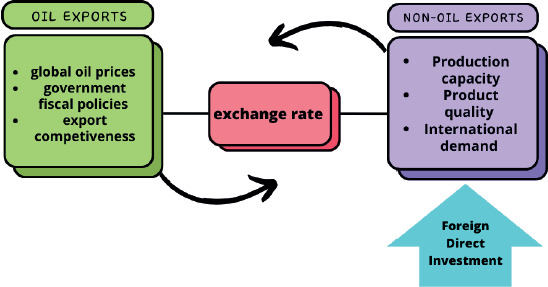
Finally, this figure highlights the asymmetric transmission mechanisms between the exchange rate and Algeria’s export sectors. Given the dominance of hydrocarbon exports in foreign exchange earnings and fiscal revenues, shocks originating in the oil and gas sector are expected to exert stronger and more persistent effects on the real effective exchange rate than shocks arising from non-hydrocarbon exports. In contrast, the response of non-hydrocarbon exports to exchange rate movements is mediated by structural factors and investment conditions, implying a more gradual and potentially weaker impact on exchange rate dynamics.
Building on the conceptual framework presented above, this section now turns to an empirical overview of Algeria’s hydrocarbon sector, which remains the dominant source of export revenues and foreign exchange earnings. Given the central role of oil and gas exports in shaping exchange rate dynamics and fiscal stability, an examination of recent trends in hydrocarbon production and exports is essential for understanding the magnitude and persistence of external shocks faced by the Algerian economy.
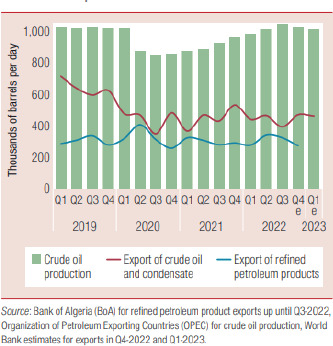
In 2022, (Analytica, 2023) OPEC’s production quota cuts initiated in October and significantly reduced Algeria’s oil production and exports, particularly after eight quarters of growth. As shown in figure (02), Algeria’s crude oil production quota decreased progressively from 1055 kb/d in October 2022 to 959 kb/d by May 2023. Despite a quarter-on-quarter production decline of 1.9% in Q4-2022 and 1.6% in Q1-2023, the annual production in 2022 increased by 12% from 2021, averaging 1020 kb/d. This increase was due to higher quotas in the year’s first 10 months, boosting crude oil exports by 9.5% and refinery production. However, the exports of refined oil and liquefied petroleum gas grew modestly by 3% and 3.5%, respectively, as the additional production mainly served the increased domestic consumption. In addition (Analytica, 2023),
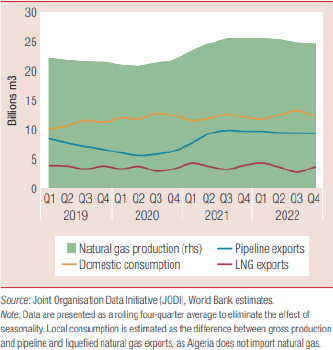
In addition, figure (03) showed that despite increased export prices in the second half of 2022, gas production and exports from Algeria slowed but remained robust. The renegotiation of natural gas prices with Italy and Spain made Algerian gas less attractive, yet it still offered a competitive option compared to global liquefied natural gas prices. Factors such as reduced gas storage and a milder winter in Europe, which lessened the demand for Algerian gas, contributed to a 5.9% year-on-year decline in natural gas production in H2-2022, steeper than the 1.1% decrease observed in the first half. Overall, 2022 saw a 3.4% drop in production from 2021, but levels were still 11.9% higher than the 2018-2020 average. This sustained demand was partly due to Europe’s efforts to diversify its energy sources away from Russia. Both pipeline and liquefied natural gas exports decreased in H2-2022, by 5.5% and 6.9% year-on-year respectively, mirroring a similar reduction in domestic consumption. Notably, pipeline gas exports to Spain decreased by 36% year-on-year in Q3-2022, whereas exports to Italy surged by 41%, driven by a significant export premium to Italy.
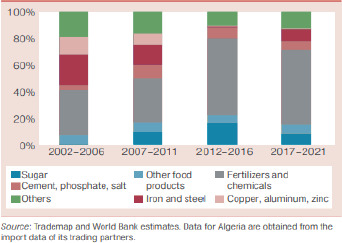
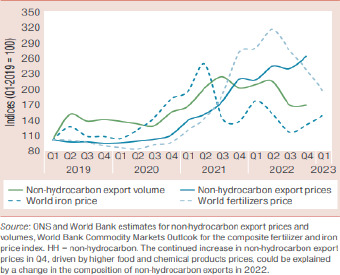
Figures (04) and (05) indicates that Algeria’s non-hydrocarbon exports experienced a significant increase in value, rising from $5 billion in 2021 to $6.6 billion in 2022, even though the actual volume of exports decreased by 3.5% during the same period. This paradoxical situation, where export volumes fell yet the value surged, can be attributed primarily to the composition of non-hydrocarbon exports and global market conditions. In 2021, the export portfolio was heavily weighted towards fertilizers, specifically nitrogen fertilizers and ammonia. The following year, the substantial growth in export value was largely fueled by a spike in global prices for fertilizers and steel products. This price hike led to a 41% increase in the overall value of Algeria’s non-hydrocarbon exports. This underscores the significant influence of international market trends on the economic returns from Algeria’s diversification efforts away from hydrocarbon dependency.
Haut du formulaire
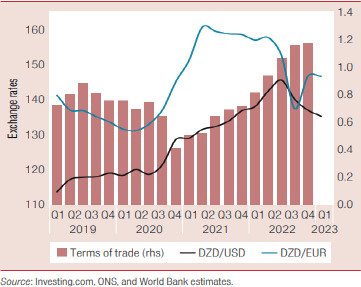
Between 2014 and 2021, the Algerian dinar consistently weakened by an average of 6.2% annually. In response to this trend and aiming to curb the impact of rising prices on imported goods, the Bank of Algeria took measures in the second half of 2022 to strengthen the dinar against major currencies. As a result, the dinar appreciated by 4.0% against the euro over the latter half of 2022, culminating in a 7.0% increase for the year and restoring its value to the 2020 level. Against the US dollar, the dinar saw a 6.2% rise in the same period, with a slight overall gain of 0.8% for 2022, bringing it back to its late 2021 standing. The dinar also improved by 9.4% against the Chinese yuan in the second half of 2022, achieving a 9.3% increase for the year and returning to its end-of-2020 level. This resulted in a 9.0% appreciation of the real effective exchange rate, especially significant as Europe also grappled with high inflation rates. Consequently, despite a downturn in oil prices, the stronger dinar led to a noticeable improvement in Algeria’s trade terms, illustrating the country’s enhanced purchasing power on the international stage, as depicted in Figure 06.
The descriptive evidence presented in this section highlights the asymmetric structure of Algeria’s export sector and its close linkage with exchange rate movements. The dominance of hydrocarbon exports suggests that shocks originating in this sector are likely to exert a stronger and more persistent influence on the real effective exchange rate than shocks from non-hydrocarbon exports. At the same time, the recent growth in non-hydrocarbon export values-driven largely by global price effects rather than volume expansion – raises questions about the sustainability of diversification gains. These stylized facts motivate the use of a dynamic econometric framework to examine how sector-specific export shocks affect exchange rate dynamics over time.
4. Methodology
To investigate the dynamic relationship between exchange rate movements and Algeria’s export structure, this study employs a Vector Autoregression (VAR) framework. The choice of a VAR model is motivated by both theoretical considerations and the structural characteristics of the Algerian economy, where exchange rate dynamics, export performance, and macroeconomic variables interact simultaneously and influence each other over time.
In resource-dependent economies such as Algeria, macroeconomic variables are highly interrelated. Export revenues, particularly from hydrocarbons, affect the supply of foreign currency, fiscal revenues, and expectations in foreign exchange markets. At the same time, exchange rate fluctuations can influence export competitiveness, investment flows, and overall economic activity. These bidirectional relationships make the VAR framework particularly appropriate for capturing the complex feedback mechanisms between exchange rate dynamics and export structure.
Unlike single-equation models, the VAR methodology treats all variables as jointly endogenous, allowing the data to determine the dynamic relationships among them. This characteristic is especially relevant when analyzing economies heavily dependent on commodity exports, where external shocks (such as fluctuations in global energy markets) can propagate through multiple macroeconomic channels (Zivot, 2003).
The VAR model is particularly well suited to capturing the short- and medium-term transmission of external shocks, such as changes in export revenues, to the real effective exchange rate. This is especially relevant for Algeria, where hydrocarbon exports dominate foreign exchange earnings and where shocks originating in global energy markets can propagate through multiple economic channels. Unlike static regression models, the VAR framework allows for lagged interactions and feedback effects, thereby providing a more realistic representation of macroeconomic adjustment processes in commodity-exporting economies (Keating, 1992; Korstanje, 2021).
Formally, the VAR model can be expressed as:
where Yt is a vector of endogenous variables including the real effective exchange rate (REER), hydrocarbon exports, non-hydrocarbon exports, foreign direct investment, and gross domestic product; A0 is a vector of intercepts; Aiare coefficient matrices capturing lagged relationships; and is a vector of white-noise error terms.
The primary analytical tool derived from the estimated VAR model is the impulse response function (IRF), which traces the temporal response of the real effective exchange rate to one-time shocks in export variables and other macroeconomic indicators. This approach allows for a direct comparison of the magnitude and persistence of exchange rate responses to hydrocarbon versus non-hydrocarbon export shocks, thereby addressing the central research question of this study. By focusing on dynamic responses rather than static coefficients, the VAR framework provides richer insights into the adjustment mechanisms underlying exchange rate behavior in Algeria.
4.1 Data and variables1
This study uses annual data covering the period 2000-2023, collected from Refinitiv Datastream Eikon and the World Bank database. The sample period is primarily determined by data availability and the consistency of sectoral export statistics in Algeria. Reliable disaggregated data for hydrocarbon and non-hydrocarbon exports are limited for earlier years, which constrains the time span of the analysis. Although the sample size is relatively small, the use of annual data is appropriate for capturing medium-term macroeconomic dynamics in resource-dependent economies. Moreover, the VAR framework remains suitable for examining dynamic interactions among the variables when the lag structure is carefully selected to avoid over-parameterization. The variables used in the analysis are summarized in Table 1.
Table 1
Variables description
Note: All variables are expressed in annual frequency. Export variables represent the total value of hydrocarbon and non-hydrocarbon exports in current U.S. dollars, while the real effective exchange rate (REER) is used as an index measure of external competitiveness. Where appropriate, variables are transformed into natural logarithms to improve comparability and interpretation in the VAR framework. The variable representing non-hydrocarbon exports is measured as the total value of Algerian exports excluding oil and gas products, expressed in levels and reported in current U.S. dollars. As such, fluctuations in this variable may partly reflect changes in international commodity prices particularly for products such as fertilizers and steel that experienced significant price increases in recent years rather than purely changes in export volumes.
The selection of variables is guided by the objective of capturing the main macroeconomic channels through which export shocks may influence exchange rate dynamics in Algeria. The real effective exchange rate (REER) represents the dependent variable reflecting currency competitiveness. Hydro-carbon exports (E-OIL) and non-hydrocarbon exports (E-Non-OIL) are included to capture the sectoral structure of Algeria’s exports and to examine the asymmetric effects of export shocks. Gross domestic product (GDP) is introduced as a proxy for overall economic activity, while foreign direct investment (FDI) reflects investment flows that may influence foreign exchange availability and external competitiveness. Together, these variables allow the VAR model to capture the dynamic interactions between export structure and exchange rate movements.
5. Results and discussion
5.1 Augmented Dickey Fuller Unit root test1
In order to evaluate the stationary characteristics of the variables, this study employed the Augmented Dickey-Fuller (ADF) test, results are summarized in Table 02.
Table 2
Unit root test results
Table 02 shows the Augmented Dickey-Fuller (ADF) test results for the variables under different model specifications. For the variables REER, E-OIL, E-Non-OIL and FDI, the ADF test indicates non-stationarity at levels across all models. However, upon first differencing, these variables achieve stationarity, while GDP is stationary at levels.
These findings imply that the variables exhibit different orders of integration, which requires further investigation of potential long-run relationships among them. Consequently, the Johansen cointegration test is conducted to examine whether a stable long-run equilibrium relationship exists among the variables before estimating the VAR model.
5.2 Johansen cointegration test:1
The Johansen cointegration test expands on the Augmented Dickey-Fuller test by assessing the long-run relationships among multiple variables (Dwyer, 2015) using both the trace and maximum eigenvalue statistics. As reported in Table 3, the test results indicate that the null hypothesis of no cointegration cannot be rejected at conventional significance levels. This suggests that the variables do not share a stable long-run equilibrium relationship over the sample period. Consequently, the analysis proceeds with the estimation of a Vector Autoregression (VAR) model in first differences, which is appropriate when variables are integrated but not cointegrated and allows the focus to remain on short- and medium-term dynamic interactions among the variables.
5.3 Lag order selection1
Lag length denotes the number of past periods used as predictors in the vector autoregressive model (Ozcicek and Douglas Mcmillin 1999). Several criteria, such as the Akaike Information Criterion (AIC), Schwarz Bayesian Criterion (BIC), and the Hannan-Quinn Criterion (HQ), help determine the optimal lag.
Results in Table 4 indicate that a lag order of one is appropriate for the VAR model. Although some criteria suggest alternative specifications, the majority of information criteria – particularly the Schwarz Criterion (SC), which is more parsimonious in small samples – support the selection of one lag. Choosing a single lag also helps avoid over-parameterization given the relatively small sample size of annual data. Therefore, the VAR model is estimated with one lag to capture the short-term dynamics among the variables while preserving degrees of freedom.
5.4 Diagnostic Tests1
After estimating the VAR model, several diagnostic tests were conducted to assess the adequacy and stability of the model. First, the stability condition of the VAR system was examined by verifying that all the inverse roots of the characteristic polynomial lie inside the unit circle. This condition confirms that the estimated VAR model is dynamically stable and suitable for impulse response analysis. In addition, residual diagnostic tests were performed to evaluate the presence of serial correlation and heteroskedasticity in the error terms. The results indicate that the residuals do not exhibit significant serial correlation, suggesting that the chosen lag length adequately captures the dynamic structure of the variables. Furthermore, tests for heteroskedasticity do not indicate major violations of the classical assumptions. Overall, these diagnostic results confirm the robustness and reliability of the estimated VAR model and support the validity of the subsequent impulse response analysis.
5.5 Impulse response functions1
The impulse response functions (IRFs) provide insight into the dynamic reactions of the real effective exchange rate (REER) to shocks in the main macroeconomic variables included in the VAR model. The responses are obtained using a Cholesky decomposition to identify structural shocks. In the recursive ordering, export variables are placed before the real effective exchange rate, reflecting the assumption that changes in export revenues can immediately affect foreign exchange supply and therefore influence the exchange rate contemporaneously, while exchange rate adjustments occur with a short lag.
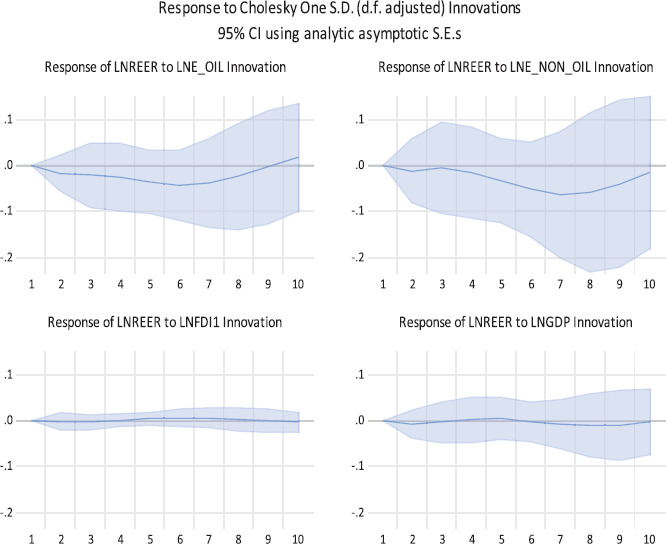
The response of the REER to a shock in hydrocarbon exports reveals a distinctive dynamic pattern. Initially, the REER exhibits a moderate depreciation, reaching approximately -0.03 to -0.04 during the first few periods of the impulse response horizon. This negative response gradually diminishes and eventually turns into appreciation in the later periods, becoming slightly positive around +0.02 to +0.03 after approximately eight to nine periods. The magnitude of the response therefore remains moderate but relatively persistent compared with other shocks. This pattern can be interpreted in light of adjustment mechanisms typical of resource-dependent economies. In the short run, fluctuations in hydrocarbon export revenues may generate temporary imbalances in foreign exchange markets and expectations. Over time, however, stronger hydrocarbon revenues increase foreign currency inflows and improve external balances, exerting upward pressure on the real exchange rate. Such dynamics are broadly consistent with mechanisms highlighted in the Dutch disease literature, where resource-export booms eventually lead to real exchange rate appreciation.
The response of the REER to shocks in non-hydrocarbon exports follows a somewhat different trajectory. Similar to hydrocarbon shocks, the initial effect is characterized by a slight depreciation. However, the magnitude of the response is somewhat larger in the negative direction in the medium term, reaching roughly -0.05 to -0.06 around the sixth to seventh period, before gradually converging toward zero. The effect dissipates more rapidly thereafter and remains relatively limited in comparison with hydrocarbon shocks. This weaker and more transitory reaction reflects the relatively small contribution of non-hydrocarbon exports to Algeria’s overall foreign exchange earnings. Although recent increases in the value of these exports suggest some progress toward diversification, their scale remains insufficient to generate exchange rate adjustments comparable to those associated with hydrocarbon revenues.
The impulse responses also indicate that shocks to foreign direct investment (FDI) have only a marginal effect on the REER. The response fluctuates within a very narrow range, generally between -0.01 and +0.01 throughout the ten-period horizon, suggesting that FDI inflows do not exert a strong short-term influence on exchange rate dynamics in Algeria. This result may reflect the nature of FDI flows, which are typically long-term investments oriented toward structural development rather than immediate trade-related foreign exchange transactions.
Similarly, shocks to gross domestic product (GDP) generate only a modest and short-lived response in the REER. The impulse response remains relatively small, generally within a band of approximately -0.02 to +0.02, indicating limited exchange rate sensitivity to fluctuations in aggregate economic activity. This finding likely reflects the dominant role of export revenues – particularly hydrocarbons – in determining foreign exchange supply in Algeria, which tends to overshadow the more indirect effects of domestic economic growth on exchange rate movements.
Overall, the impulse response analysis highlights a clear asymmetry in the exchange rate effects of sectoral export shocks. Hydrocarbon export shocks exert a stronger and more persistent influence on the real effective exchange rate, whereas shocks originating from non-hydrocarbon exports generate weaker and more temporary effects. These findings reinforce the stylized fact that Algeria’s exchange rate dynamics remain closely tied to developments in the hydrocarbon sector. From a policy perspective, the results suggest that strengthening the productive capacity and international competitiveness of non-hydrocarbon sectors is essential for reducing exchange rate vulnerability to external energy-market shocks and enhancing macroeconomic resilience in the long run.
6. Discussion and policy implication
The findings of this study highlight the persistent dominance of hydrocarbon exports in shaping exchange rate dynamics in Algeria. The impulse response analysis reveals that shocks to hydrocarbon exports exert stronger and more persistent effects on the real effective exchange rate than shocks originating from non-hydrocarbon exports. This asymmetry confirms that, despite ongoing diversification efforts, Algeria’s exchange rate behavior remains highly sensitive to developments in global energy markets.
The weak and transitory response of the exchange rate to non-hydrocarbon export shocks suggests that recent diversification gains have been driven largely by price effects rather than by structural expansion in export volumes or competitiveness. As a result, non-hydrocarbon exports have not yet reached a scale sufficient to buffer exchange rate fluctuations or reduce external vulnerability. This finding underscores the distinction between diversification in export values and diversification in productive capacity.
Moreover, the negligible response of the real effective exchange rate to foreign direct investment and GDP shocks reflects the limited short – to medium-term influence of these variables on foreign exchange dynamics in a hydrocarbon-dominated economy. While economic growth and investment are essential for long-term development, their exchange rate effects appear to be overshadowed by the dominant role of hydrocarbon export revenues. Together, these results suggest that exchange rate resilience in Algeria remains contingent upon deeper structural transformation rather than incremental diversification alone.
Policy Implications
The empirical findings carry important implications for exchange rate management and diversification strategies in Algeria. −
- First, the strong and persistent influence of hydrocarbon export shocks on the exchange rate highlights the need for policies that mitigate exposure to global energy price volatility. Strengthening fiscal stabilization mechanisms, such as sovereign wealth funds and countercyclical fiscal rules, can help smooth the impact of external shocks on foreign exchange markets.
- Second, the limited exchange rate response to non-hydrocarbon exports indicates that diversification policies should move beyond export value expansion toward structural competitiveness. Policies aimed at improving production capacity, technological upgrading, and export quality in non-hydro-carbon sectors are essential to enhance their contribution to foreign exchange earnings and exchange rate stability. Without such structural improvements, diversification is unlikely to translate into meaningful exchange rate resilience.
- Third, the weak impact of foreign direct investment on exchange rate dynamics suggests that attracting FDI alone is insufficient unless it is effectively integrated into productive, export-oriented sectors. Regulatory reforms, improvements in the business climate, and targeted incentives should focus on channeling investment toward activities that expand export capacity and reduce reliance on hydrocarbons.
- Finally, exchange rate policy should be carefully calibrated to support diversification objectives. While short-term interventions may help stabilize the real effective exchange rate, long-term stability requires coherent macroeconomic policies that ensure fiscal sustainability, control inflation, and support reserve accumulation. Coordinating exchange rate management with structural and industrial policies is therefore critical for achieving sustainable economic diversification.
7. Conclusion
This paper provides a comprehensive analysis of how exchange rate fluctuations impact Algeria’s export sectors, leveraging the Vector Autoregression (VAR) model to explore these complex relationships. The findings highlight the nuanced and multifaceted nature of the exchange rate’s influence on both hydrocarbon and non-hydrocarbon exports, offering critical insights into the economic dynamics of a country heavily reliant on oil and gas revenues.
Our analysis reveals that while hydrocarbon exports respond to exchange rate fluctuations in a manner that reflects Algeria’s economic reliance on this sector, the non-hydrocarbon sector’s response underscores the challenges and opportunities of diversifying the economy. The initial depreciation followed by long-term appreciation of the dinar against major currencies in response to hydrocarbon export shocks suggests a potential for economic adjustment and resilience. Meanwhile, the non-hydrocarbon sector’s struggle to leverage exchange rate movements for competitive advantage in the global market highlights the need for structural reforms and investments to enhance sectoral productivity and competitiveness.
The study also sheds light on the minimal direct impact of Foreign Direct Investment (FDI) and Gross Domestic Product (GDP) growth on the Real Effective Exchange Rate (REER), suggesting that while these factors are crucial for overall economic health, their influence on the exchange rate is moderated by the dominant role of hydrocarbon exports. This finding calls for a nuanced approach to economic policy that considers the broader implications of FDI and GDP growth beyond immediate exchange rate effects.
Policy implications derived from our findings emphasize the importance of pursuing economic diversification as a strategic priority for Algeria. Investing in non-hydrocarbon sectors, improving the regulatory and business environment to attract FDI, and implementing macroeconomic policies that support stable and competitive exchange rates are essential steps towards reducing vulnerability to external shocks and fostering sustainable economic growth.
In the broader context, our study contributes to the understanding of the interplay between exchange rates and export dynamics in resource-rich economies, highlighting the critical role of policy in navigating the challenges and seizing the opportunities presented by global market conditions. As Algeria continues to grapple with the complexities of economic diversification and exchange rate management, the insights from this study offer valuable guidance for policymakers, scholars, and stakeholders committed to achieving a more resilient and diversified economic future.
Ultimately, the path towards sustainable economic development in Algeria is contingent upon a balanced and strategic approach to harnessing its natural resource wealth, enhancing non-hydrocarbon export capabilities, and fostering an economic environment conducive to innovation, investment, and inclusive growth.